Imagine your teacher says, “Everyone gather around,” or your friend texts, “Let’s gather at the café tonight.” Simple word, right?
Yet many people still search for the exact gather meaning especially when learning English, writing professionally, or trying to understand subtle context in conversations.
This everyday word pops up everywhere: classrooms, offices, family chats, and even social media captions.
Sometimes it means bringing people together. Other times, it means figuring something out from clues. That flexibility makes it useful but also a little confusing.
In this complete, easy-to-follow guide, you’ll learn:
- The exact definition of gather
- Where the word came from
- How to use it correctly in real conversations
- Common mistakes to avoid
- Related words and modern usage tips
Whether you’re a student, professional, or English learner, this guide will make the meaning crystal clear.
What Does “Gather” Mean?
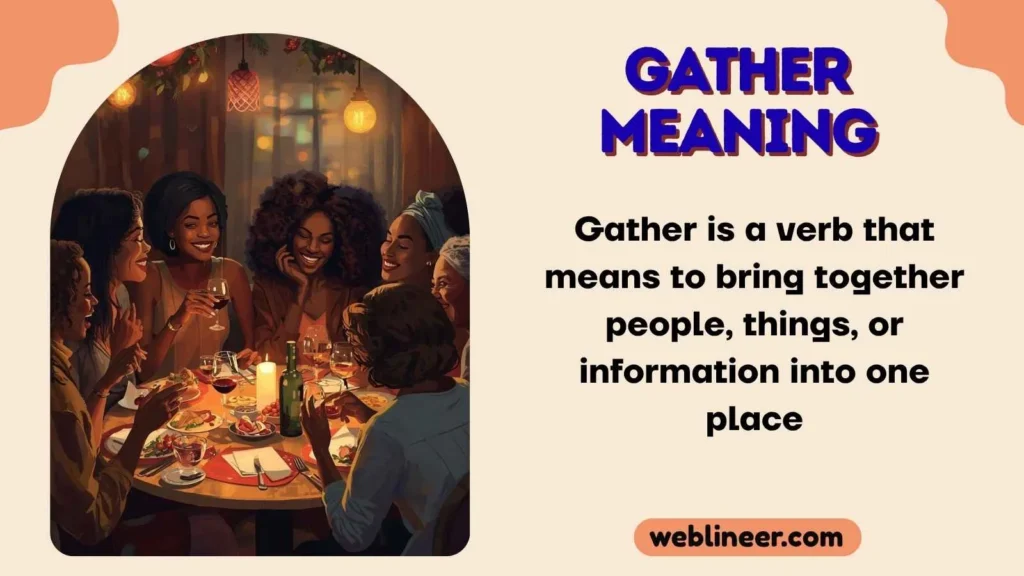
Gather is a verb that means to bring together people, things, or information into one place. It can also mean to understand or conclude something from clues or observations.
Quick Answer
Gather means to collect, assemble, or bring things together, or to figure something out from information or evidence.
Origin of the Word
The word gather comes from the Old English word “gaderian,” which meant:
- to unite
- to assemble
- to bring together
It has been used in English for over 1,000 years, making it one of the language’s classic everyday verbs.
How the Meaning Has Evolved
Originally, gather mainly referred to physically collecting things—like crops or people. Over time, the meaning expanded to include mental actions, such as:
- Gathering information
- Gathering evidence
- Gathering ideas
- Gathering courage
Pronunciation Guide
Gather is pronounced:
GATH-er
/ˈɡæðər/
Breakdown:
- GATH (rhymes with math)
- er (soft ending)
How to Use “Gather” Correctly in Texts & Chat
The word gather is flexible. You can use it in everyday speech, professional writing, and digital messages without sounding awkward.
Common Contexts and Tone
Casual
- Let’s gather at my place tonight.
- Everyone gather around the table.
Professional
- We need to gather more data before making a decision.
- Please gather the documents for the meeting.
Emotional or Reflective
- She gathered the courage to speak.
- I gather that you’re feeling stressed.
Platform-Specific Usage
SMS / WhatsApp
- Let’s gather at 7.
- Can you gather everyone?
Instagram / Social Media
- Family gathering vibes
- Time to gather memories
Discord / Gaming
- Gather at spawn point
- Team, gather resources
Work Email
- Kindly gather all required files before submission.
When NOT to Use It
Avoid using gather when:
- You mean something very specific like buy or download
- You want a more technical term
- You need precise instructions
Example:
Incorrect:
“Gather the software”
Better:
“Install the software”
Formatting Tips
- Capitalization: Normal sentence rules
- Works with emojis:
- 🎉 (events)
- 📂 (documents)
- 👥 (people)
- 🧠 (ideas)
Example:
Let’s gather at the café 🎉
Real Conversation Examples Using “Gather”
Here are realistic situations where the word naturally appears.
Between Friends
Ali: Let’s gather at the mall after school.
Sara: Sounds good. What time?
Meaning:
They plan to meet in one place.
In a Family Chat
Mom: Everyone gather in the living room.
Dad: Dinner is ready.
Meaning:
Bring family members together.
At Work
Manager: Please gather the reports before the meeting.
Employee: I’ll have them ready by noon.
Meaning:
Collect documents.
In a Dating Scenario
Person A: I gather you enjoy traveling.
Person B: Yes, especially beach destinations.
Meaning:
They understood something from previous information.
In Gaming
Player 1: Gather resources before nightfall.
Player 2: On it.
Meaning:
Collect items needed for survival.
Common Mistakes & Misunderstandings
Even simple words can be misused. Here are the most common errors.
1. Confusing Gather with Meet
Incorrect:
We will gather you at the station.
Correct:
We will meet you at the station.
Why?
Gather means bring together—not greet someone.
2. Using Gather for Buying
Incorrect:
I will gather groceries.
Correct:
I will buy groceries.
Use gather only when collecting or assembling.
3. Misunderstanding the “Understand” Meaning
Sentence:
I gather you’re upset.
Some people think this means collecting something.
But here, it means:
“I understand”
or
“I assume”
Generational Differences
Older adults may use gather in formal speech.
Younger users often use it casually in daily conversation.
Both uses are correct.
Cultural Differences
In English-speaking countries:
Gather is neutral and widely accepted.
In non-native English regions:
Learners may confuse it with:
- collect
- meet
- bring
“Gather” Across Different Platforms & Demographics
The word gather isn’t slang. It’s a standard English verb used by all age groups.
Gen Z Usage
Gen Z uses it casually in:
- Group chats
- Gaming
- Event planning
- Social media captions
Example:
Squad gathering tonight 🎉
Millennials
Millennials often use it in:
- Work communication
- Family planning
- Scheduling
Example:
Let’s gather feedback from customers.
Older Generations
Older adults typically use gather in:
- Formal speech
- Written communication
- Meetings
Example:
We must gather evidence before making a decision.
Is It Formal or Informal?
Answer:
Both
Gather is considered:
- Professional
- Safe for work
- Everyday language
Related Slang, Abbreviations & Alternatives
Here are words similar to gather, along with their meanings.
| Word | Meaning | Tone |
|---|---|---|
| Collect | Bring items together | Neutral |
| Assemble | Put people or parts together | Formal |
| Meet | Come together at a place | Casual |
| Accumulate | Build up gradually | Formal |
| Compile | Gather information into one list | Professional |
| Conclude | Decide after thinking | Formal |
| Round up | Bring together quickly | Informal |
| Bring together | Unite people or items | Neutral |
| Organize | Arrange systematically | Professional |
| Summon | Call people to appear | Formal |
Synonyms help vary your writing and improve clarity.
FAQs
What does gather mean in texting?
In texting, gather usually means to meet or bring people together. It can also mean collecting information or understanding something from context.
Example:
Let’s gather at 8 PM.
Can gather mean to understand something?
Yes. Gather can mean to figure something out or make a conclusion based on clues.
Example:
I gather you’re tired after the long trip.
Is gather a verb or noun?
Gather is mainly used as a verb, meaning to collect or bring together.
It can also be a noun in sewing, referring to small folds in fabric.
Is gather formal English?
Gather is considered neutral. It works in both professional and casual communication.
Examples:
Work: Please gather the data.
Home: Gather everyone for dinner.
What is the difference between gather and collect?
Both mean to bring things together, but:
Gather often implies bringing items or people into one place.
Collect often implies picking up items over time.
Conclusion
The gather meaning is simple but powerful: to bring together, collect, or understand information. It’s one of those versatile words that works in school, work, family conversations, and everyday life.
You’ll hear it everywhere—from teachers calling students to meetings to gamers organizing teams. Once you understand its different uses, it becomes an easy and natural part of your vocabulary.
Language grows through practice. So next time you plan an event, organize files, or figure something out, you’ll know exactly when to use gather.
Drop your favorite English word or phrase you want explained next!

Hi, I’m Smith Roy, the writer of Weblineer.com, where I break down words, slang, and meanings into something you can actually understand without overthinking it.
I’ve always been curious about how language works, how a simple word can carry different meanings depending on context, culture, or even a trending moment online. That curiosity turned into Weblineer, a space where I simplify complex terms, decode internet slang, and explain meanings in a way that feels natural, clear, and useful.