Ever heard someone say, “The body was already in rigor mortis,” during a crime show or medical drama? Maybe you paused the episode and wondered what that actually means. You’re not alone.
The term pops up everywhere from forensic documentaries to biology textbooks and it sounds technical, even a little intimidating.
Understanding the rigor mortis meaning isn’t just for doctors or detectives. It helps students, curious readers, and anyone interested in science make sense of what happens to the human body after death.
It’s also a key concept in forensic investigations, helping experts estimate time of death.
In this guide, you’ll learn:
- The exact definition of rigor mortis
- When and why it happens
- Real-life examples and timelines
- Common myths and misunderstandings
- Related scientific terms explained simply
Let’s break it down step by step.
What Does “Rigor Mortis” Mean?
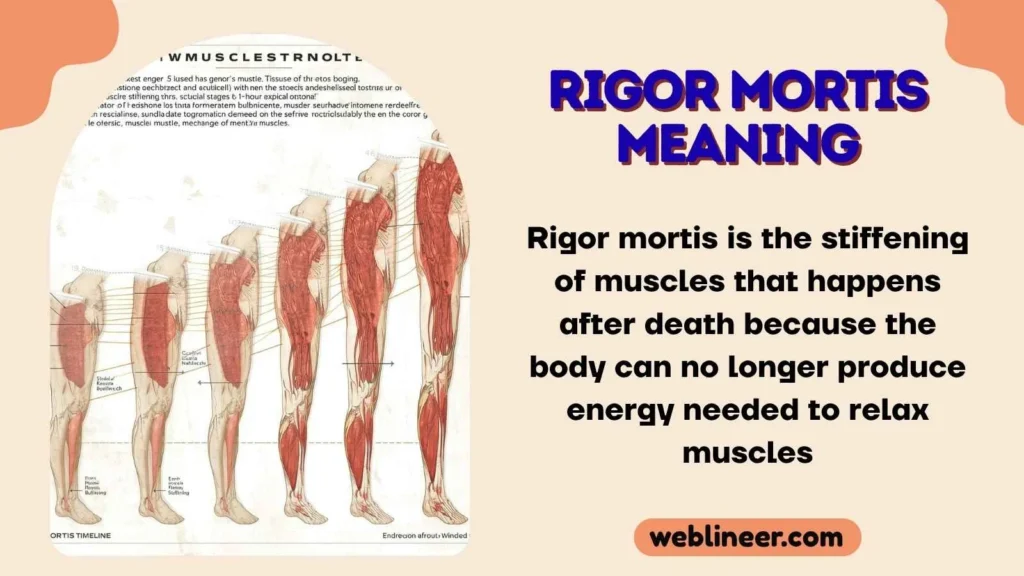
Rigor mortis is the stiffening of muscles that happens after death because the body can no longer produce energy needed to relax muscles.
Pronunciation
RIG-er MOR-tis
Origin of the Term
The phrase comes from Latin:
- Rigor = stiffness
- Mortis = of death
So literally, it means “stiffness of death.”
Scientists have used this term since the early 1800s, especially in medicine and forensic science. Over time, it became widely recognized through crime investigations and popular media.
Quick Answer:
Rigor mortis is the natural stiffening of a body’s muscles after death, usually starting within a few hours and lasting up to two days.
How the Meaning Has Evolved
Originally, the term was strictly medical. Today, it’s also commonly used in:
- Crime shows and movies
- Forensic reports
- Biology classes
- Legal investigations
How Rigor Mortis Works in the Body
Here’s the simple science behind it.
When a person is alive, muscles move because of a chemical called ATP (adenosine triphosphate). Think of ATP as the body’s energy currency.
After death:
- The body stops producing ATP
- Calcium builds up in muscle cells
- Muscles contract and lock in place
- Stiffness spreads through the body
Typical Rigor Mortis Timeline
0–2 hours after death
Muscles are still relaxed
2–6 hours
Rigor mortis begins
6–12 hours
Stiffness spreads
12 hours
Full rigor mortis
24–48 hours
Stiffness fades
Environmental factors can change this timeline dramatically.
For example:
- Hot weather → faster rigor mortis
- Cold weather → slower rigor mortis
- Physical activity before death → quicker onset
How to Use “Rigor Mortis” Correctly in Conversation
Although it’s a scientific term, people use it in everyday speech—especially when discussing crime, medicine, or biology.
Correct Context and Tone
Neutral / scientific:
“The medical examiner noted signs of rigor mortis.”
Informational:
“Rigor mortis helps investigators estimate time of death.”
Casual explanation:
“Rigor mortis is why bodies become stiff after death.”
When NOT to Use It
Avoid using the term casually in sensitive situations, such as:
- Funerals
- Grief conversations
- Emotional discussions
It can sound clinical or insensitive.
Real Conversation Examples Using “Rigor Mortis”
Example 1 — Between Students
Student A:
“When does rigor mortis start after death?”
Student B:
“Usually within a few hours.”
Meaning:
They are discussing biological processes in an academic context.
Example 2 — In a Crime Investigation
Detective:
“The victim was already in rigor mortis.”
Forensic Expert:
“That suggests death occurred several hours earlier.”
Meaning:
Rigor mortis helps estimate time of death.
Example 3 — In a Medical Setting
Doctor:
“The body showed early signs of rigor mortis.”
Meaning:
Medical professionals are documenting post-death changes.
Example 4 — In a Documentary
Narrator:
“Rigor mortis set in during the night.”
Meaning:
The timeline of death is being explained.
Example 5 — In a Classroom
Teacher:
“Rigor mortis occurs because muscles run out of energy.”
Meaning:
The concept is being taught scientifically.
Common Mistakes & Misunderstandings
1. Thinking Rigor Mortis Happens Immediately
Many people assume muscles stiffen right after death.
Reality:
It usually takes 2 to 6 hours to begin.
2. Believing It Lasts Forever
Another common myth.
Reality:
Rigor mortis disappears after 24 to 48 hours.
3. Assuming It Only Happens in Humans
Incorrect.
Rigor mortis occurs in:
- Humans
- Animals
- Fish
- Birds
Any creature with muscles experiences it.
Rigor Mortis Across Science and Forensics
Rigor mortis plays a major role in forensic investigations.
In Forensic Science
Experts use it to estimate:
- Time of death
- Body position
- Movement after death
However, it’s never used alone. Investigators also consider:
- Body temperature
- Decomposition
- Environmental conditions
In Biology Education
Students learn about rigor mortis when studying:
- Muscle physiology
- Cellular energy
- Human anatomy
In Popular Media
You’ll often hear the term in:
- Crime shows
- True crime podcasts
- Medical dramas
But TV sometimes exaggerates the speed or accuracy.
Related Terms, Concepts & Alternatives
| Term | Meaning |
|---|---|
| Livor mortis | Blood settling in the body after death |
| Algor mortis | Cooling of the body after death |
| Decomposition | Breakdown of tissues after death |
| Autopsy | Examination of a body after death |
| Forensic science | Scientific investigation of crimes |
| Time of death | Estimated moment when death occurred |
| Cadaver | Dead human body |
| Mortuary | Place where bodies are stored |
| Pathologist | Doctor who studies disease and death |
| Postmortem | Occurring after death |
These terms often appear together in medical and legal contexts.
FAQs
What causes rigor mortis?
Rigor mortis happens because muscles lose energy after death. Without energy, muscle fibers cannot relax, causing stiffness.
How long does rigor mortis last?
It typically lasts 24 to 48 hours, but temperature and environment can change the duration.
Does rigor mortis happen in all deaths?
Yes. It occurs in nearly all humans and animals unless extreme conditions interfere, such as severe trauma or very cold temperatures.
Can rigor mortis be used to determine time of death?
Yes, but only as an estimate. Forensic experts combine it with other evidence for accuracy.
Why does rigor mortis eventually disappear?
As decomposition begins, muscle tissues break down, causing the body to become flexible again.
Conclusion
The rigor mortis meaning is simple once you break it down: it’s the natural stiffening of muscles after death caused by chemical changes in the body.
It usually begins within a few hours, peaks around 12 hours, and fades within two days.
Understanding rigor mortis helps explain what happens biologically after death. It also plays a critical role in forensic science, medicine, and education.
Curious about more science terms like this?
Explore related topics, build your knowledge, and keep asking questions. That’s how real learning sticks.

Hi, I’m Smith Roy, the writer of Weblineer.com, where I break down words, slang, and meanings into something you can actually understand without overthinking it.
I’ve always been curious about how language works, how a simple word can carry different meanings depending on context, culture, or even a trending moment online. That curiosity turned into Weblineer, a space where I simplify complex terms, decode internet slang, and explain meanings in a way that feels natural, clear, and useful.