You’ve probably seen “MS” pop up on LinkedIn profiles, university brochures, or job requirements and wondered what it actually means.
Is it just another fancy academic title, or does it really matter for your career?
Understanding the ms degree meaning is more important than ever in 2026. With rising competition in tech, science, and research-driven fields, postgraduate degrees are no longer just optional they’re often a game-changer.
In this guide, you’ll learn exactly what an MS degree is, where it comes from, how to use the term correctly, and whether it’s worth pursuing. We’ll break it all down in simple language—no academic jargon, no confusion.
What Does “MS Degree” Mean?
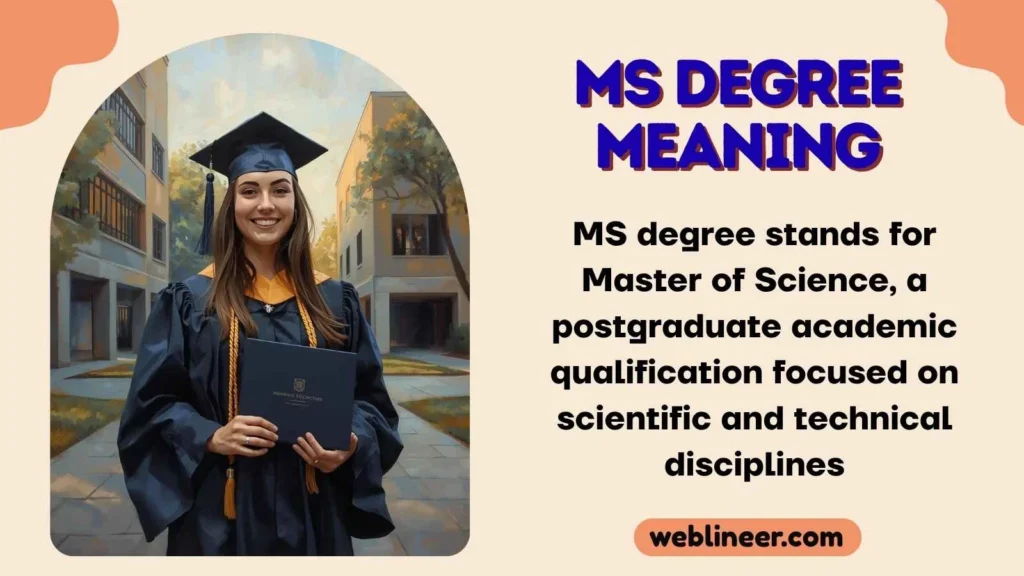
MS degree stands for Master of Science, a postgraduate academic qualification focused on scientific and technical disciplines.
Quick Answer:
An MS degree is a postgraduate qualification in science or technical fields that builds advanced knowledge and specialized skills beyond a bachelor’s degree.
Origin & Background
The concept of the Master of Science degree dates back to European universities but became widely standardized in countries like the United States during the 20th century.
- Common in: USA, Canada, Australia
- Equivalent in other countries: MSc (Master of Science)
Evolution Over Time
Originally research-heavy, MS degrees today offer two main paths:
- Course-based MS (focused on classes and exams)
- Thesis-based MS (includes research and a dissertation)
Pronunciation
Simple and direct:
👉 “Em-Ess Degree”
How to Use “MS Degree” Correctly in Texts & Chat
While “MS degree” isn’t slang, people often use it casually in conversations, resumes, or chats.
Tone & Context
- ✔️ Neutral and professional
- ✔️ Common in academic and career discussions
- ❌ Not used humorously or sarcastically
Platform-Specific Usage
- LinkedIn: “Completed my MS degree in Data Science 🎓”
- WhatsApp: “Thinking about doing an MS abroad”
- Twitter/X: “MS degree vs experience—what matters more?”
- Reddit: Often used in career advice threads
- Discord: Common in study or tech communities
When NOT to Use It
Avoid abbreviating in:
- Formal academic writing → Write “Master of Science”
- First mention in official documents
- Situations where clarity is crucial
Formatting Tips
- Capitalize: MS degree
- Optional: Write as “M.S.” in formal contexts
- No emojis in professional usage (except casual posts)
Real Conversation Examples Using “MS Degree”
1. Between Friends
A: “What are your plans after graduation?”
B: “Thinking about an MS degree in AI.”
👉 Shows ambition and specialization.
2. In a Group Chat
Friend 1: “Should I go abroad?”
Friend 2: “If you’re serious about tech, an MS degree helps a lot.”
👉 Suggests career value.
3. Dating Scenario
Person A: “So what do you do?”
Person B: “I’m pursuing an MS degree in Biotechnology.”
👉 Signals education and career focus.
4. Work Chat
Colleague: “We need someone with advanced analytics skills.”
Manager: “Let’s prioritize candidates with an MS degree.”
👉 Indicates higher qualification preference.
5. Gaming/Online Community
User: “Why are you offline lately?”
Reply: “Busy with my MS degree deadlines 😅”
👉 Adds a relatable, human touch.
Common Mistakes & Misunderstandings
1. Confusing MS with MSc
Many assume they’re different. In reality:
- MS = used in the US
- MSc = used in the UK and others
👉 Same level, different naming.
2. Thinking It’s Only for Science Students
Not true. MS degrees exist in:
- Data Science
- Finance
- Psychology
- Environmental Studies
3. Assuming It Guarantees a Job
An MS degree helps—but skills, experience, and networking still matter.
Generational Differences
- Gen Z: Sees MS as a career booster
- Millennials: Value it for specialization
- Older generations: Sometimes view it as optional
“MS Degree” Across Different Platforms & Demographics
Gen Z Usage
- Frequently discussed in study abroad content
- Popular in TikTok career advice videos
Millennials
- Often linked with career switching or advancement
Professional Platforms
- LinkedIn: Highly valued credential
- Job portals: Often listed as a requirement
Is It Formal or Informal?
- ✔️ Formal term
- ✔️ Safe for work
- ✔️ Universally understood
Related Slang, Abbreviations & Alternatives
| Term | Meaning |
|---|---|
| MSc | Master of Science (UK equivalent) |
| MBA | Master of Business Administration |
| PhD | Doctor of Philosophy |
| BSc | Bachelor of Science |
| MA | Master of Arts |
| PG | Postgraduate |
| Undergrad | Bachelor’s level study |
| Grad School | Postgraduate education |
| STEM | Science, Technology, Engineering, Math |
| Diploma | Short-term academic qualification |
FAQs
What is the difference between MS and MSc?
MS and MSc are essentially the same degree. The difference lies in regional naming conventions—MS is used in the US, while MSc is used in the UK and many other countries.
Is an MS degree worth it in 2026?
Yes—especially in tech, science, and research fields. It can significantly boost your career prospects, salary potential, and expertise in specialized areas.
Can I do an MS degree without a science background?
Sometimes. Many universities accept students from related or interdisciplinary backgrounds, but you may need prerequisite courses.
Which countries are best for an MS degree?
Popular destinations include:
- USA
- Canada
- Germany
- Australia
- UK
Each offers different benefits in cost, duration, and job opportunities.
Does an MS degree require research?
Not always. You can choose:
- Thesis-based (research-focused)
- Non-thesis (course-based)
Conclusion
The ms degree meaning is simple but its impact is powerful. It’s more than just a title; it’s a pathway to deeper knowledge, better career opportunities, and global exposure.
Whether you’re planning to study abroad, switch careers, or specialize in your field, an MS degree can open doors that a bachelor’s alone often can’t.
Still deciding? Start by exploring your interests, career goals, and budget. Then take the next step with confidence.
👉 Got questions or thoughts? Drop your favorite degree or career plan below!

Hi, I’m Candy Rox, the voice behind Weblineer.com, where words get decoded and meanings finally make sense.
I’ve always been fascinated by how a single word can carry different vibes depending on where and how it’s used. From trending slang to everyday phrases, I break things down in a way that’s simple, clear, and actually useful in real conversations.