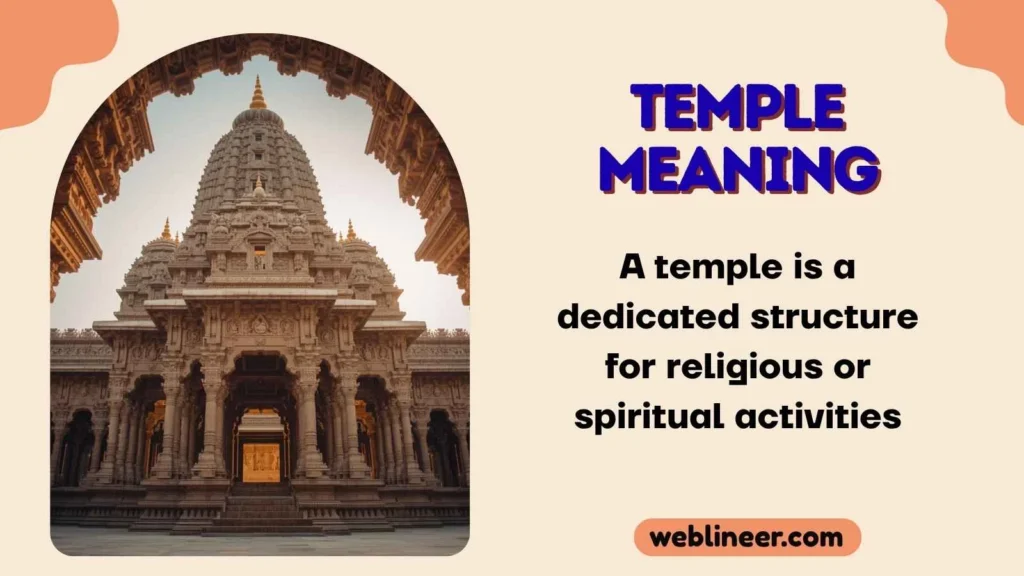
You’ve probably heard the word temple in very different situations. Maybe someone mentioned visiting a temple during a holiday, reading about ancient temples in history class, or even rubbing their temple when they had a headache.
Same word totally different meanings.
That’s exactly why understanding the temple meaning matters today. In a global, digital world, words travel fast across cultures, religions, and conversations.
Knowing the correct meaning helps you communicate clearly, avoid confusion, and sound confident whether you’re writing, studying, traveling, or chatting online.
In this complete 2026 guide, you’ll learn:
- The exact definition of temple
- Its religious, anatomical, and symbolic meanings
- Real-life usage examples
- Common misunderstandings people make
- Related terms and cultural context
Let’s break it down in the simplest way possible.
What Does “Temple” Mean?
The temple meaning depends on context, but it usually refers to either a sacred place of worship or a specific part of the human body.
Simple definition:
A temple is a building used for religious worship, or the flat area on the side of the head between the forehead and ear.
Quick Answer
Temple meaning: A temple is a sacred place for religious worship or the side area of the human head. It symbolizes spirituality, devotion, and reflection in many cultures.
Origin of the Word
The word temple comes from the Latin word:
templum — meaning “a sacred place set apart for worship.”
Over time, the meaning expanded into different fields:
- Religion — sacred buildings
- Anatomy — side of the head
- Architecture — historical structures
- Symbolism — holiness and peace
Today, the word is widely used in education, healthcare, religion, and everyday conversation.
Pronunciation Guide
Temple is pronounced:
TEM-puhl
/ˈtɛm.pəl/
Two syllables. Stress on the first.
How to Use “Temple” Correctly in Texts & Chat
The word temple is neutral, formal, and widely understood. But the correct meaning depends entirely on context.
Common Contexts
1. Religion
Used when talking about worship or spirituality.
Example:
“We visited the temple during the festival.”
2. Body / Health
Used when referring to the head.
Example:
“My temple hurts after staring at the screen all day.”
3. History / Culture
Used when discussing ancient civilizations.
Example:
“The temple was built over 2,000 years ago.”
Platform-Specific Usage
SMS / WhatsApp
- Casual conversations
- Health or travel discussions
Instagram / TikTok
- Travel photos
- Cultural posts
- Religious celebrations
Discord / Reddit
- Gaming references
- History discussions
Workplace / Professional Settings
- Completely appropriate
- Neutral vocabulary
When NOT to Use It
Avoid confusion by clarifying context when needed.
For example:
Instead of:
“My temple is amazing”
Say:
“The temple we visited is amazing”
Clarity matters.
Formatting Tips
- Capitalize when part of a proper name
Example: Golden Temple - Use lowercase for general meaning
Example: a temple nearby - No special punctuation required
Real Conversation Examples Using “Temple”
Here are realistic dialogue-style examples showing how the word works in everyday situations.
Between Friends (Health Context)
Friend 1: My temple is pounding after that long meeting.
Friend 2: You should take a break and drink some water.
What it conveys:
Physical discomfort or headache.
Family Conversation (Travel Context)
Parent: We’re visiting the temple tomorrow morning.
Child: Can I bring my camera?
What it conveys:
A religious or cultural visit.
Workplace Chat (Professional Context)
Manager: The meeting will be held near the temple complex.
Employee: Got it. I’ll arrive early.
What it conveys:
A location reference.
Tourist Conversation (History Context)
Tourist: This temple looks ancient.
Guide: Yes, it was built in the 9th century.
What it conveys:
Historical significance.
Student Conversation (Anatomy Context)
Student: I accidentally hit my temple during practice.
Coach: Let’s check it immediately.
What it conveys:
Concern about a sensitive body area.
Common Mistakes & Misunderstandings
Even simple words like temple can cause confusion.
Here are the most common mistakes.
1. Mixing Religious and Body Meanings
Incorrect:
“My temple is sacred”
Correct:
“My temple hurts”
Context changes everything.
2. Assuming All Worship Buildings Are Temples
Not every religious building is called a temple.
Examples:
Church — Christianity
Mosque — Islam
Synagogue — Judaism
Temple — Multiple religions
Each term has specific usage.
3. Pronunciation Errors
Some people pronounce it like:
tem-PLEH
tem-PULL
Correct pronunciation:
TEM-puhl
Generational Differences
Older adults often use the religious meaning first.
Younger people may think of health or anatomy.
Both are correct.
Cultural Differences
In many Asian countries, the word temple is used daily because temples are common community centers.
In Western countries, the word appears more in tourism, history, and education.
“Temple” Across Different Platforms & Demographics
The usage of temple varies depending on age group and environment.
Gen Z
Most common contexts:
- Travel content
- Cultural posts
- History or photography
- Wellness discussions
Example:
“Visited an ancient temple today.”
Millennials
Common contexts:
- Family trips
- Cultural education
- Religious events
Older Generations
Most common contexts:
- Religion
- Worship
- Community gatherings
Online Platforms
TikTok
- Travel videos
- Cultural storytelling
- Vacation photos
- Architecture posts
- History discussions
- Cultural debates
Discord
- Gaming references
- Mythology conversations
Formal or Informal?
Temple is both.
It works in:
- Academic writing
- Professional communication
- Casual conversation
- Travel content
Safe for work:
Yes.
Related Slang, Abbreviations & Alternatives
Here are words related to temple meaning that often appear in similar conversations.
| Term | Meaning | Usage Context |
|---|---|---|
| Shrine | Sacred place for worship | Religion |
| Sanctuary | Protected sacred space | Religion |
| Church | Christian worship building | Christianity |
| Mosque | Islamic place of worship | Islam |
| Synagogue | Jewish worship building | Judaism |
| Monastery | Home for monks | Buddhism / Christianity |
| Cathedral | Large church | Christianity |
| Chapel | Small worship space | Religion |
| Pagoda | Tower-style temple | Asian architecture |
| Sanctuary | Safe spiritual place | Symbolic |
Synonyms (casual language):
- holy place
- sacred building
- worship center
Antonym examples:
- secular building
- ordinary structure
FAQs
What does temple mean in simple words?
A temple is a sacred place where people worship or pray. It can also mean the soft area on the side of the head. The correct meaning depends on the situation.
Why is the temple on the head called a temple?
The body part is called a temple because it is a sensitive and important area. Historically, it was considered a vital spot connected to life and health.
Is a temple always religious?
No. The word can also refer to anatomy, architecture, or symbolism. But most commonly, it refers to a place of worship.
What is the symbolic meaning of a temple?
Symbolically, a temple represents peace, devotion, purity, and connection to something sacred. It often stands for spiritual reflection and inner calm.
Can temple be used in professional writing?
Yes. The word is formal, neutral, and widely accepted in academic, medical, and professional communication.
Conclusion
The temple meaning is simple once you understand the context. It can refer to a sacred place of worship, an important part of the human body, or a powerful cultural symbol.
This versatility is exactly why the word shows up everywhere — from travel blogs and history books to medical conversations and everyday chats.
Now you know how to recognize, use, and explain the word with confidence in 2026 and beyond.
Got another word you’re curious about?
Drop your favorite term, and explore more language guides next.

Hi, I’m Smith Roy, the writer of Weblineer.com, where I break down words, slang, and meanings into something you can actually understand without overthinking it.
I’ve always been curious about how language works, how a simple word can carry different meanings depending on context, culture, or even a trending moment online. That curiosity turned into Weblineer, a space where I simplify complex terms, decode internet slang, and explain meanings in a way that feels natural, clear, and useful.