Ever heard someone say, “He sublimated his anger into music,” and wondered what that actually means? You’re not alone.
The sublimated meaning often pops up in psychology discussions, self-help books, and even everyday conversations but it can feel a bit abstract at first glance.
In a world where stress, emotions, and pressure are constant, understanding this concept is surprisingly practical.
It explains why some people turn frustration into workouts, heartbreak into art, or anxiety into productivity. In short, it’s about transforming energy instead of suppressing it.
This guide breaks everything down in plain English.
You’ll learn the definition, origin, real-life examples, common mistakes, and how people use the term across different settings from therapy sessions to casual conversations.
Updated for 2026, this is your complete, no-confusion resource.
What Does “Sublimated” Mean?
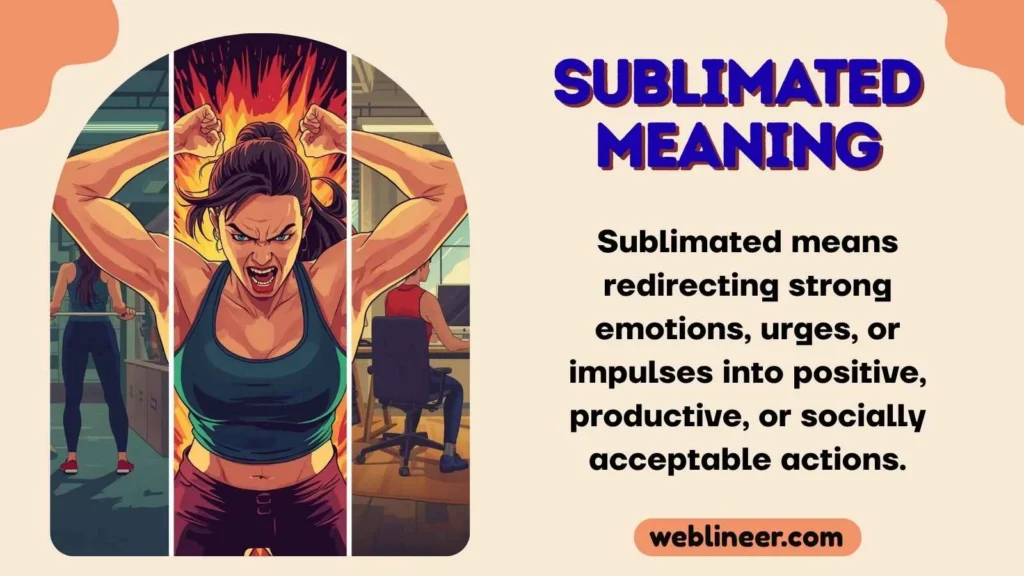
Sublimated means redirecting strong emotions, urges, or impulses into positive, productive, or socially acceptable actions.
In psychology, the concept comes from sublimation, a defense mechanism first described by Sigmund Freud. He believed people could transform negative or unacceptable feelings into useful behaviors—like turning aggression into sports or creativity.
Origin Story
- Early 1900s: Introduced in psychoanalysis
- Psychology roots: Defense mechanism theory
- Modern use: Everyday language, therapy, education, and self-improvement
Over time, the term moved beyond psychology. Today, people use it casually to describe turning emotional energy into something constructive.
Pronunciation Guide
SUB-luh-may-tid
/ˈsʌb.lə.meɪ.tɪd/
Quick Answer Box
Sublimated means transforming strong emotions or impulses into positive actions instead of harmful ones.
How to Use “Sublimated” Correctly in Texts & Chat
The word sounds formal, but people use it in both professional and casual conversations—especially when discussing emotions, creativity, or personal growth.
Correct Context and Tone
Appropriate Uses:
- Psychology discussions
- Personal development conversations
- Workplace or academic writing
- Emotional or reflective storytelling
Tone:
Reflective, thoughtful, analytical
Platform-Specific Usage
SMS / WhatsApp
“She sublimated her stress into painting.”
Instagram Caption
“Sublimated my anxiety into gym sessions 💪”
Twitter / X
“Creative work is just sublimated chaos.”
Discord / Reddit
“Gaming helps me sublimate frustration after work.”
When NOT to Use It
Avoid using the word when:
- Talking about simple mood changes
- Using casual slang conversations
- Describing suppression instead of transformation
- In very informal jokes
Formatting Tips
- Usually lowercase: sublimated
- Rarely abbreviated
- Often paired with action verbs like:
- channel
- redirect
- transform
- express
Real Conversation Examples Using “Sublimated”
Between Friends
Alex: I was furious after the argument.
Sam: What did you do?
Alex: I went for a long run and cleared my head.
Sam: Nice—you sublimated that anger.
Emotional Meaning:
The speaker turned anger into exercise instead of conflict.
In a Workplace Chat
Manager: Deadlines can be stressful.
Employee: True. I sublimated that pressure into finishing the report early.
Emotional Meaning:
Stress became productivity.
In a Relationship Conversation
Partner: You seem calmer lately.
Jordan: I started writing poetry. I guess I sublimated my emotions.
Emotional Meaning:
Feelings were expressed creatively.
In a Family Setting
Parent: You looked upset yesterday.
Teen: I was, but I sublimated it by practicing basketball.
Emotional Meaning:
Negative feelings were redirected into skill-building.
In a Therapy Session
Therapist: How did you handle the frustration?
Client: I sublimated it into painting.
Emotional Meaning:
A healthy coping strategy was used.
Common Mistakes & Misunderstandings
1. Confusing Sublimation With Suppression
Incorrect:
“I sublimated my feelings by ignoring them.”
Correct:
“I sublimated my feelings by writing about them.”
Ignoring emotions is suppression. Transforming them is sublimation.
2. Using It for Small Mood Changes
Not every emotional reaction is sublimation.
Example:
Feeling tired and taking a nap is not sublimation.
Sublimation involves:
- Strong emotion
- Conscious redirection
- Positive outcome
3. Generational Misunderstandings
Older generations may interpret the word as overly academic, while younger audiences often encounter it in:
- Psychology content
- Self-help books
- Therapy discussions
- Motivational posts
Cultural Differences
In many cultures, emotional control is valued. The idea of channeling feelings into work, sports, or art fits naturally into those traditions—even if the word “sublimated” isn’t commonly used.
“Sublimated” Across Different Platforms & Demographics
Gen Z
Uses the concept frequently, even if not the exact word.
Examples:
- Gym culture
- Creative hobbies
- Productivity routines
- Mental health discussions
Millennials
Often use the word in:
- Therapy conversations
- Career development
- Personal growth content
Older Adults
More likely to encounter the term in:
- Psychology articles
- Academic settings
- Professional writing
Platform Frequency
TikTok
Common in mental health and productivity content.
Instagram
Used in captions about fitness or creativity.
Discord / Reddit
Appears in discussions about coping strategies.
Is It Formal or Informal?
Semi-formal word
Safe for:
- Work emails
- Academic writing
- Therapy discussions
Less common in:
- Casual slang
- Text abbreviations
- Humor posts
Related Slang, Abbreviations & Alternatives
| Term | Meaning | Tone |
|---|---|---|
| Channel emotions | Redirect feelings into action | Neutral |
| Vent | Release emotions verbally | Casual |
| Cope | Manage stress or emotions | Neutral |
| Redirect energy | Shift focus productively | Professional |
| Express feelings | Share emotions openly | Neutral |
| Transform stress | Turn pressure into productivity | Motivational |
| Release tension | Reduce emotional strain | Casual |
| Work it out | Solve emotional issues through activity | Informal |
| Process emotions | Understand and manage feelings | Professional |
| Emotional regulation | Controlling emotional responses | Clinical |
FAQs
What does sublimated mean in psychology?
In psychology, sublimated means redirecting strong emotions or impulses into positive activities. For example, someone feeling anger might exercise, create art, or focus on work instead of acting aggressively. Psychologists consider this a healthy coping mechanism.
Is sublimation healthy?
Yes. Sublimation is widely regarded as one of the healthiest emotional coping strategies because it transforms negative energy into productive or creative outcomes rather than suppressing or expressing it destructively.
Can emotions be sublimated without therapy?
Absolutely. People naturally sublimate emotions in everyday life—like turning stress into productivity, frustration into exercise, or sadness into creative expression.
What is a real-life example of sublimation?
A common example is someone who feels anxious and decides to clean the house, work on a project, or go to the gym. The emotional energy is redirected into useful action.
Is sublimated the same as repressed?
No. Repressed emotions are hidden or pushed away. Sublimated emotions are transformed into positive behavior. One avoids feelings; the other uses them constructively.
Conclusion
The sublimated meaning is simple once you see it in action: it’s about turning emotional energy into something useful. Not hiding it. Not exploding. Transforming it.
From workouts and art to productivity and problem-solving, sublimation shows up everywhere in modern life. It’s one of the healthiest ways humans deal with pressure, frustration, and intense feelings.
Next time you feel overwhelmed, try channeling that energy into something constructive you might be sublimating without even realizing it.
Drop your favorite example of turning stress into productivity below.

Hi, I’m Smith Roy, the writer of Weblineer.com, where I break down words, slang, and meanings into something you can actually understand without overthinking it.
I’ve always been curious about how language works, how a simple word can carry different meanings depending on context, culture, or even a trending moment online. That curiosity turned into Weblineer, a space where I simplify complex terms, decode internet slang, and explain meanings in a way that feels natural, clear, and useful.