Tulpa meaning, Imagine chatting with a friend who casually says, “I’ve been talking to my tulpa lately.”
You pause. Wait—what exactly is a tulpa?
The term has quietly moved from ancient spiritual traditions into modern internet culture, Reddit discussions, and psychology conversations.
Today, understanding the tulpa meaning matters more than ever especially as online communities explore mental health, imagination, and identity in new ways.
Some people use the word in a spiritual sense. Others use it playfully, like describing an imaginary companion or fictional character that feels real.
And occasionally, it shows up in serious psychological discussions.
In this guide, you’ll learn:
- The exact definition of tulpa
- Where the term came from historically
- How people use it online today
- Real examples from conversations
- Common misunderstandings to avoid
Whether you’re a curious reader, parent, student, writer, or internet user, this article gives you the clearest, most trustworthy explanation available—fully updated for 2026.
What Does “Tulpa” Mean?
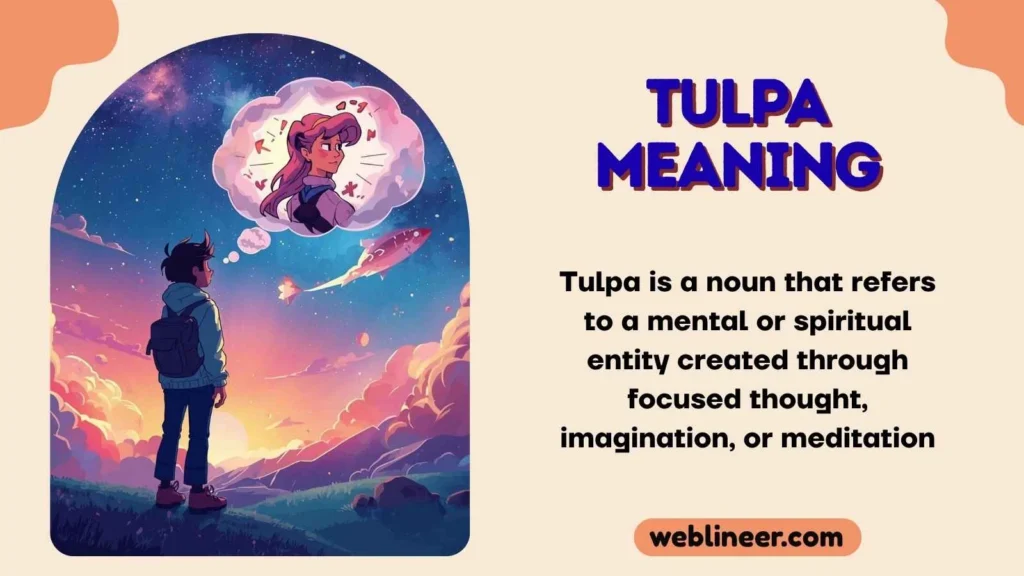
Tulpa is a noun that refers to a mental or spiritual entity created through focused thought, imagination, or meditation.
In simple terms, it describes an imagined being that feels separate or independent from the person who created it.
Quick Answer
A tulpa is a thought-form or imagined companion created through intense concentration or imagination. The concept comes from Tibetan Buddhism but is now widely used online to describe imaginary personalities or mental companions.
Origin of the Word “Tulpa”
The word comes from Tibetan Buddhism, where the original term is:
Tulpa (ཏུལ་པ)
Historically, monks believed advanced meditators could create physical manifestations using deep concentration. These manifestations were called thought-forms.
The idea became popular in Western culture after:
- Early 20th-century spiritual writings
- Occult and mystical literature
- Psychology discussions
- Internet forums in the 2000s
How the Meaning Has Evolved
Over time, the meaning shifted significantly.
Traditional meaning:
A spiritual manifestation created through meditation.
Modern internet meaning:
An imagined personality, companion, or character that feels independent.
Pop culture meaning:
A fictional or psychological construct.
Pronunciation Guide
Tulpa is pronounced:
TUL-pah
Simple breakdown:
TUL — like “dull”
pah — like “pa”
How to Use “Tulpa” Correctly in Texts & Chat
The word tulpa is usually used in thoughtful, niche, or internet-community conversations rather than casual slang.
Tone and Context
Tulpa is typically used in:
- Psychological discussions
- Spiritual conversations
- Online forums
- Creative writing
- Fandom communities
It can sound:
- Curious
- Philosophical
- Imaginative
- Sometimes humorous
Platform-Specific Usage
Reddit
Often used in mental health or imagination communities.
Example:
“I created a tulpa to help me focus when studying.”
Discord
Used in roleplay or creative communities.
Example:
“My tulpa helps me brainstorm story ideas.”
TikTok
Usually discussed in storytelling or psychology content.
Example:
“Have you heard about people making tulpas?”
WhatsApp / SMS
Rare in everyday texting.
When to Use It vs. When NOT To
Use it when:
- Discussing imagination or psychology
- Talking about fictional characters
- Exploring spirituality
- Writing stories
Avoid using it:
- In professional emails
- In medical diagnoses
- In formal reports
- As a joke about mental illness
Formatting Tips
Correct usage:
tulpa
my tulpa
a tulpa
Avoid:
TULPA (unless emphasizing)
tulpa!!!
tulpa???
Emoji pairings (casual contexts):
🧠 imagination
✨ creativity
👤 identity
Real Conversation Examples Using Tulpa
Example 1 — Between Friends
Friend A:
“I started journaling conversations with my tulpa.”
Friend B:
“That sounds interesting—like talking to your inner voice?”
Meaning:
The speaker treats the tulpa as a mental companion or creative tool.
Example 2 — In a Creative Writing Group
Writer:
“My main character started as a tulpa in my imagination.”
Meaning:
The word describes a fictional personality that feels vivid and independent.
Example 3 — In a Gaming Community
Player:
“My tulpa reminds me to stay calm during ranked matches.”
Meaning:
Used metaphorically as an inner guide or mental persona.
Example 4 — Family Conversation
Teen:
“I read about people creating tulpas online.”
Parent:
“Is that like an imaginary friend?”
Meaning:
Curiosity and clarification about the concept.
Example 5 — Online Forum Discussion
User:
“Some people believe tulpas can think independently.”
Meaning:
Discussion about psychological or spiritual interpretations.
Common Mistakes & Misunderstandings
1. Thinking a Tulpa Is Always Supernatural
Reality:
Most modern uses are psychological or imaginative—not mystical.
2. Confusing Tulpa with Mental Illness
This is a common misconception.
A tulpa is not automatically:
- schizophrenia
- dissociative identity disorder
- hallucinations
Many people simply use the term creatively.
3. Assuming Everyone Uses the Word the Same Way
Different communities interpret it differently.
Examples:
Spiritual groups → mystical meaning
Writers → creative imagination
Internet users → mental companion
Generational Differences
Gen Z
More familiar through internet culture.
Millennials
Recognize it from online forums.
Older generations
May interpret it as an imaginary friend.
Cultural Differences
Western internet communities
Psychological or creative meaning.
Eastern spiritual traditions
Religious or philosophical meaning.
“Tulpa” Across Different Platforms & Demographics
Gen Z Usage
Gen Z often encounters the term through:
- TikTok discussions
- Reddit communities
- Online fandoms
- Roleplay groups
It is usually used in a curious or exploratory way.
Millennials
Millennials are more likely to know the term from:
- Early internet forums
- Gaming communities
- Science fiction discussions
Older Adults
Older generations may:
- Rarely use the term
- Associate it with spirituality
- Compare it to imaginary friends
Is It Formal or Informal?
Tulpa is:
Informal — in everyday conversation
Neutral — in academic discussion
Not slang — technically a spiritual term
Is It Safe for Work?
Usually yes.
But context matters.
Avoid using it in:
- professional communication
- clinical settings
- serious mental health discussions
Related Slang, Abbreviations & Alternatives
| Term | Meaning | Usage Context |
|---|---|---|
| Imaginary friend | Made-up companion | Childhood psychology |
| Alter ego | Alternate personality | Psychology / creativity |
| Persona | Social identity | Writing / branding |
| Inner voice | Internal thoughts | Everyday conversation |
| Spirit guide | Spiritual helper | Religion |
| Thought-form | Mental creation | Philosophy |
| OC (Original Character) | Fictional character | Fandom |
| Avatar | Digital identity | Gaming |
| AI companion | Virtual assistant | Technology |
| Roleplay character | Fictional role | Online communities |
FAQs
What does tulpa meaning in psychology?
In psychology, a tulpa is usually described as a mental construct created through imagination or visualization. It may function as an internal dialogue partner or creative persona rather than a separate personality.
Is a tulpa the same as an imaginary friend?
Not exactly.
Both involve imagination, but a tulpa is typically created intentionally and may be treated as more independent than a traditional imaginary friend.
Can adults have tulpas?
Yes.
Adults sometimes use the concept in creative writing, meditation, or self-reflection. However, it is important to maintain awareness that the tulpa is a mental creation.
Is the concept of tulpa dangerous?
Usually not.
For most people, imagination and visualization are harmless. Problems may arise only if the belief interferes with daily functioning or mental health.
Why is tulpa trending online?
The topic gained attention due to:
- internet forums
- psychology discussions
- storytelling communities
- social media curiosity
It reflects growing interest in identity, imagination, and mental experiences.
Conclusion
The tulpa meaning has traveled a fascinating path from ancient Tibetan meditation practices to modern internet conversations.
What started as a spiritual idea is now widely used to describe imagined companions, creative personas, or mental constructs.
Today, the word sits at the intersection of psychology, creativity, and online culture. Sometimes it’s serious. Sometimes playful. Often misunderstood.
Understanding terms like tulpa helps you navigate digital conversations with confidence—whether you’re reading forums, writing fiction, or simply staying curious about how language evolves.
Drop your favorite unusual internet term below—or explore more modern slang guides to keep your digital vocabulary sharp.

Hi, I’m Smith Roy, the writer of Weblineer.com, where I break down words, slang, and meanings into something you can actually understand without overthinking it.
I’ve always been curious about how language works, how a simple word can carry different meanings depending on context, culture, or even a trending moment online. That curiosity turned into Weblineer, a space where I simplify complex terms, decode internet slang, and explain meanings in a way that feels natural, clear, and useful.