Ever opened a new class group chat and someone asks, “Did anyone check the syllabus yet?” If you paused for a second wondering what exactly they meant you’re not alone.
Understanding syllabus meaning is more important than ever in 2026, especially with online classes, hybrid learning, and digital classrooms becoming the norm.
Whether you’re a student, parent, or even a professional taking a course, the syllabus is your starting point.
Think of it as your course GPS. Without it, you’re just guessing where things are headed.
In this guide, you’ll learn exactly what a syllabus is, how to use it properly, real-life examples, common mistakes people make, and how it differs from similar terms like curriculum. Updated for 2026, this is your complete, no-confusion resource.
What Does “Syllabus” Mean?
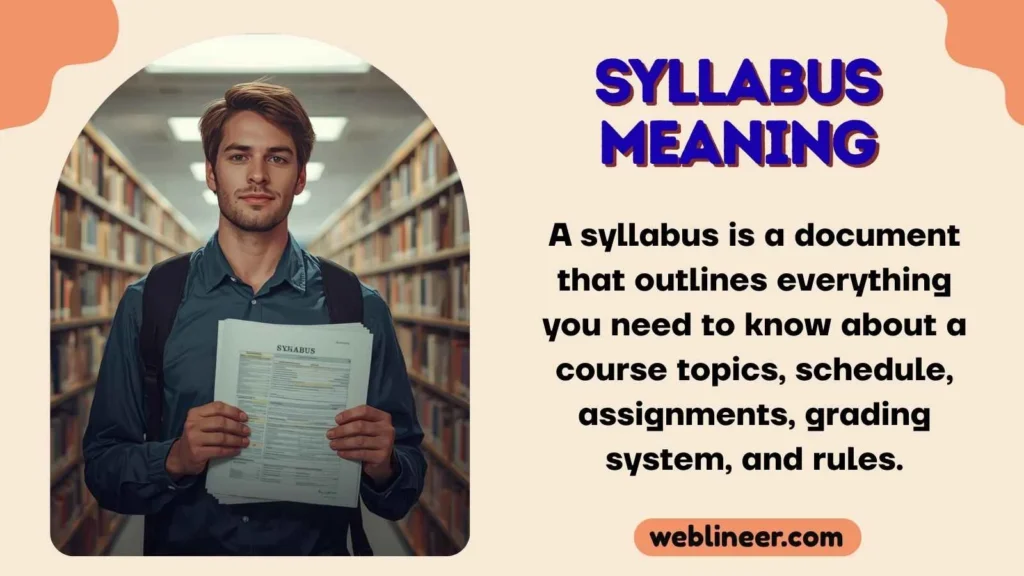
A syllabus is a document that outlines everything you need to know about a course—topics, schedule, assignments, grading system, and rules.
📌 Quick Answer:
A syllabus is a course outline that tells students what they will learn, how they will be assessed, and what is expected of them.
Origin of the Word
The word “syllabus” comes from Latin, though interestingly, it may have originated from a historical spelling error of the Greek word “sittybos.” Over time, it evolved into the modern academic term we use today.
How the Meaning Has Evolved
- Before: Simple list of topics
- Now (2026): A detailed contract between teacher and student, including policies, deadlines, and even digital tools
Pronunciation
Syllabus → SIL-uh-buhs
How to Use “Syllabus” Correctly in Texts & Chat
While “syllabus” isn’t slang, it shows up often in modern digital conversations—especially among students.
Tone & Context
- Neutral and informational
- Common in academic and semi-casual settings
- Rare in fully casual slang chats unless school is involved
Platform Usage
- WhatsApp: “Did sir send the syllabus?”
- Instagram DMs: “I need the syllabus for that course 😭”
- Discord (study servers): “Check the syllabus before asking questions.”
- Email (formal): “Please refer to the syllabus for grading criteria.”
When to Use It
✅ Talking about courses or classes
✅ Asking about assignments or structure
✅ Referring to academic planning
When NOT to Use It
❌ Casual conversations unrelated to education
❌ Professional settings outside education (unless training-related)
Formatting Tips
- No abbreviations (usually written fully as “syllabus”)
- Can be plural: syllabi or syllabuses
- Often paired with words like: course, outline, class, subject
Real Conversation Examples Using “Syllabus”
1. Between Friends
A: “Bro, did you see the syllabus?”
B: “Yeah, we have 3 assignments next week 💀”
👉 Shows concern and planning awareness.
2. In a Group Chat
Message: “Guys, everything is in the syllabus. Please read it.”
👉 Slightly authoritative tone—someone informed.
3. Student & Teacher
Student: “Will this topic be in exams?”
Teacher: “It’s clearly mentioned in the syllabus.”
👉 Indicates importance and structure.
4. Online Course Discussion
User: “Where can I find deadlines?”
Reply: “Check the syllabus PDF.”
👉 Directing someone to official information.
5. Family Context
Parent: “Did your school give a syllabus?”
Child: “Yes, I’ll share it.”
👉 Shows planning and academic tracking.
Common Mistakes & Misunderstandings
1. Confusing Syllabus with Curriculum
- Syllabus = One course
- Curriculum = Entire program
👉 This is the most common mistake.
2. Ignoring the Syllabus
Many students don’t read it—and later miss deadlines or rules.
👉 Think of it as skipping instructions before assembling furniture.
3. Assuming It Never Changes
Some believe the syllabus is fixed—but teachers may update it.
👉 Always check for latest versions.
Generational Differences
- Gen Z: Uses it casually in chats
- Millennials: More formal usage
- Older generations: Often confuse it with curriculum
“Syllabus” Across Different Platforms & Demographics
Gen Z Usage
- Frequently mentioned in memes and student TikToks
- Example: “Me ignoring the syllabus all semester 😭”
Millennials
- Use it professionally and academically
- More likely to read it fully
Online Trends
- Viral “first day of class” content often references syllabus
- Study influencers emphasize “reading the syllabus”
Formality Level
- Semi-formal
- Safe for school, college, and workplace training contexts
Related Slang, Abbreviations & Alternatives
| Term | Meaning |
|---|---|
| Course Outline | Another word for syllabus |
| Curriculum | Overall educational plan |
| Lesson Plan | Teacher’s daily teaching guide |
| Module | Section of a course |
| Study Guide | Exam preparation material |
| Coursework | Assignments and tasks |
| Academic Plan | Long-term education structure |
| Semester Plan | Timeline for a term |
| Class Schedule | Timing of classes |
👉 Learn more about “curriculum vs syllabus” to avoid confusion.
FAQs
What is syllabus meaning in simple words?
A syllabus is a guide for a course that tells you what topics will be taught, what assignments you’ll do, and how you’ll be graded. It helps students stay organized and understand expectations from day one.
Is a syllabus the same as a timetable?
No. A timetable only shows class timings, while a syllabus includes detailed information about topics, assignments, and rules.
Why do teachers give a syllabus?
Teachers provide a syllabus to clearly communicate course structure, expectations, and deadlines so students can plan and succeed.
Can a syllabus change during a course?
Yes. Teachers may update it based on progress, unexpected events, or improvements. Always check for updates.
What is the plural of syllabus?
The plural can be syllabi (traditional) or syllabuses (modern usage). Both are correct.
Conclusion
The syllabus meaning is simple but its importance is huge. It’s not just a document; it’s your roadmap for success in any course.
Ignore it, and you risk confusion. Use it properly, and everything becomes clearer from deadlines to expectations.
In today’s fast-paced, digital-first education world, understanding your syllabus is one of the smartest moves you can make.
So next time someone says, “Check the syllabus,” you’ll know exactly what they mean and why it matters.
👉 Got a favorite academic term you want explained next? Drop it below!

Hi, I’m Candy Rox, the voice behind Weblineer.com, where words get decoded and meanings finally make sense.
I’ve always been fascinated by how a single word can carry different vibes depending on where and how it’s used. From trending slang to everyday phrases, I break things down in a way that’s simple, clear, and actually useful in real conversations.