Have you ever heard someone say a building was “consecrated” and wondered what that actually means? Maybe it came up in a religious ceremony, a history book, or even a formal speech.
The word sounds important and it is but the exact consecrate meaning can feel a bit mysterious at first.
Here’s the thing: understanding this word isn’t just for priests, scholars, or history buffs. It shows up in news headlines, cultural traditions, weddings, memorials, and even motivational speeches.
Knowing how to use it correctly can make your writing and speaking sound more precise, respectful, and confident.
In this guide, you’ll learn:
- The simple definition of consecrate
- Where the word comes from
- How to use it correctly in real-life situations
- Common mistakes people make
- Related words and modern usage examples
Let’s break it down in a clear, practical way.
What Does “Consecrate” Mean?
Definition:
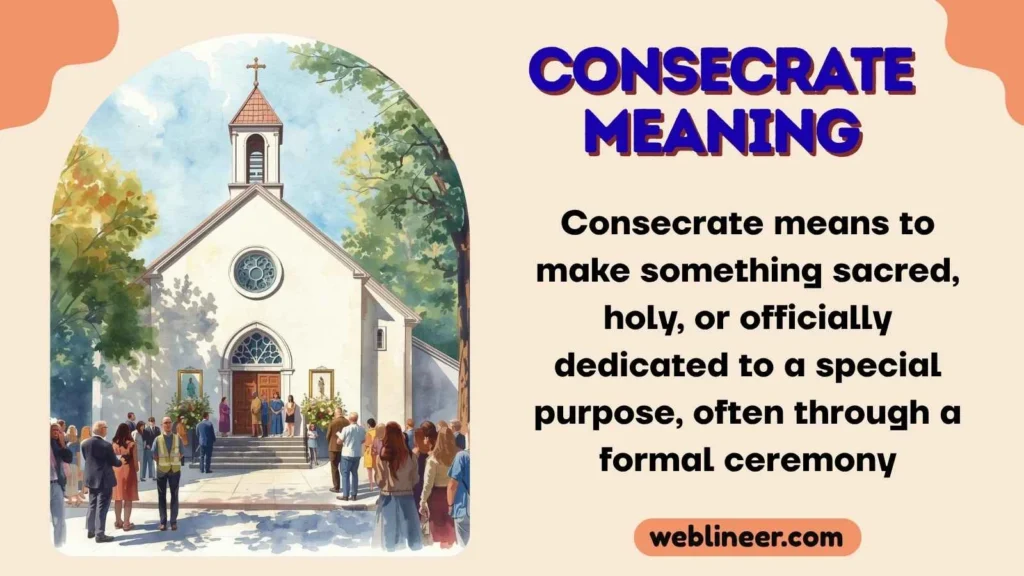
Consecrate means to make something sacred, holy, or officially dedicated to a special purpose, often through a formal ceremony.
Quick Answer
Consecrate means to set something apart as sacred or dedicate it to a meaningful purpose, usually in a religious or ceremonial way.
Origin of the Word
The word consecrate comes from the Latin word consecrare, which means:
“to make sacred” or “to devote.”
It entered the English language in the late 1300s and was widely used in churches and religious texts. Over time, its meaning expanded beyond religion into symbolic and ceremonial uses.
Pronunciation Guide
Consecrate is pronounced:
KON-si-krayt
/ˈkɒn.sɪ.kreɪt/
Think:
CON + se + crate
How the Meaning Has Evolved
Originally, the word was strictly religious. Today, it can also be used figuratively.
Traditional use:
- Consecrate a church
- Consecrate a bishop
Modern figurative use:
- Consecrate a memory
- Consecrate a cause
- Consecrate a national monument
How to Use “Consecrate” Correctly in Writing & Speech
Using consecrate correctly depends on tone and context. It’s usually formal, respectful, and meaningful.
Correct Context and Tone
Appropriate tones:
- Formal
- Ceremonial
- Respectful
- Spiritual
- Symbolic
Examples of proper contexts:
- Religious ceremonies
- Memorial services
- Dedications
- Historical writing
- Formal speeches
When to Use It
Use consecrate when something is being:
- Made sacred
- Officially dedicated
- Honored with deep respect
- Set apart for a special purpose
When NOT to Use It
Avoid using consecrate in:
- Casual conversations
- Jokes or sarcasm
- Everyday tasks
Incorrect:
“I consecrated my new laptop.”
Correct:
“The temple was consecrated during a traditional ceremony.”
Formatting Tips
- Usually lowercase unless starting a sentence
- Often paired with formal language
- Rarely used with emojis in serious contexts
Real Conversation Examples Using “Consecrate”
Example 1 — Religious Ceremony
Priest:
“We will consecrate this church on Sunday morning.”
Meaning:
The church will be officially declared sacred.
Example 2 — Memorial Event
Organizer:
“The monument was consecrated in honor of the fallen soldiers.”
Meaning:
The monument was dedicated with respect and ceremony.
Example 3 — Historical Context
Teacher:
“The king consecrated the cathedral after its completion.”
Meaning:
The cathedral was formally declared holy.
Example 4 — Symbolic Use
Speaker:
“We consecrate this day to remembering those who helped us succeed.”
Meaning:
The day is being honored and dedicated.
Example 5 — Personal Commitment
Friend:
“She consecrated her life to helping children in need.”
Meaning:
She devoted her life to a meaningful purpose.
Common Mistakes & Misunderstandings
1. Confusing Consecrate with Dedicate
Dedicate is broader.
Consecrate usually implies something sacred or solemn.
Example:
Dedicate:
“He dedicated the book to his parents.”
Consecrate:
“The altar was consecrated during the ceremony.”
2. Using It in Casual Situations
Many people use consecrate where a simpler word works better.
Incorrect:
“I consecrated my new phone.”
Better:
“I set up my new phone.”
3. Assuming It’s Only Religious
While often religious, the word can also be symbolic or emotional.
Example:
“They consecrated the park as a place of peace.”
“Consecrate” Across Different Contexts & Demographics
Religious Communities
Most common usage.
Seen in churches, temples, mosques, and ceremonial traditions.
Academic and Historical Writing
Historians frequently use the word when describing:
- Coronations
- Religious buildings
- National monuments
Modern Professional Use
You might hear consecrate in:
- Government speeches
- Memorial events
- Cultural ceremonies
Generational Usage
Older generations:
Use the word more frequently in formal speech.
Younger generations:
Less common in daily conversation but still recognized in formal or religious settings.
Related Words, Synonyms & Alternatives
| Word | Meaning | Usage Style |
|---|---|---|
| Dedicate | Devote to a purpose | General |
| Sanctify | Make holy | Religious |
| Bless | Give divine favor | Spiritual |
| Ordain | Appoint to religious office | Formal |
| Hallow | Make sacred | Traditional |
| Devote | Give time or energy | Everyday |
| Inaugurate | Officially begin | Formal |
| Honor | Show respect | General |
| Memorialize | Preserve memory | Emotional |
| Set apart | Separate for purpose | Informal |
Synonyms:
- dedicate
- sanctify
- bless
Antonyms:
- neglect
- ignore
- profane
FAQs
What does consecrate mean in simple English?
Consecrate means to make something sacred or officially dedicate it to an important purpose. It is often used in religious ceremonies but can also describe honoring something deeply.
Is consecrate a religious word?
Mostly, yes. The word is commonly used in religious settings like churches and temples. However, it can also be used in symbolic or formal situations outside religion.
Can consecrate be used in a sentence?
Yes. For example:
“The bishop consecrated the new cathedral during the ceremony.”
What is the difference between consecrate and sanctify?
Both mean to make something holy, but sanctify focuses more on spiritual purity, while consecrate emphasizes official dedication.
Is consecrate a formal word?
Yes. It is considered formal and respectful. It is rarely used in casual conversation.
Conclusion
The consecrate meaning is simple once you break it down: it means to make something sacred or dedicate it to a special purpose.
Whether used in religion, history, or symbolic speech, the word carries a sense of respect and significance.
It’s not a casual word but that’s exactly what makes it powerful. When you use consecrate, you signal seriousness, honor, and intention.
Now you know when to use it, how to pronounce it, and how to avoid common mistakes. That’s language mastery in action.
Got another word you’re curious about? Explore more meanings and keep building your vocabulary.

Hi, I’m Candy Rox, the voice behind Weblineer.com, where words get decoded and meanings finally make sense.
I’ve always been fascinated by how a single word can carry different vibes depending on where and how it’s used. From trending slang to everyday phrases, I break things down in a way that’s simple, clear, and actually useful in real conversations.