Ever had one of those days where everything feels just a little… off! off kilter meaning?
Your routine is the same, your coffee tastes fine, but something doesn’t quite line up. That slightly strange, out-of-sync feeling is exactly what people mean when they use the phrase off kilter.
Understanding the off kilter meaning matters more than you might think.
This quirky expression pops up in conversations, social media captions, movie reviews, and even workplace chats. It’s descriptive, vivid, and surprisingly versatile.
In this updated-for-2026 guide, you’ll learn:
- The exact definition and origin of the phrase
- How to use it naturally in texts and conversations
- Real-life examples across different situations
- Common mistakes to avoid
- Similar slang and expressions you can use instead
Let’s break it down in plain English.
What Does “Off Kilter” Mean?
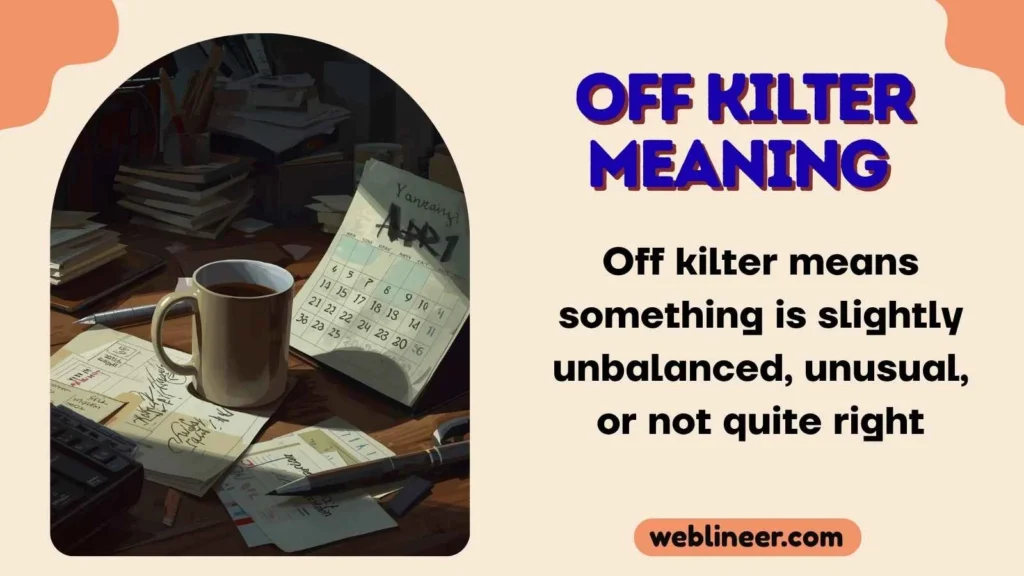
Off kilter means something is slightly unbalanced, unusual, or not quite right. It can describe emotions, behavior, situations, or even physical objects.
Quick Answer
Off kilter means slightly unbalanced, odd, or out of sync. It describes something that feels unusual, unpredictable, or not functioning normally.
Origin of the Phrase
The word kilter dates back to Scotland in the 1600s. It originally referred to proper alignment or good condition. When something was in kilter, it was balanced and working correctly.
So naturally:
Off kilter = out of alignment
Over time, the phrase shifted from physical balance to emotional and social situations. Today, it’s used far more often to describe moods, behavior, humor, or events.
Pronunciation Guide
off KIL-ter
/ɔf ˈkɪl tər/
Stress falls on kil.
How to Use “Off Kilter” Correctly in Texts & Chat
The phrase is flexible and works in many casual conversations. It’s descriptive without sounding overly dramatic.
Tone and Context
Off kilter is usually:
- Casual
- Descriptive
- Slightly humorous
- Mildly concerned
It rarely sounds harsh or offensive.
Where You’ll See It
SMS / Text Messages
WhatsApp chats
Instagram captions
Discord conversations
Workplace messaging
Movie or book reviews
Example Uses by Platform
Text message
“I feel off kilter today—didn’t sleep much.”
Instagram caption
“Life’s a little off kilter lately, but we’re rolling with it.”
Work chat
“The schedule feels off kilter this week.”
Gaming chat
“Our strategy went totally off kilter after that update.”
When NOT to Use It
Avoid in:
Legal documents
Formal academic writing
Serious medical discussions
Highly technical reports
In those settings, words like unbalanced, irregular, or misaligned sound more appropriate.
Formatting Tips
Use lowercase in most cases:
off kilter
Hyphenated version also appears:
off-kilter
Emoji pairings that fit the tone:
😅
🤪
⚖️
🤷♂️
Real Conversation Examples Using “Off Kilter”
Here are realistic scenarios showing how the phrase works in everyday communication.
Between Friends
Friend 1:
“Why are you so quiet today?”
Friend 2:
“I don’t know, I just feel a bit off kilter.”
Meaning:
They feel emotionally or mentally out of balance.
In a Group Chat
Person A:
“Did the meeting start early?”
Person B:
“Yeah, everything went off kilter this morning.”
Meaning:
The schedule became disorganized.
Dating Scenario
Partner:
“You seem different tonight.”
You:
“I’m just a little off kilter after that stressful day.”
Meaning:
You feel unsettled or tired.
Family Conversation
Parent:
“The house feels off kilter without your sister here.”
Meaning:
Something feels emotionally incomplete.
Gaming Context
Player 1:
“Our team strategy went off kilter after the first round.”
Meaning:
The plan stopped working properly.
Common Mistakes & Misunderstandings
Even simple phrases get misused sometimes. Here are the most frequent issues.
Mistake 1: Assuming It Means ” wild “
Not exactly.
Off kilter usually means:
slightly unusual
a bit out of balance
It does NOT automatically mean:
wild
dangerous
extreme
Correct:
“His humor is off kilter.”
Incorrect:
“He’s off kilter, so stay away.”
Mistake 2: Using It Only for People
The phrase works for many things.
You can describe:
Mood
Plans
Weather
Schedules
Objects
Stories
Example:
“The movie has an off-kilter plot.”
Mistake 3: Confusing It With “Off the Rails”
These phrases sound similar but feel stronger.
Off kilter = slightly unbalanced
Off the rails = completely out of control
Think of it like this:
Off kilter → wobbling
Off the rails → crashing
“Off Kilter” Across Different Platforms & Demographics
Language evolves fast, especially online. Here’s how the phrase shows up in modern communication.
Gen Z
Often used to describe:
Weird humor
Unexpected behavior
Awkward social situations
Example:
“That meme is so off kilter.”
Millennials
Common in:
Workplace conversations
Parenting discussions
Lifestyle posts
Example:
“My routine feels off kilter after vacation.”
Older Generations
Used more literally:
Physical imbalance
Unusual behavior
Changes in routine
Example:
“The chair looks off kilter.”
Social Media Trends
You’ll see off kilter frequently in:
TikTok captions
Instagram reels
Podcast descriptions
Movie reviews
It’s especially popular when describing:
Dark humor
Surreal storytelling
Quirky personalities
Related Slang, Abbreviations & Alternatives
Here are useful alternatives and similar expressions.
| Term | Meaning | Tone |
|---|---|---|
| Out of whack | Not working properly | Casual |
| Unbalanced | Not stable | Neutral |
| Quirky | Odd in a fun way | Positive |
| Offbeat | Unusual style | Creative |
| Weird | Strange | Informal |
| Out of sync | Not aligned | Neutral |
| Tilted | Slightly unstable | Casual |
| Awkward | Social discomfort | Informal |
| Unusual | Different from normal | Neutral |
| Out of line | Improper behavior | Negative |
Synonyms
unbalanced
uneven
odd
irregular
misaligned
Antonyms
balanced
stable
normal
aligned
steady
FAQs
What does off kilter mean in slang?
In slang, off kilter means something feels slightly strange, awkward, or out of balance. It’s often used casually to describe moods, behavior, or situations that don’t feel quite normal but aren’t serious problems.
Is off kilter a negative expression?
Not necessarily. The phrase can be neutral, mildly negative, or even playful. For example, calling humor “off kilter” often suggests it’s quirky or unconventional rather than bad.
Can you use off kilter at work?
Yes, in most casual workplace conversations. It’s suitable for describing schedules, workflows, or moods. However, it’s best avoided in formal reports or official documentation.
Why do people say off kilter?
People use the phrase because it paints a clear mental picture. Instead of saying “things are slightly wrong,” off kilter suggests imbalance in a vivid, relatable way.
Is off kilter American or British English?
The phrase appears in both American and British English. It originated from Scottish language roots and spread globally through everyday conversation and literature.
Conclusion
The off kilter meaning is simple but surprisingly expressive. It describes that slightly unbalanced feeling when things aren’t quite right emotionally, physically, or socially.
It’s casual, versatile, and widely understood across generations. Whether you’re talking about a strange day, a quirky movie, or a messy schedule, this phrase fits naturally into everyday conversation.
Language keeps evolving, and expressions like off kilter stick around because they’re vivid, relatable, and easy to use.
Now your turn:
Drop your favorite quirky phrase or slang term in the comments and keep the conversation going.

Hi, I’m Smith Roy, the writer of Weblineer.com, where I break down words, slang, and meanings into something you can actually understand without overthinking it.
I’ve always been curious about how language works, how a simple word can carry different meanings depending on context, culture, or even a trending moment online. That curiosity turned into Weblineer, a space where I simplify complex terms, decode internet slang, and explain meanings in a way that feels natural, clear, and useful.