Have you ever heard someone say a neighborhood is an “enclave” and wondered what that actually means? Maybe you saw it in a news article, a geography lesson, or even a real estate listing describing a “quiet residential enclave.”
The word sounds formal, but the idea behind it is surprisingly simple and very relevant today.
Understanding the enclave meaning helps you make sense of world maps, cultural communities, and even everyday conversations about cities and neighborhoods.
It shows up in politics, geography, migration stories, and urban planning. In short, it’s a small word with big real-world impact.
In this guide, you’ll learn:
- The clear definition of enclave
- Where the term came from
- How people use it in modern conversation
- Real examples you can instantly understand
- Common mistakes to avoid
Whether you’re a student, writer, non-native English speaker, or just curious about vocabulary, this article will give you the complete, practical understanding you need.
What Does “Enclave” Mean?
Simple Definition
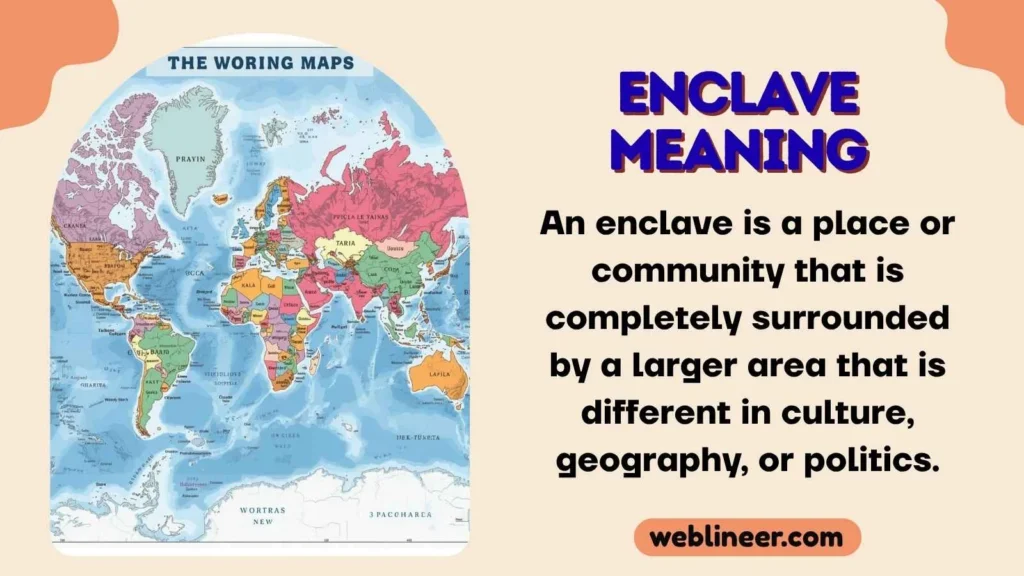
An enclave is a place or community that is completely surrounded by a larger area that is different in culture, geography, or politics.
It can refer to:
- A country inside another country
- A neighborhood with a shared culture
- A small community within a larger city
Quick Answer:
An enclave is a smaller area or group that exists inside a larger, different area—often maintaining its own identity, culture, or boundaries.
Origin of the Word
The word enclave comes from:
- French: enclaver
- Meaning: to enclose or lock in
It first appeared in English in the 18th century, mainly in diplomatic and geographic discussions. Over time, the meaning expanded beyond politics to include cultural and social communities.
Today, the term is widely used in:
- Geography
- Sociology
- Real estate
- News reporting
- Urban planning
Pronunciation Guide
Enclave is pronounced:
EN-klayv
/ˈɛn.kleɪv/
Breakdown:
- EN — like “pen”
- klayv — rhymes with “wave”
How to Use “Enclave” Correctly in Texts & Conversation
The word enclave is slightly formal but still common in everyday English. You’ll often see it in writing, news, and academic discussions.
Typical Context and Tone
Use enclave when describing:
- A distinct community within a larger area
- A culturally unified neighborhood
- A geographically enclosed territory
- A quiet residential area
Tone:
- Neutral
- Informational
- Descriptive
Platform-Specific Usage
SMS / WhatsApp
“That street is like a peaceful little enclave away from traffic.”
Instagram Caption
“Found a hidden café in a cozy neighborhood enclave.”
Twitter / X
“The city’s tech enclave keeps growing every year.”
“Our town has a small artist enclave near the river.”
Discord / Gaming Chat
“We built a base enclave inside the mountain.”
When NOT to Use It
Avoid using enclave in:
- Very casual slang conversations
- Situations where “neighborhood” is clearer
- Informal jokes or memes
- Basic beginner English conversations
Example mistake:
❌ “Let’s meet at the food enclave.”
✔ “Let’s meet at the food court.”
Formatting Tips
You typically write enclave:
- In lowercase
- Without abbreviations
- Without emojis in formal writing
In casual social media, emojis can add tone:
Examples:
- peaceful enclave 🏡
- cultural enclave 🌍
- quiet enclave 🌿
Real Conversation Examples Using “Enclave”
Between Friends
Ali: That neighborhood feels different from the rest of the city.
Sara: Yeah, it’s kind of an enclave for artists.
Meaning:
The word suggests a unique, close-knit creative community.
In a Family Conversation
Parent: Why do so many people from that country live there?
Teen: It’s an ethnic enclave—they support each other.
Meaning:
The term highlights cultural identity and shared background.
At Work
Manager: We’re targeting the tech enclave downtown for our new office.
Meaning:
It refers to a concentrated group of professionals in one area.
In a Travel Scenario
Traveler: This village feels separate from the rest of the region.
Guide: It’s actually a historical enclave.
Meaning:
The word indicates geographic or cultural separation.
In Gaming
Player 1: Where’s your base?
Player 2: Hidden in a mountain enclave.
Meaning:
Used metaphorically to describe a protected location.
Common Mistakes & Misunderstandings
1. Confusing Enclave with Exclave
These words sound similar but mean different things.
Enclave:
Surrounded by another territory.
Exclave:
Separated from its main territory.
Simple rule:
- Enclave = inside
- Exclave = separated
2. Assuming It Only Applies to Countries
Many people think enclave is only political.
Not true.
It can describe:
- Neighborhoods
- Communities
- Social groups
- Professional clusters
3. Using It as a Synonym for Neighborhood
Not every neighborhood is an enclave.
An enclave must be:
- Distinct
- Unified
- Surrounded or separated
Generational Differences
Older adults may use enclave mainly in geography or politics.
Younger people often use it in:
- Urban culture
- Social media
- Lifestyle descriptions
Cultural Differences
In multicultural cities, the term is common.
Examples:
- immigrant communities
- cultural districts
- language-based neighborhoods
In smaller towns, the word may sound more formal.
“Enclave” Across Different Platforms & Demographics
Gen Z Usage
Gen Z typically uses enclave in:
- School assignments
- Social commentary
- Travel content
- Urban culture discussions
Frequency: Moderate
Millennials
Millennials use the term frequently in:
- Real estate listings
- Parenting discussions
- Community planning
Example:
“We moved into a quiet family enclave.”
Older Generations
More likely to use it in:
- Geography
- News
- Historical discussions
Is It Formal or Informal?
Formality Level: Medium
It works well in:
- Academic writing
- News articles
- Professional communication
But it may sound slightly formal in casual chat.
Trending Usage
The term enclave has become more visible due to:
- Migration patterns
- Globalization
- Urban diversity
- Cultural identity discussions
It often appears in news headlines and research studies about communities.
Related Slang, Abbreviations & Alternatives
| Term | Meaning | Tone |
|---|---|---|
| Community | A group of people living together | Neutral |
| Neighborhood | Local residential area | Casual |
| District | Administrative or cultural area | Formal |
| Colony | Settlement of people from another place | Historical |
| Settlement | Newly established community | Neutral |
| Cultural hub | Center of activity or culture | Informal |
| Cluster | Group concentrated in one area | Technical |
| Territory | Land under control | Formal |
| Ethnic community | People sharing cultural background | Neutral |
| Enclosed area | Space surrounded by boundaries | Descriptive |
FAQs
What is the simple definition of enclave?
An enclave is a small area or community surrounded by a larger, different area. It can refer to a geographic territory, cultural group, or neighborhood with a shared identity.
What is an ethnic enclave?
An ethnic enclave is a neighborhood where people from the same cultural or national background live together, often maintaining language, traditions, and businesses from their home country.
What is the difference between enclave and exclave?
An enclave is surrounded by another territory, while an exclave is separated from its main territory and located within foreign land. The key difference is direction—inside versus separated.
Can a city neighborhood be an enclave?
Yes. Many neighborhoods are considered enclaves when they have a strong cultural, economic, or social identity distinct from the surrounding city.
Is enclave a formal word?
Enclave is moderately formal. It is commonly used in education, news, and professional writing but can also appear in everyday conversation.
Conclusion
The enclave meaning is simple once you see it in real life: a smaller community or area surrounded by a larger, different one. It might be a country inside another country, a cultural neighborhood in a big city, or a quiet residential pocket tucked away from busy streets.
This word shows up everywhere—from geography textbooks to real estate ads—and understanding it helps you read, write, and communicate more clearly. It’s especially useful in conversations about culture, migration, and community identity.
Now that you know how to recognize and use enclave confidently, keep exploring language. Every new word opens another door to understanding the world around you.
Got another word you’re curious about? Drop it next.

Hi, I’m Smith Roy, the writer of Weblineer.com, where I break down words, slang, and meanings into something you can actually understand without overthinking it.
I’ve always been curious about how language works, how a simple word can carry different meanings depending on context, culture, or even a trending moment online. That curiosity turned into Weblineer, a space where I simplify complex terms, decode internet slang, and explain meanings in a way that feels natural, clear, and useful.