Ever heard someone say, “My cousin is a cadet,” and wondered what that actually means? Is it a soldier? A student? Someone in uniform marching on a field?
You’re not alone. The cadet meaning often confuses people because it shows up in schools, military academies, police training programs, and even casual conversations. One minute it sounds formal and serious, the next it’s used proudly in everyday talk.
Understanding this word matters more than ever today. Many schools and youth programs around the world are introducing cadet-style training to build discipline, leadership, and teamwork skills employers and educators value in 2026 and beyond.
In this complete guide, you’ll learn:
- The exact definition of cadet
- Where the word came from
- How it’s used in schools, military, and daily life
- Real conversation examples
- Common misunderstandings to avoid
Let’s break it down in plain English.
What Does “Cadet” Mean?
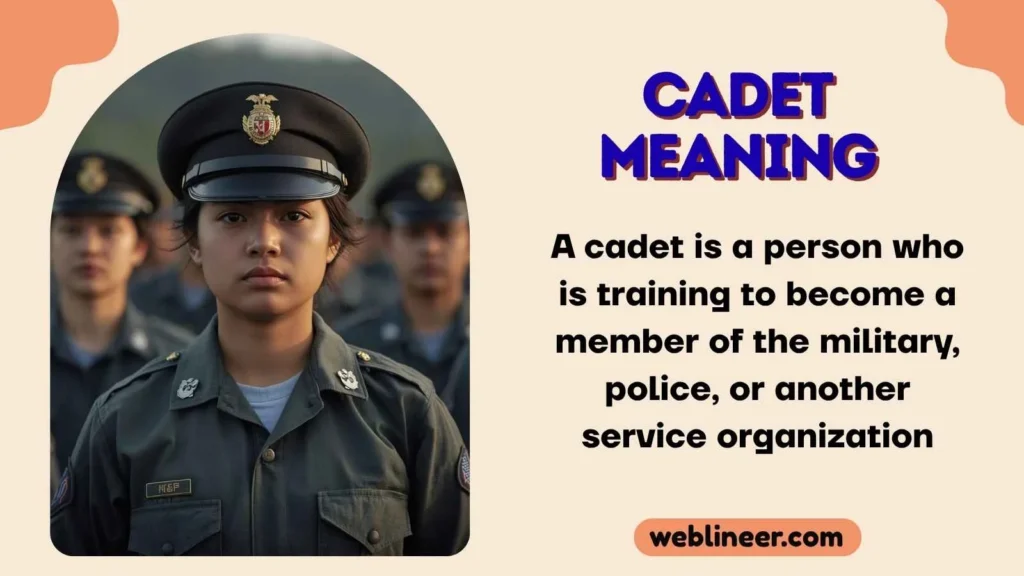
A cadet is a person who is training to become a member of the military, police, or another service organization. It can also refer to students in structured programs focused on leadership and discipline.
Quick Answer
A cadet is a trainee or student preparing for a future role in the military, police, or a disciplined profession.
Origin of the Word “Cadet”
The word cadet comes from the French word “cadet,” meaning younger son or junior member.
Historically, younger sons in noble families often joined the military because they didn’t inherit family property. Over time, the term evolved to describe anyone training for service roles.
How the Meaning Has Evolved
1700s–1800s
Cadet referred mainly to young men training in military academies.
1900s
The term expanded to include police and naval trainees.
Today (2026)
Cadet can refer to:
- Military trainees
- Police trainees
- Students in leadership programs
- Youth in discipline-based training groups
Pronunciation Guide
Cadet = kuh-DET
Phonetic: /kəˈdet/
Stress the second syllable.
How to Use “Cadet” Correctly in Texts & Chat
The word cadet is formal but still common in everyday conversation, especially when discussing education, careers, or achievements.
Correct Context and Tone
Use cadet when talking about:
- Military training
- Police academies
- School leadership programs
- Youth discipline programs
- Career preparation
Tone:
- Respectful
- Professional
- Proud
- Encouraging
Platform-Specific Usage
SMS / WhatsApp
“My brother just became a cadet today!”
Instagram
“Proud to wear this uniform as a cadet 💪”
Discord / Gaming
“I’m a cadet in the academy program now.”
Twitter / X
“New cadets graduated this morning. Big achievement.”
Reddit
“Thinking about joining a cadet program—any advice?”
When NOT to Use It
Avoid using cadet when:
- Talking about regular students
- Describing casual training
- Referring to someone already fully employed as a soldier
Incorrect example:
“He’s a cadet in the army for 10 years.”
Correct example:
“He was a cadet before becoming a soldier.”
Formatting Tips
- Usually lowercase: cadet
- Capitalize in titles: Cadet Officer
- Common emoji pairings:
🎖️
🪖
🇺🇸
💪
Real Conversation Examples Using “Cadet”
Here are realistic scenarios showing how people actually use the word.
Between Friends
Ali: I heard you joined the academy.
Sara: Yeah, I’m officially a cadet now.
Meaning:
Sara is proud to be in training for a professional role.
In a Family Conversation
Mother: Your cousin just became a police cadet.
Father: That’s wonderful. He worked hard for it.
Meaning:
The word signals achievement and discipline.
In a School Setting
Teacher: All cadets must report to the field at 8 AM.
Student: Yes, sir.
Meaning:
The term refers to students in a structured program.
In a Work or Career Discussion
Manager: We hired five new cadets this year.
Employee: That should strengthen the team.
Meaning:
Cadets are new trainees entering the profession.
In a Social Media Post
Caption:
“First day as a cadet. Nervous but excited!”
Meaning:
The word expresses pride and a new beginning.
Common Mistakes & Misunderstandings
Even simple words like cadet can be misunderstood. Here are the most common issues.
1. Thinking a Cadet Is Already a Soldier
This is the biggest mistake.
A cadet is still learning and training—not fully qualified yet.
Correct understanding:
Cadet = trainee
Soldier = professional
2. Using the Word for Any Student
Not all students are cadets.
A cadet must be part of a structured training program.
Incorrect:
“He’s a math cadet.”
Correct:
“He’s a military cadet.”
3. Generational Confusion
Older generations often associate cadets only with the military.
Younger people may use it for:
- Police training
- School leadership programs
- Youth development programs
Both uses are correct today.
Cultural and Regional Differences
In some countries, cadet programs are common in schools.
In others, the word is used mainly for military training.
But the core idea stays the same:
Training + discipline + future service
“Cadet” Across Different Platforms & Demographics
The meaning of cadet is stable, but usage varies by age group and context.
Gen Z
Often uses the word in:
- School programs
- Social media posts
- Career announcements
Tone: proud and motivational.
Millennials
Usually use it in professional or educational contexts.
Examples:
- Career planning
- Training programs
- Leadership development
Older Generations
Most commonly associate the word with:
- Military service
- Police academies
- Discipline and authority
Is “Cadet” Formal or Informal?
Level: Semi-formal
Safe for:
- School communication
- Professional discussions
- Official announcements
Not slang. Not casual slang, Not offensive.
Trending Use in 2026
Cadet programs are growing worldwide because organizations value:
- Leadership
- Discipline
- Teamwork
- Responsibility
That’s why the word appears more often in education and career discussions today.
Related Terms, Abbreviations & Alternatives
Here are closely related words that people often confuse with cadet.
| Term | Meaning |
|---|---|
| Recruit | A new member joining an organization |
| Trainee | Someone learning a job or skill |
| Officer | A trained professional leader |
| Intern | A temporary learner in a workplace |
| Apprentice | A beginner learning a trade |
| Student | A person studying in school |
| Patrol | A group assigned to monitor an area |
| Academy | A training institution |
| Graduate | Someone who completed training |
| Officer Candidate | A trainee preparing to become an officer |
Synonyms in casual language:
- trainee
- learner
- beginner
Opposite idea:
- professional
- veteran
- officer
FAQs
What does cadet mean in school?
A cadet in school is a student enrolled in a structured program that teaches leadership, discipline, and teamwork. These programs often include uniforms, drills, and physical training designed to prepare students for future careers or leadership roles.
Is a cadet a police officer?
No. A cadet is still in training. They are learning the skills needed to become a police officer but have not yet completed the full certification or employment process.
How long does someone stay a cadet?
The duration depends on the program. Some cadet programs last a few months, while others may continue for several years, especially in military or police academies.
Can girls become cadets?
Yes. Cadet programs are open to both males and females in most countries. Today, many women successfully complete cadet training and build careers in military, law enforcement, and leadership roles.
Is being a cadet a job?
Usually, no. Being a cadet is typically a training stage rather than a full job. However, some programs provide stipends or benefits during the training period.
Conclusion
The cadet meaning is simple once you break it down: a cadet is someone learning, training, and preparing for a future role in service or leadership.
It’s a word connected to discipline, growth, and ambition. Whether in school, the military, or a police academy, the idea stays the same training today for responsibility tomorrow.
And in 2026, the term matters more than ever. Organizations everywhere are investing in leadership programs, making the role of a cadet both respected and valuable.
Curious about more words like this?
Drop your favorite term in the comments and keep exploring the language of modern communication.

Hi, I’m Candy Rox, the voice behind Weblineer.com, where words get decoded and meanings finally make sense.
I’ve always been fascinated by how a single word can carry different vibes depending on where and how it’s used. From trending slang to everyday phrases, I break things down in a way that’s simple, clear, and actually useful in real conversations.