You’re standing in the grocery aisle, staring at a carton of eggs labeled “cage-free.” The price is higher than the regular ones. The packaging looks ethical and healthy. But a question pops into your head: What does this actually mean?
Understanding the cage free eggs meaning matters more than ever in 2026. Food labels have become marketing tools, and shoppers want transparency about animal welfare, nutrition, and sustainability.
Parents want better options for their families. Budget-conscious buyers want to know if the extra cost is justified. And health-focused consumers want clear facts not buzzwords.
In this guide, you’ll learn exactly what cage-free eggs are, how they differ from free-range and organic eggs, when the label matters, and the most common myths people believe.Everything is explained in plain English no industry jargon, no confusion.
Updated for 2026, this is your complete, trustworthy reference.
What Does “Cage Free Eggs” Mean?
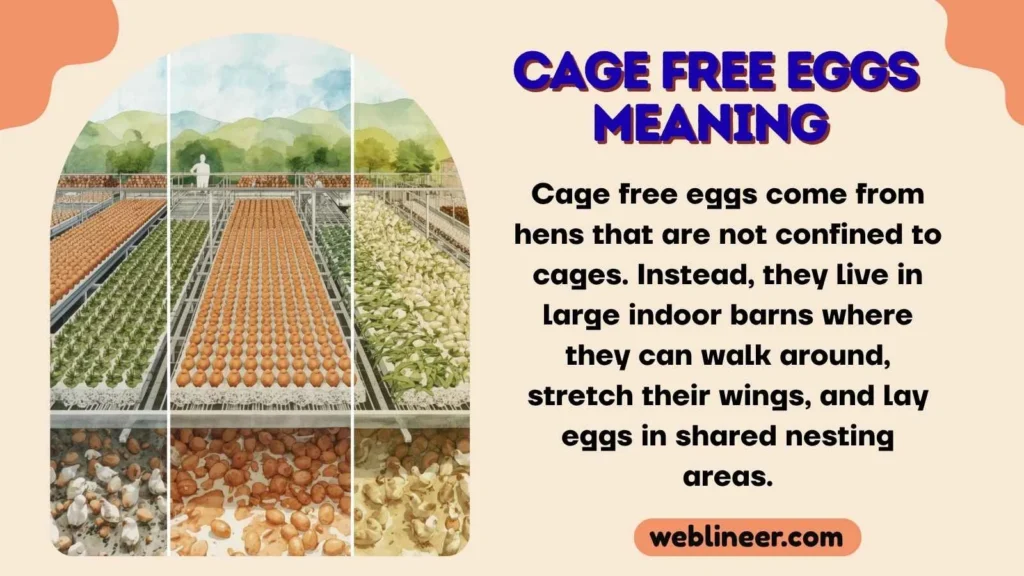
Cage free eggs come from hens that are not confined to cages. Instead, they live in large indoor barns where they can walk around, stretch their wings, and lay eggs in shared nesting areas.
They are still kept indoors in most cases.
Quick Answer
Cage free eggs mean eggs laid by hens that live in open indoor housing without cages, allowing movement and natural behaviors, but not necessarily outdoor access.
Origin of the Term
The term cage-free gained popularity in the early 2000s as consumers became more concerned about animal welfare. Grocery chains and food companies began adopting alternative housing systems to meet demand.
By the 2020s, many countries and major retailers committed to transitioning away from battery cages. As a result, cage-free labeling became one of the most recognized food welfare claims worldwide.
How the Meaning Has Evolved
Originally, cage-free was seen as a major ethical improvement. Today, consumers understand it as:
- Better than caged systems
- Not the highest welfare standard
- One option among many labeling categories
Pronunciation Guide
Cage-free
Pronounced: kayj free
How to Use the Term “Cage Free Eggs” Correctly in Shopping & Conversation
This isn’t slang—but people still misuse it constantly. Knowing when and how to use the term helps avoid confusion.
Correct Context and Tone
The term is commonly used in:
- Grocery shopping
- Nutrition discussions
- Parenting decisions
- Animal welfare conversations
- Cooking and baking
Tone is typically:
- Informational
- Ethical
- Health-conscious
- Consumer-focused
Where You’ll See It
Common places:
- Supermarket egg cartons
- Restaurant menus
- Online grocery stores
- Food packaging labels
- School nutrition guides
When to Use It vs. When NOT To
Use it when:
- Comparing egg types
- Discussing animal welfare
- Explaining food labels
- Making purchasing decisions
Avoid assuming:
- Cage-free means outdoor access
- Cage-free means organic
- Cage-free means healthier
Formatting Tips
The term is usually written as:
- Cage free
- Cage-free
Both are acceptable.
Real Conversation Examples Using “Cage Free Eggs”
Example 1 — Between Friends
Sara: Should I buy these eggs or the cheaper ones?
Lena: Those are cage-free. The hens aren’t kept in cages.
Meaning: Lena is explaining the animal welfare difference.
Example 2 — In a Family Kitchen
Parent: Why are these eggs more expensive?
Teen: They’re cage-free. It’s supposed to be better for the chickens.
Meaning: The label signals ethical farming practices.
Example 3 — At the Grocery Store
Shopper: Are these organic?
Employee: No, they’re cage-free, but not organic.
Meaning: Clarifies that the labels are different categories.
Example 4 — In a Cooking Group Chat
Alex: Does it matter what eggs I use for baking?
Maya: Not really. Cage-free or regular works the same.
Meaning: Nutritional and cooking performance differences are minimal.
Example 5 — Budget Discussion
Roommate: Should we switch to cage-free eggs?
Other roommate: Maybe once they’re on sale.
Meaning: A practical cost-based decision.
Common Mistakes & Misunderstandings
1. Thinking Cage Free Means Outdoor Access
This is the most common misunderstanding.
Reality:
- Most cage-free hens live indoors
- Outdoor access is not required
Outdoor access typically belongs to:
- Free-range systems
- Pasture-raised systems
2. Assuming Cage Free Eggs Are Healthier
Many shoppers believe cage-free eggs have more nutrients.
In truth:
- Protein is the same
- Vitamins are similar
- Taste differences are minimal
The main difference is housing conditions, not nutrition.
3. Confusing Cage Free With Organic
These labels address different things.
Cage-free:
Housing system
Organic:
Feed, medication rules, and farming practices
They can overlap—but they are not the same.
Generational Misunderstandings
Older consumers often assume:
- Cage-free equals farm-raised outdoors
Younger consumers tend to understand:
- Labels are marketing-driven
- Standards vary
Cultural or Regional Differences
In some regions:
- Cage-free is becoming the minimum standard
- Conventional caged systems are declining
In others:
- Cage-free remains a premium option
“Cage Free Eggs” Across Different Consumers & Trends
Gen Z
Gen Z shoppers are:
- Highly label-aware
- Concerned about animal welfare
- Influenced by sustainability messaging
They often choose cage-free as a baseline ethical option.
Millennials
Millennials focus on:
- Family health
- Ingredient quality
- Responsible sourcing
They are the largest buyers of alternative egg products.
Older Generations
Older consumers typically prioritize:
- Price
- Familiar brands
- Availability
However, awareness is steadily increasing.
Social Media & Food Trends
Cage-free eggs frequently appear in:
- Healthy recipe videos
- Grocery hauls
- Meal prep content
- Parenting blogs
The label gained widespread attention after large restaurant chains pledged to switch to cage-free egg sourcing during the 2010s and 2020s.
Is Cage Free Considered Formal or Informal?
It is:
- A regulated food label
- Widely accepted
- Safe for professional use
You can use the term in:
- Schools
- Hospitals
- Government programs
- Restaurants
Related Labels, Terms & Alternatives
| Term | Meaning |
|---|---|
| Free-range | Hens have some outdoor access |
| Pasture-raised | Hens spend significant time outdoors on pasture |
| Organic eggs | Produced with organic feed and strict standards |
| Conventional eggs | Produced in standard caged systems |
| Brown eggs | Color difference only, not welfare-related |
| Omega-3 eggs | Enhanced nutritional content |
| Farm fresh | Marketing term, not regulated |
| Vegetarian-fed | Diet-based labeling |
| Certified humane | Welfare certification program |
| Local eggs | Produced near the selling location |
FAQs
Are cage free eggs cruelty-free?
Not necessarily. Cage-free systems improve movement and behavior compared to cages, but conditions can still vary widely depending on farm management and stocking density.
Do cage free eggs taste better?
Most people cannot reliably distinguish cage-free eggs from conventional eggs in blind taste tests. Flavor differences usually depend on freshness and feed rather than housing style.
Are cage free eggs better for baking?
Functionally, they perform the same as regular eggs in recipes. Structure, moisture, and protein behavior remain consistent across egg types.
Why are cage free eggs more expensive?
Costs are higher because cage-free systems require:
- More space
- More labor
- Different equipment
These factors increase production expenses.
Are cage free eggs becoming mandatory?
Many retailers and restaurants have committed to transitioning to cage-free eggs. While not universal, the trend continues to expand globally.
Conclusion
Understanding the cage free eggs meaning helps you make smarter choices in the grocery aisle. It’s not just a label it’s a signal about how animals are raised and how food is produced.
Cage-free eggs offer improved living conditions compared to traditional cages, but they are not the highest welfare option.
Knowing the difference between cage-free, free-range, and organic labels gives you real buying power.
Next time you pick up a carton, you’ll know exactly what you’re paying for.
Curious about more food label meanings? Keep exploring—and share your favorite grocery discovery with friends.

Hi, I’m Candy Rox, the voice behind Weblineer.com, where words get decoded and meanings finally make sense.
I’ve always been fascinated by how a single word can carry different vibes depending on where and how it’s used. From trending slang to everyday phrases, I break things down in a way that’s simple, clear, and actually useful in real conversations.