Ever heard someone say,
“Voy a parkear el carro”
or
“Te llamo pa’ atrás later”
If you paused for a second—but still understood—it’s because you just encountered Spanglish in action.
The spanglish meaning has become more relevant than ever in today’s global, digital world. From TikTok captions to family group chats, bilingual communication is exploding. Millions of people mix English and Spanish naturally, often without realizing it. And thanks to social media, what started in neighborhoods and households is now part of mainstream culture.
In this guide, you’ll learn:
- The exact definition of Spanglish
- Where it came from
- How people use it in real conversations
- Common mistakes to avoid
- Real examples you’ll instantly recognize
Whether you’re a student, parent, language learner, or just curious about internet slang, this is your complete, no-confusion guide.
Table of Contents
- What Does Spanglish Mean?
- How to Use Spanglish Correctly
- Real Conversation Examples
- Common Mistakes & Misunderstandings
- Spanglish Across Platforms & Demographics
- Related Slang & Alternatives
- FAQs About Spanglish
What Does “Spanglish” Mean?
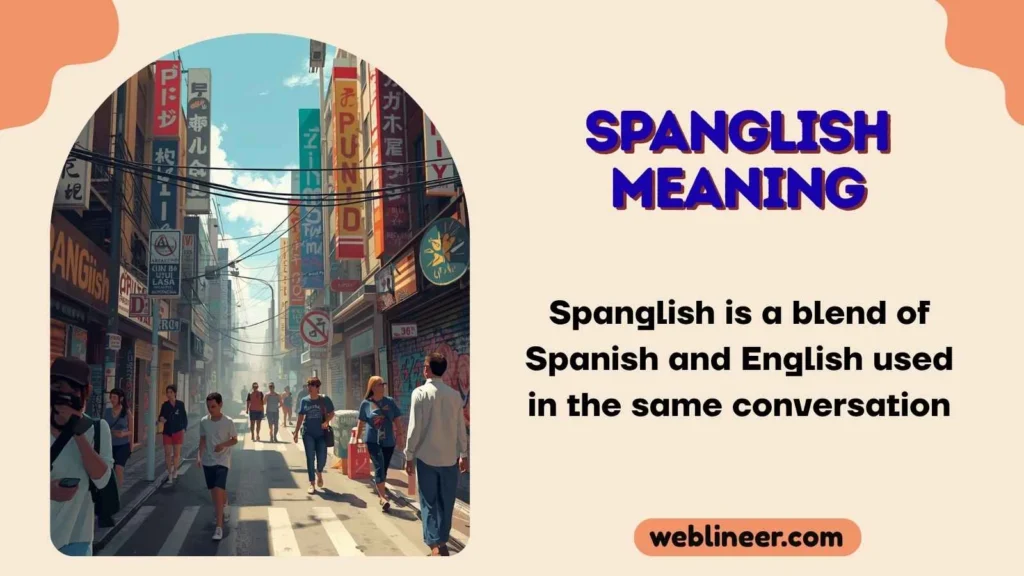
Spanglish is a blend of Spanish and English used in the same conversation, sentence, or phrase. It often involves switching between languages or combining vocabulary and grammar from both.
Quick Answer
Spanglish is an informal way of speaking that mixes English and Spanish words or grammar. It’s commonly used by bilingual speakers to communicate naturally and express cultural identity.
Origin of the Term “Spanglish”
The word Spanglish combines:
- Spanish
- English
It first appeared in the 1940s–1950s, especially in communities where Spanish-speaking immigrants interacted daily with English speakers.
The term gained popularity in:
- U.S. border states
- Puerto Rico
- New York City
- Los Angeles
- Miami
Over time, Spanglish evolved from simple word borrowing into a dynamic communication style used in:
- Music
- Movies
- Social media
- Advertising
- Everyday conversation
Today, it’s considered a cultural identity marker as much as a communication tool.
How the Meaning Has Evolved
Then:
Basic mixing due to language necessity.
Now:
Intentional cultural expression and modern slang.
In 2026, Spanglish is:
- Normal
- Widely understood
- Digitally amplified
- Socially accepted
How to Use “Spanglish” Correctly in Texts & Chat
Spanglish isn’t random. It follows patterns based on comfort, culture, and context.
Tone and Context
Spanglish is typically:
- Casual
- Friendly
- Cultural
- Expressive
- Humorous
Not usually:
- Formal
- Academic
- Professional
Platform-Specific Usage
SMS / WhatsApp
Very common.
Example:
“Estoy busy ahora, te llamo later.”
Instagram / TikTok
Often used for humor and identity.
Example:
“No tengo tiempo para drama today.”
Discord / Gaming
Used among bilingual players.
Example:
“Vamos mid lane, bro.”
Reddit / Online Forums
Used casually in bilingual communities.
Example:
“Eso makes sense.”
When to Use Spanglish
Use it when:
- Talking to bilingual friends
- Messaging family
- Posting on social media
- Expressing cultural identity
- Communicating casually
When NOT to Use Spanglish
Avoid it in:
- Job applications
- Academic papers
- Legal documents
- Professional emails
- Formal presentations
Formatting Tips
Common patterns:
Lowercase:
spanglish sentence
Mixed punctuation:
“Estoy tired 😴”
Emoji pairings:
- 😂
- 🤦♂️
- 😅
- 🙌
These help convey tone quickly.
Real Conversation Examples Using “Spanglish”
Here are realistic scenarios showing how people use Spanglish daily.
Between Friends
Friend 1:
“Vamos al mall later?”
Friend 2:
“Sí, pero necesito comer first.”
Meaning:
Casual planning using mixed vocabulary.
Dating Scenario
Person A:
“Te extraño so much.”
Person B:
“Aww, yo también.”
Meaning:
Expressing affection naturally.
Family Group Chat
Mom:
“Did you eat?”
Son:
“Sí, ya comí lunch.”
Meaning:
Comfortable bilingual communication.
Work Chat
Coworker:
“Can you send el report?”
Employee:
“Sí, te lo mando ahora.”
Meaning:
Informal but functional communication.
Gaming Chat
Player:
“Bro, necesito backup ahora.”
Teammate:
“Voy en camino.”
Meaning:
Fast, efficient communication under pressure.
Common Mistakes & Misunderstandings
Even fluent speakers sometimes misuse Spanglish.
Here are the most common issues.
Mistake 1: Assuming It’s a Formal Language
Reality:
Spanglish is informal.
It’s not used in official documents or academic writing.
Mistake 2: Mixing Grammar Incorrectly
Example mistake:
“I am teniendo hambre.”
Correct:
“Tengo hambre”
or
“I am hungry”
Spanglish still follows natural grammar patterns.
Mistake 3: Thinking It’s “Broken Language”
This is outdated thinking.
Modern linguists consider Spanglish:
- Valid communication
- Cultural expression
- Linguistic creativity
Generational Misunderstandings
Older generations may think:
“It’s incorrect language.”
Younger speakers see it as:
Identity and efficiency.
Cultural Differences
Spanglish usage varies by region.
Examples:
Mexico–U.S. border
Puerto Rico
Miami
New York
Each area develops unique vocabulary.
“Spanglish” Across Different Platforms & Demographics
Spanglish is heavily influenced by technology and culture.
Gen Z Usage
Gen Z uses Spanglish:
- On TikTok
- In memes
- In captions
- In group chats
Common reasons:
- Humor
- Identity
- Speed
Millennials
Millennials use it:
- With family
- In casual workplaces
- In parenting communication
Older Generations
More selective usage.
Often limited to:
- Home conversations
- Community interactions
Frequency by Platform
Most common:
- TikTok
- Discord
- SMS
Is Spanglish Safe for Work?
Depends on the workplace.
Safe in:
Casual teams
Creative industries
Bilingual offices
Not ideal in:
Formal corporate communication
Related Slang, Abbreviations & Alternatives
Here are commonly related terms to understand alongside the spanglish meaning.
| Term | Meaning |
|---|---|
| Code-switching | Switching between languages in conversation |
| Bilingual slang | Informal language mixing two languages |
| Loanword | Word borrowed from another language |
| Hybrid language | Combination of linguistic systems |
| Hinglish | Mix of Hindi and English |
| Taglish | Mix of Tagalog and English |
| Franglais | Mix of French and English |
| Tex-Mex | Cultural and language blend in Texas |
| Latino slang | Informal expressions used in Latino communities |
FAQs
Is spanglish meaning considered a language?
No. Spanglish is not an official language. It’s a communication style where speakers mix English and Spanish naturally.
Why do bilingual people speak Spanglish?
They use it because:
- It’s faster
- It’s familiar
- It reflects culture
- It feels natural
Can someone learn Spanglish intentionally?
Yes, but it usually develops naturally through exposure to both languages and bilingual communities.
Is Spanglish only spoken in the United States?
No. It appears in:
- Puerto Rico
- Mexico border regions
- Latin America
- Online communities worldwide
Is Spanglish harmful to language learning?
No. Research shows bilingual language mixing can actually improve communication skills and cognitive flexibility.
Conclusion
The spanglish meaning goes far beyond mixing two languages. It represents identity, culture, and modern communication in a connected world.
It’s flexible.
It’s creative.
And it’s here to stay.
Whether you hear it in a family kitchen, a gaming lobby, or a viral TikTok video, Spanglish reflects how people really talk today.
Now you know exactly what it means—and how to recognize it.
Got a favorite Spanglish phrase? Drop it in the comments and share it with the world.

Hi, I’m Smith Roy, the writer of Weblineer.com, where I break down words, slang, and meanings into something you can actually understand without overthinking it.
I’ve always been curious about how language works, how a simple word can carry different meanings depending on context, culture, or even a trending moment online. That curiosity turned into Weblineer, a space where I simplify complex terms, decode internet slang, and explain meanings in a way that feels natural, clear, and useful.