You’re scrolling through social media, maybe TikTok or a group chat, and suddenly someone says, “We’re about to have a freak off tonight.”
Wait—what exactly does that mean?
The freak off meaning has become more visible in online conversations, music lyrics, and viral content over the last few years. Depending on the context, it can sound playful, bold, or even a bit risqué.
That’s why understanding the phrase matters—especially if you want to avoid awkward misunderstandings.
Slang moves fast. What sounded shocking a decade ago might feel normal today, and new expressions pop up almost weekly.
This guide breaks down the term in plain English so anyone—teen, parent, professional, or non-native speaker—can understand it confidently.
In this article, you’ll learn:
- The exact definition and origin of the phrase
- How people use it in texts and social media
- Real conversation examples
- Common mistakes to avoid
- Related slang terms you might see next
Let’s dive in.
What Does “Freak Off” Mean?
Definition:
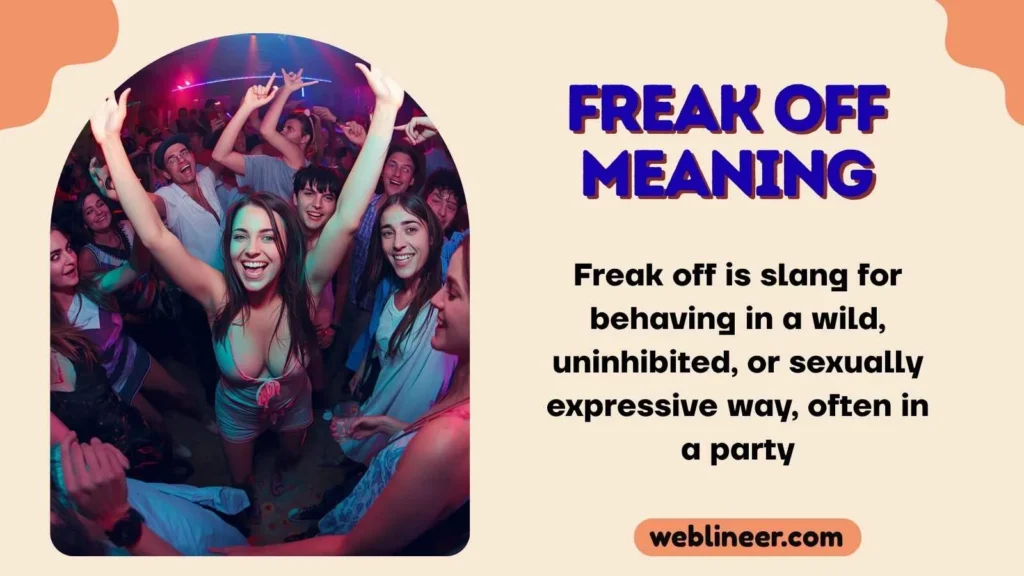
Freak off is slang for behaving in a wild, uninhibited, or sexually expressive way, often in a party, club, or private setting. It can also mean letting loose or acting boldly without holding back.
Origin of the Phrase
The term traces back to hip-hop and club culture in the late 1990s and early 2000s. It appeared in lyrics and nightlife slang where “freak” described someone confident, expressive, or adventurous—especially on the dance floor.
Over time, social media platforms amplified the phrase. TikTok, Instagram, and meme culture helped normalize it, especially among younger audiences who enjoy playful, dramatic language.
How the Meaning Has Evolved
Originally:
- Focused on partying or dancing wildly
Now:
- Can imply sexual energy
- Can simply mean having fun or acting boldly
- Often used humorously or exaggeratively
Pronunciation Guide
freak off
/ freek awf /
Quick Answer
“Freak off” means acting wild, uninhibited, or sexually expressive—often in a party or playful context. The tone depends heavily on the situation and audience.
How to Use “Freak Off” Correctly in Texts & Chat
Understanding context is everything here. The phrase is casual, expressive, and sometimes suggestive.
Tone and Context
Most common tones include:
- Playful
- Bold
- Humorous
- Dramatic
- Slightly provocative
It’s rarely neutral.
Platform-Specific Usage
SMS / WhatsApp
Used jokingly among friends.
Example:
“We’re having a full freak off at the party tonight.”
Instagram / TikTok
Often used in captions or comments describing energetic dancing or partying.
Discord / Gaming Chats
May describe chaotic fun or over-the-top behavior.
Twitter/X
Used humorously or sarcastically.
Example:
“This playlist got me ready for a freak off.”
When to Use It
Use it when:
- Talking with close friends
- Discussing parties or fun events
- Posting casual social media content
- Making jokes or exaggerations
When NOT to Use It
Avoid it in:
- Work emails
- Professional meetings
- Formal writing
- Conversations with people you don’t know well
Formatting Tips
Capitalization:
- Usually lowercase
Punctuation:
- Often used with exclamation marks
Emoji Pairings:
Common choices:
- 🔥
- 💃
- 😜
- 🎉
Example:
“Tonight is going to be a freak off 🔥”
Real Conversation Examples Using “Freak Off”
Between Friends
Alex:
“Did you see the dance floor last night?”
Jordan:
“Yeah, it turned into a full freak off.”
Meaning:
They’re describing wild, energetic dancing.
In a Group Chat
Sam:
“Bring snacks and speakers.”
Taylor:
“Say less. This party is about to be a freak off.”
Meaning:
Excitement about a fun, lively party.
Dating Scenario
Chris:
“So what kind of music do you like?”
Riley:
“Anything that makes me want to freak off on the dance floor.”
Meaning:
Playful confidence and love for dancing.
Family Context (Teen to Sibling)
Teen:
“Mom’s out tonight.”
Sibling:
“So… movie night or freak off?”
Meaning:
Joking about having fun or acting wild.
Gaming Chat
Player 1:
“That boss fight was chaos.”
Player 2:
“Total freak off energy.”
Meaning:
Describing intense, unpredictable action.
Common Mistakes & Misunderstandings
1. Assuming It Always Means Something Sexual
While it can carry sexual undertones, it often just means:
- Wild fun
- Energetic dancing
- Letting loose
Context determines the meaning.
2. Using It in Professional Settings
This is one of the fastest ways to create confusion—or discomfort.
Example mistake:
“We had a freak off brainstorming session.”
That sounds inappropriate in most workplaces.
3. Generational Misunderstandings
Younger users might see it as harmless slang.
Older generations may interpret it as explicit.
This gap can lead to awkward conversations.
Cultural and Regional Differences
In some regions:
- The phrase may sound more provocative
- It may be unfamiliar altogether
If someone looks confused, simply explain:
“It just means having fun or acting wild.”
“Freak Off” Across Different Platforms & Demographics
Gen Z
Most likely to use the phrase casually.
Common contexts:
- TikTok captions
- Party videos
- Dance challenges
Tone:
Playful and expressive.
Millennials
Use it less frequently but still understand it.
Often appears in:
- Social media jokes
- Pop culture references
Tone:
Humorous or nostalgic.
Older Generations
Less likely to use it.
Possible reactions:
- Confusion
- Discomfort
- Curiosity
Is It Safe for Work?
Short answer:
No.
It’s informal slang and sometimes suggestive. Stick to neutral language in professional environments.
Viral Trends That Boosted Popularity
The phrase spread widely through:
- Dance videos
- Party memes
- Music lyrics
- Social media challenges
These trends normalized expressive slang and playful exaggeration.
Related Slang, Abbreviations & Alternatives
| Term | Meaning | Tone |
|---|---|---|
| Turn up | Party energetically | Positive |
| Wild out | Lose control emotionally or socially | Dramatic |
| Go off | Perform impressively or passionately | Excited |
| Get lit | Become excited or energized | Fun |
| Party hard | Celebrate intensely | Casual |
| Let loose | Relax and act freely | Neutral |
| Rage | Party intensely | Youthful |
| Go wild | Act wildly | Playful |
| Dance it out | Release energy through dancing | Positive |
| Cut loose | Stop being restrained | Relaxed |
Synonyms:
- Party
- Celebrate
- Let loose
Antonyms:
- Stay calm
- Keep it low-key
- Behave formally
FAQs
What does freak off mean in texting?
In texting, freak off usually means having wild fun, dancing energetically, or acting boldly. The phrase is informal and often playful. Friends use it to describe excitement about parties, music, or high-energy situations.
Is freak off inappropriate?
It depends on context. Among friends, it’s usually harmless slang. In professional or formal settings, it can sound suggestive and may be considered inappropriate. Use discretion based on your audience.
Does freak off always refer to partying?
No. While it often relates to parties or dancing, it can also describe any situation where people act wild, energetic, or uninhibited. Sometimes it’s used purely for humor.
Who commonly uses the phrase freak off?
The phrase is most common among teenagers and young adults, especially those active on social media platforms like TikTok, Instagram, and Discord. However, anyone familiar with modern slang may use it casually.
Is freak off a new slang term?
Not entirely. The phrase has existed for decades in music and nightlife culture, but its popularity has increased recently due to viral content and online trends.
Conclusion
Language never stands still. Slang evolves, spreads, and sometimes surprises us. The freak off meaning is a perfect example of how a phrase can shift from nightlife slang to everyday online conversation.
At its core, the term simply describes wild, energetic, or uninhibited behavior—often in a fun, playful way. But context matters. The same phrase can feel harmless among friends and awkward in a formal setting.
Now that you understand the meaning, usage, and tone, you can recognize the phrase instantly and use it confidently when the situation fits.
Got another slang term you’re curious about? Drop it in the comments and let’s decode it next.

Hi, I’m Smith Roy, the writer of Weblineer.com, where I break down words, slang, and meanings into something you can actually understand without overthinking it.
I’ve always been curious about how language works, how a simple word can carry different meanings depending on context, culture, or even a trending moment online. That curiosity turned into Weblineer, a space where I simplify complex terms, decode internet slang, and explain meanings in a way that feels natural, clear, and useful.