You’ve probably seen the word spurious in a news article, research paper, or heated online debate — and paused for a second.
Wait… does that mean fake? Wrong? Suspicious?
You’re not alone.
Understanding the spurious meaning matters more than ever in 2026, when misinformation spreads fast and bold claims show up everywhere from social media posts to marketing emails.
Knowing this one word can help you spot unreliable information, sound more confident in conversations, and avoid embarrassing misunderstandings.
In this guide, you’ll learn:
- The exact definition of spurious in simple language
- Where the word came from and how it’s used today
- Real conversation examples you can copy
- Common mistakes people make (and how to avoid them)
- Related words and modern usage across platforms
Let’s make this word crystal clear once and for all.
What Does “Spurious” Mean?
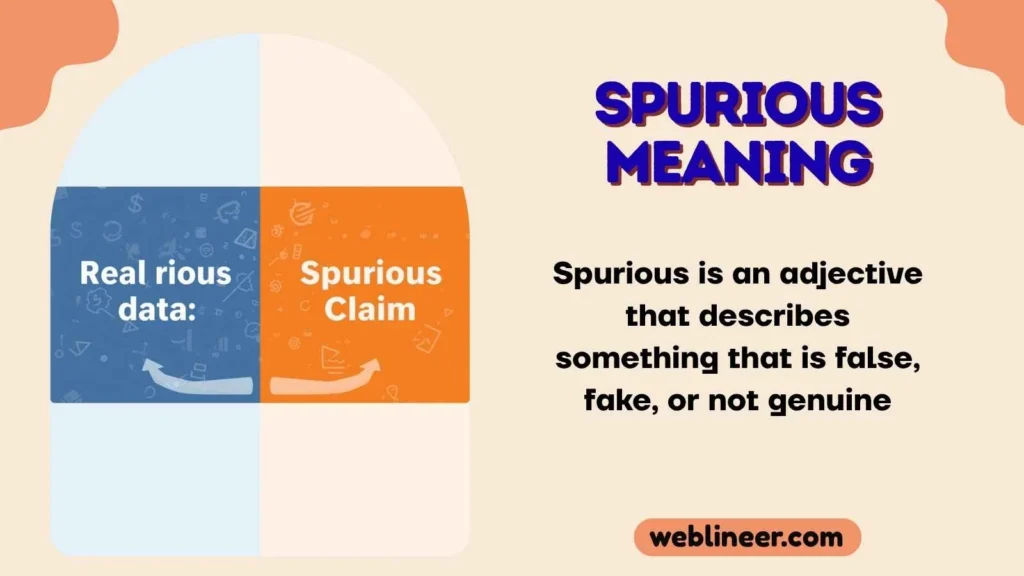
Spurious is an adjective that describes something that is false, fake, or not genuine, even though it may look real or believable.
Quick Answer
Spurious means false or fake — something that appears real but is actually misleading, incorrect, or not authentic.
Simple Definition
Spurious = False but convincing
Think of it as:
- Something that looks legitimate
- But isn’t trustworthy
- Or lacks real proof
Origin of the Word
The word spurious comes from Latin:
“spurius” — meaning illegitimate or false
It entered the English language in the 17th century, originally used to describe children born outside marriage. Over time, the meaning expanded to include anything considered false, unreliable, or misleading.
Today, it’s widely used in:
- News reporting
- Academic writing
- Science and statistics
- Online debates
- Professional communication
Pronunciation Guide
Spurious is pronounced:
SPYOOR-ee-uhs
/ˈspjʊəriəs/
Break it down:
SPY + your + us
How to Use “Spurious” Correctly in Texts & Chat
The word spurious is slightly formal, but it’s still common in modern communication — especially when discussing facts, claims, or data.
Correct Context and Tone
Use spurious when something:
- Seems true but isn’t
- Is based on weak evidence
- Is misleading or unreliable
- Raises suspicion
Tone is usually:
- Serious
- Analytical
- Critical
- Professional
Platform-Specific Usage
SMS / WhatsApp
- “That message about free money looks spurious.”
Instagram / TikTok comments
- “These stats feel spurious.”
Twitter / X
- “The report makes spurious claims without evidence.”
Discord / Reddit
- “That argument is based on spurious assumptions.”
When NOT to Use It
Avoid using spurious in:
- Very casual chats with kids
- Emotional conversations
- Situations where simple words like “fake” work better
For example:
Instead of:
“Your excuse is spurious.”
Say:
“That excuse sounds fake.”
Formatting Tips
- Use lowercase in normal sentences
- No special punctuation needed
- Usually appears before a noun
Examples:
- spurious claim
- spurious data
- spurious results
- spurious rumor
Real Conversation Examples Using “Spurious”
Here are realistic scenarios showing how people actually use the word.
Between Friends
Alex: Did you see that post about earning $5,000 in one day?
Jordan: Yeah, it looked pretty spurious.
Meaning:
Jordan suspects the claim is fake or misleading.
In a Group Chat
Sam: This website says drinking lemon water cures everything.
Nina: That sounds like a spurious health claim.
Meaning:
Nina believes the claim is unreliable or unsupported.
At Work
Manager: We need to verify these numbers. Some of them look spurious.
Meaning:
The manager thinks the data may be incorrect or fabricated.
In Academic Discussion
Student: The study shows a strong link between ice cream sales and crime.
Professor: That could be a spurious correlation.
Meaning:
The relationship may be misleading or caused by another factor.
In Online Gaming
Player 1: This mod promises unlimited rewards.
Player 2: Sounds spurious — probably a scam.
Meaning:
Player 2 doubts the authenticity of the offer.
Common Mistakes & Misunderstandings
Even educated speakers sometimes misuse spurious. Here are the most frequent errors.
1. Using It to Mean “Random”
Incorrect:
“That was a spurious idea.”
Correct:
“That was a random idea.”
Why:
Spurious means false — not unexpected.
2. Confusing It With “Serious”
These words sound similar but have opposite meanings.
Serious: Important or sincere
Spurious: False or fake
Example:
Incorrect:
“He made a spurious mistake.”
Correct:
“He made a serious mistake.”
3. Using It Without Evidence
Calling something spurious implies doubt or criticism.
So use it carefully — especially in professional settings.
Generational Differences
Older adults may encounter spurious more often in:
- Newspapers
- Legal documents
- Academic writing
Younger generations typically see it in:
- Online fact-checking
- Social media debates
- News commentary
Cultural Differences
In global English usage:
United States / UK:
Common in journalism and research
International English learners:
Often learned in academic or exam settings
“Spurious” Across Different Platforms & Demographics
Let’s look at how the word shows up in real digital communication.
Gen Z
Uses it mostly in:
- School assignments
- Debate discussions
- Fact-checking posts
Example:
“This statistic feels spurious.”
Millennials
Common in:
- Work emails
- Professional conversations
- News discussions
Example:
“We should review these spurious numbers.”
Older Generations
Often used in:
- Formal writing
- Legal or policy discussions
- Academic communication
Is It Formal or Informal?
Moderately formal
Safe for:
- Work
- School
- Professional communication
Less common in:
- Casual texting
- Humor
- Everyday slang
Trending Usage in 2026
The word spurious appears frequently in conversations about:
- Fake news
- AI-generated content
- Online scams
- Misleading statistics
- Health misinformation
In short:
The more information people consume, the more useful this word becomes.
Related Words, Synonyms & Alternatives
Here are useful alternatives to spurious and how they differ.
| Word | Meaning | Tone |
|---|---|---|
| Fake | Not real | Casual |
| False | Incorrect | Neutral |
| Fraudulent | Intentionally deceptive | Formal |
| Bogus | Fake or nonsense | Informal |
| Misleading | Gives wrong impression | Neutral |
| Dubious | Suspicious | Slightly formal |
| Fabricated | Invented or made up | Formal |
| Counterfeit | Fake copy | Legal/business |
| Unfounded | Without evidence | Academic |
| Invalid | Not correct or acceptable | Professional |
FAQs
What does spurious mean in simple words?
Spurious means fake or false, especially when something looks real at first. It describes information, claims, or results that appear believable but are actually misleading or unsupported.
What is a spurious example?
A classic example is a website claiming a miracle cure without scientific proof. The claim looks convincing but lacks evidence, making it spurious.
What is a spurious relationship?
A spurious relationship happens when two things seem connected but aren’t truly related. Usually, another hidden factor explains the connection.
Example:
Ice cream sales and crime both rise in summer — not because one causes the other, but because of warm weather.
Is spurious a formal word?
Yes, spurious is considered moderately formal. It’s commonly used in professional, academic, and journalistic writing, but less often in casual conversation.
What is the opposite of spurious?
The opposite of spurious includes:
- Genuine
- Authentic
- Legitimate
- Valid
- Reliable
These words describe something that is real and trustworthy.
Conclusion
The spurious meaning is simple once you see it in action:
something that looks real but isn’t trustworthy.
It’s a powerful word for spotting misinformation, questioning suspicious claims, and communicating clearly in professional settings. In a world full of bold promises and viral headlines, knowing this term gives you an edge.
Use it when evidence feels shaky.
Avoid it when you just mean random.
And remember — clarity builds credibility.
Want to keep leveling up your vocabulary?
Explore more language guides and share your favorite tricky word in the comments.

Hi, I’m Smith Roy, the writer of Weblineer.com, where I break down words, slang, and meanings into something you can actually understand without overthinking it.
I’ve always been curious about how language works, how a simple word can carry different meanings depending on context, culture, or even a trending moment online. That curiosity turned into Weblineer, a space where I simplify complex terms, decode internet slang, and explain meanings in a way that feels natural, clear, and useful.