You’re scrolling through a medical report, hospital discharge summary, or Google search results—and suddenly you see the term “CIDP.”
It looks technical. Maybe even scary. You might wonder: What exactly does this mean? Is it serious? Can it be treated?
Understanding the cidp meaning medical isn’t just about decoding a complicated acronym. It’s about gaining clarity, reducing anxiety, and knowing what steps come next.
Whether you’re a patient, caregiver, student, or simply curious, learning about CIDP can help you make informed decisions and ask the right questions.
Here’s the good news: CIDP is treatable, and many people live full, active lives with proper care.
In this comprehensive guide, you’ll learn:
- The exact medical definition of CIDP
- Common symptoms and early warning signs
- Causes and risk factors
- Diagnosis and treatment options
- Long-term outlook and daily life tips
Let’s break it down in plain, human language.
What Does “CIDP” Mean in Medical Terms?
CIDP stands for:
Chronic Inflammatory Demyelinating Polyneuropathy
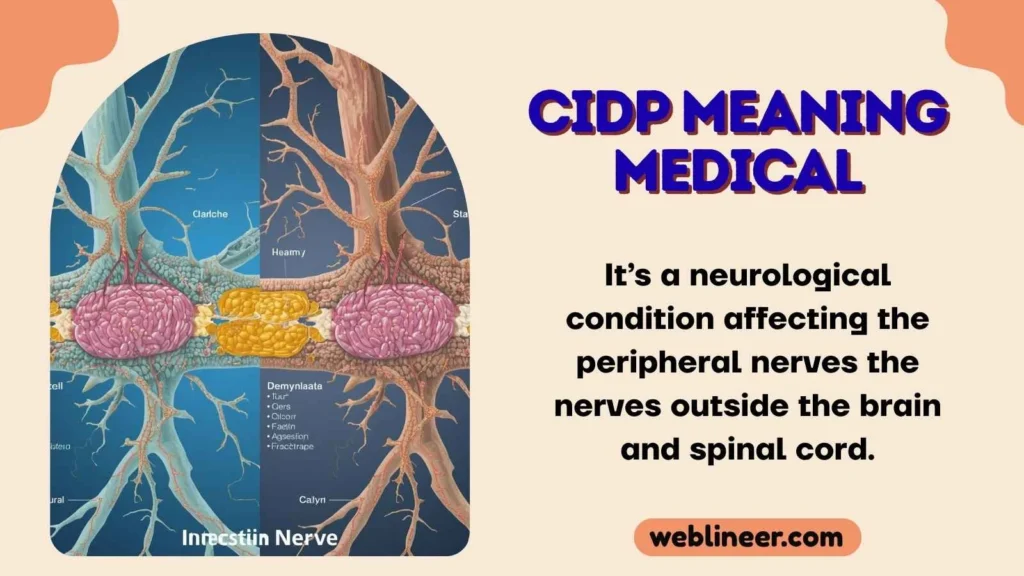
It’s a neurological condition affecting the peripheral nerves—the nerves outside the brain and spinal cord.
Quick Answer
CIDP is an autoimmune disorder where the immune system attacks the protective coating of nerves (myelin), leading to muscle weakness, numbness, and coordination problems.
Simple Definition
CIDP is a rare autoimmune nerve disease that causes progressive weakness and sensory problems because the body mistakenly damages nerve insulation.
Breaking Down the Name
- Chronic — Long-term condition
- Inflammatory — Involves immune system inflammation
- Demyelinating — Damages the nerve coating (myelin)
- Polyneuropathy — Affects multiple nerves
When Was CIDP First Identified?
CIDP was formally described in the 1970s as a chronic version of another nerve disorder called Guillain-Barré syndrome. Since then, medical understanding and treatments have improved dramatically.
Pronunciation Guide
CIDP:
“sid-pee”
Doctors and patients commonly say the letters individually.
What Causes CIDP?
The exact cause of CIDP isn’t fully understood. But researchers agree on one key factor:
It’s an autoimmune disorder.
That means the immune system mistakenly attacks healthy nerve tissue.
Possible Triggers
Common suspected triggers include:
- Viral infections
- Bacterial infections
- Immune system dysfunction
- Genetic susceptibility
- Other autoimmune diseases
Risk Factors
You may have a slightly higher risk if you:
- Are between 40 and 60 years old
- Have diabetes or another autoimmune condition
- Are male (slightly higher incidence)
But here’s the important part:
CIDP can affect anyone—even children.
Symptoms of CIDP: Early Warning Signs
Symptoms usually develop gradually over weeks or months.
That slow progression is one of the key differences between CIDP and sudden nerve conditions.
Most Common Symptoms
- Muscle weakness
- Numbness or tingling
- Difficulty walking
- Loss of balance
- Fatigue
- Reduced reflexes
Early Symptoms Many People Notice
- Trouble climbing stairs
- Dropping objects
- Weak grip strength
- Tingling in hands or feet
- Feeling unusually tired
Advanced Symptoms
If untreated, symptoms may progress to:
- Severe weakness
- Mobility problems
- Muscle wasting
- Chronic pain
- Difficulty performing daily tasks
Important Timeline Clue
Doctors often suspect CIDP when symptoms:
- Last more than 8 weeks
- Gradually worsen
- Affect both sides of the body
How Doctors Diagnose CIDP
Diagnosing CIDP can take time because symptoms resemble other nerve disorders.
Doctors use multiple tests to confirm the diagnosis.
Common Diagnostic Tests
1. Nerve Conduction Study (NCS)
Measures how fast electrical signals travel through nerves.
2. Electromyography (EMG)
Evaluates muscle and nerve function.
3. Spinal Fluid Test (Lumbar Puncture)
Checks protein levels in cerebrospinal fluid.
4. MRI Scan
Looks for nerve inflammation.
5. Blood Tests
Rules out other conditions.
Why Diagnosis Can Be Delayed
CIDP is:
- Rare
- Often misdiagnosed
- Similar to other nerve disorders
Early diagnosis significantly improves treatment success.
CIDP Treatment Options Explained
Here’s the encouraging part:
CIDP is treatable.
Most patients respond well to therapy.
Primary Treatment Methods
1. Corticosteroids
These medications reduce inflammation in nerves.
Examples:
- Prednisone
- Methylprednisolone
They’re often the first line of treatment.
2. Intravenous Immunoglobulin (IVIG)
This therapy uses healthy antibodies to regulate the immune system.
It’s one of the most effective treatments for CIDP.
Benefits:
- Fast symptom relief
- Improved strength
- Reduced nerve damage
3. Plasma Exchange (Plasmapheresis)
This procedure removes harmful antibodies from the blood.
Doctors typically use it when:
- Symptoms are severe
- Other treatments don’t work
4. Immunosuppressant Medications
These drugs reduce immune system activity.
Examples include:
- Azathioprine
- Rituximab
- Cyclophosphamide
Physical Therapy
Physical therapy is essential for:
- Strength recovery
- Balance improvement
- Mobility support
Many patients regain independence with consistent therapy.
Is CIDP Curable or Life-Threatening?
This is one of the most common questions—and understandably so.
Is CIDP Curable?
There is currently:
No permanent cure
But there is excellent news:
CIDP is highly manageable.
Many people achieve:
- Symptom control
- Long-term remission
- Normal or near-normal life
Is CIDP Life-Threatening?
Usually:
No
CIDP rarely affects life expectancy when treated properly.
However, untreated CIDP can lead to:
- Severe disability
- Mobility loss
- Long-term nerve damage
That’s why early treatment matters.
Living With CIDP: Daily Life & Recovery
Life with CIDP can feel overwhelming at first. But many people adapt successfully.
Daily Management Tips
1. Follow your treatment plan
Consistency is critical.
2. Stay physically active
Gentle exercise helps maintain strength.
3. Prioritize rest
Fatigue is common with CIDP.
4. Use mobility aids if needed
Examples:
- Cane
- Walker
- Orthopedic braces
These tools improve safety and independence.
Recovery Outlook
Many patients experience:
- Significant improvement within months
- Periods of remission
- Stable long-term health
Some require ongoing treatment, but quality of life can remain high.
CIDP vs Other Neurological Conditions
CIDP is often confused with similar disorders.
Here’s a quick comparison.
| Condition | Key Difference |
|---|---|
| Guillain-Barré Syndrome | Sudden onset, short-term |
| Multiple Sclerosis | Affects brain and spinal cord |
| Peripheral Neuropathy | Often caused by diabetes |
| ALS | Progressive motor neuron disease |
Understanding these differences helps doctors make accurate diagnoses.
Related Medical Terms & Conditions
Here are closely related neurological and medical terms:
- Peripheral neuropathy — Nerve damage outside the brain
- Autoimmune disease — Immune system attacks healthy tissue
- Demyelination — Loss of nerve insulation
- Neuropathy — General nerve disorder
- Guillain-Barré syndrome — Acute nerve inflammation
- Multiple sclerosis — Central nervous system disease
- Nerve conduction study — Diagnostic nerve test
- Immunotherapy — Treatment that modifies immune response
- Remission — Period with reduced symptoms
FAQs
What does CIDP stand for in medical terms?
CIDP stands for Chronic Inflammatory Demyelinating Polyneuropathy. It is a neurological disorder where the immune system attacks the protective covering of peripheral nerves, causing weakness, numbness, and coordination problems.
What are the first symptoms of CIDP?
Early symptoms usually include gradual muscle weakness, tingling in hands or feet, balance problems, and fatigue. Many people first notice difficulty climbing stairs, gripping objects, or walking steadily.
Is CIDP a serious disease?
CIDP can be serious if left untreated because it may lead to long-term nerve damage and disability. However, with early diagnosis and proper treatment, most people manage symptoms effectively and maintain a good quality of life.
Can CIDP be cured?
Currently, there is no permanent cure for CIDP. But treatments such as IVIG, steroids, and plasma exchange can control symptoms, reduce nerve damage, and help many patients achieve remission.
How long can someone live with CIDP?
Most people with CIDP have a normal life expectancy, especially when the condition is diagnosed early and treated consistently. Many patients live for decades with stable symptoms or periods of remission.
Conclusion
Understanding the cidp meaning medical turns a confusing medical term into something manageable and less intimidating.
CIDP is a rare neurological condition but it’s also a treatable one. With early diagnosis, proper therapy, and consistent care, many people live active, fulfilling lives.
If you or someone you love has been diagnosed with CIDP, knowledge is your strongest tool. Ask questions. Stay informed. Follow your treatment plan.
And if you found this guide helpful, consider sharing it with someone who might need clarity today.

Hi, I’m Smith Roy, the writer of Weblineer.com, where I break down words, slang, and meanings into something you can actually understand without overthinking it.
I’ve always been curious about how language works, how a simple word can carry different meanings depending on context, culture, or even a trending moment online. That curiosity turned into Weblineer, a space where I simplify complex terms, decode internet slang, and explain meanings in a way that feels natural, clear, and useful.