Ever come across the word “Brahmin” in a book, conversation, or social media debate and wondered what it really means? You’re not alone.
The term carries deep historical, cultural, and social weight and depending on context, it can mean slightly different things.
Understanding the brahmin meaning matters more than ever in today’s global conversations about identity, history, and culture.
It’s not just a word it’s tied to centuries of tradition, belief systems, and evolving social norms.
In this guide (Updated for 2026), you’ll learn:
- The exact definition of Brahmin
- Its origin and historical roots
- How it’s used in modern conversations
- Common misconceptions to avoid
Let’s break it down in a clear, respectful, and easy-to-understand way.
What Does “Brahmin” Mean?
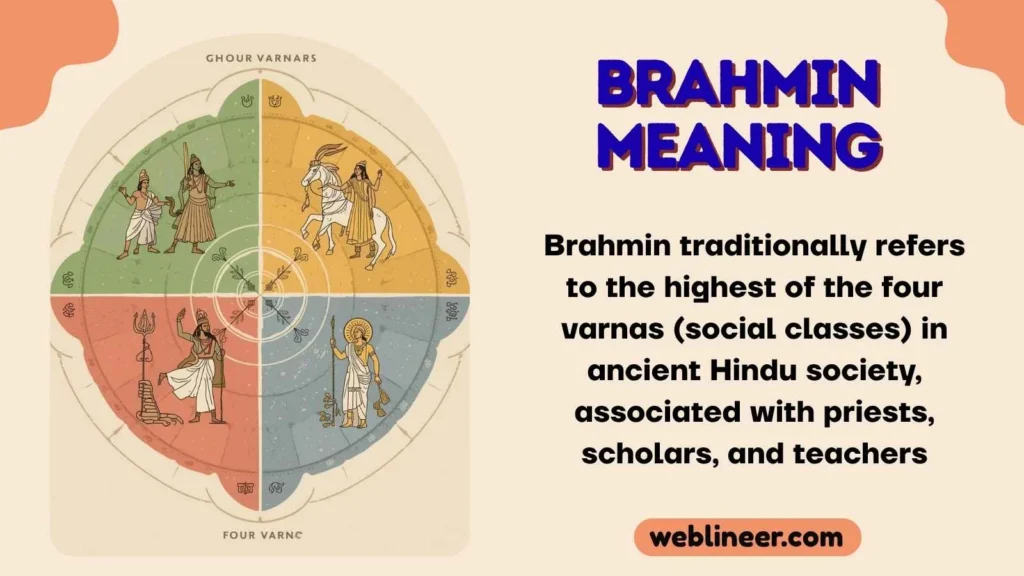
Brahmin traditionally refers to the highest of the four varnas (social classes) in ancient Hindu society, associated with priests, scholars, and teachers.
Quick Answer:
A Brahmin is traditionally a member of the priestly and scholarly class in Hindu society, responsible for rituals, teaching, and preserving sacred knowledge.
Origin & Etymology
- Derived from the Sanskrit word “Brahmana”
- Linked to “Brahman”, meaning ultimate reality or universal truth in Hindu philosophy
- First mentioned in ancient texts like the Vedas (over 3,000 years ago)
Evolution of Meaning
- Ancient Times: Spiritual leaders and educators
- Medieval Period: Institutionalized as part of the caste system
- Modern Era: A mix of cultural identity, surname, and sometimes debated social label
Pronunciation
Brah-min (BRAH-min)
How to Use “Brahmin” Correctly in Texts & Chat
Unlike slang or abbreviations, Brahmin is a culturally sensitive and formal term. It’s important to use it thoughtfully.
Appropriate Contexts
- Academic discussions
- Cultural or historical explanations
- Identity-related conversations
Tone & Usage
- Neutral and respectful
- Avoid casual or joking usage
- Not suitable for memes or sarcasm
Platform-Specific Use
- WhatsApp: “He comes from a Brahmin family.”
- Twitter/X: Used in debates about caste, history, or social issues
- Reddit: Often appears in discussions about religion or anthropology
- Instagram: Rare, unless educational content
When NOT to Use It
- In jokes or insults
- Without understanding context
- In professional settings unless relevant
Real Conversation Examples Using “Brahmin”
1. Between Friends (Educational Context)
A: “What does Brahmin mean?”
B: “It’s traditionally the priestly class in Hindu society.”
👉 Conveys explanation and curiosity.
2. In a Classroom Discussion
Teacher: “Brahmins were responsible for preserving religious texts.”
👉 Shows formal, academic usage.
3. Cultural Conversation
A: “Is Brahmin a caste?”
B: “Yes, it’s part of the traditional varna system.”
👉 Clarifies social structure.
4. Online Discussion (Social Context)
User1: “Caste issues still affect Brahmin and non-Brahmin communities.”
User2: “True, it’s a complex topic.”
👉 Highlights modern relevance.
5. Family Conversation
Parent: “Our ancestors were Brahmins.”
Child: “What does that mean today?”
👉 Shows generational curiosity.
Common Mistakes & Misunderstandings
1. Thinking Brahmin = Religion
It’s not a religion. It’s a social classification within Hinduism.
2. Assuming All Brahmins Are Priests Today
Historically yes—but today, Brahmins work in all professions.
3. Using It Casually or as a Joke
This can come across as insensitive due to its cultural weight.
Generational Differences
- Older generations: Strong identity marker
- Younger generations: More nuanced or sometimes rejected
Cultural Differences
- In India: deeply understood
- Outside: often misunderstood or oversimplified
“Brahmin” Across Different Platforms & Demographics
Gen Z vs Millennials
- Gen Z: More critical discussions around caste
- Millennials: Balanced between tradition and modern views
Online Presence
- TikTok: Rare, mostly educational videos
- Instagram: Used in infographics
- Discord/Reddit: Deep debates and discussions
Formality Level
- Highly formal and cultural
- Not slang or casual language
- Not “safe for humor” in most contexts
Modern Relevance
The term still appears in:
- Academic research
- Social justice conversations
- Cultural identity discussions
Related Slang, Abbreviations & Alternatives
While Brahmin isn’t slang, here are related cultural or social terms:
| Term | Meaning |
|---|---|
| Varna | Social class system in Hinduism |
| Caste | Social hierarchy system |
| Kshatriya | Warrior class |
| Vaishya | Merchant class |
| Shudra | Laborer class |
| Dalit | Historically marginalized group |
| mentor | Spiritual teacher |
| Pandit | Scholar or priest |
| Dharma | Duty or moral order |
| Karma | Action and consequence |
FAQs
What does Brahmin mean in simple terms?
A Brahmin is traditionally a member of the highest class in Hindu society, associated with priests and scholars. The role focused on teaching, rituals, and preserving knowledge.
Is Brahmin a caste or a religion?
Brahmin is a caste (varna), not a religion. It exists within Hinduism’s traditional social structure.
What is the role of Brahmins in Hinduism?
Historically, Brahmins performed religious rituals, taught sacred texts, and guided spiritual practices.
Can someone become a Brahmin today?
Traditionally, it’s hereditary. Modern views vary, and some argue identity should not be birth-based.
Is the term Brahmin still relevant in modern society?
Yes, but its meaning is evolving. It’s now discussed in cultural, historical, and social contexts rather than just religious roles.
Conclusion
The brahmin meaning goes far beyond a simple definition. It’s rooted in thousands of years of history, tied to knowledge, spirituality, and social structure.
Today, the term sits at the intersection of tradition and modern debate. Some see it as cultural identity, others as part of a system that needs rethinking.
What’s clear? Context matters. Respect matters even more.
If you found this guide helpful, explore more cultural terms and deepen your understanding of how language shapes the world.
👉 Got questions or another term you want explained? Drop it below!

Hi, I’m Smith Roy, the writer of Weblineer.com, where I break down words, slang, and meanings into something you can actually understand without overthinking it.
I’ve always been curious about how language works, how a simple word can carry different meanings depending on context, culture, or even a trending moment online. That curiosity turned into Weblineer, a space where I simplify complex terms, decode internet slang, and explain meanings in a way that feels natural, clear, and useful.