You’ve probably heard the word kingpin in crime shows, news headlines, or even casual conversations.
Someone might say, “He’s the kingpin behind the whole operation.” But what exactly does that mean—and can it apply outside of crime?
Understanding the kingpin meaning matters more than ever in today’s digital world. The term shows up in business articles, social media discussions, gaming communities, and everyday conversations.
Sometimes it describes a powerful leader. Other times, it refers to the one person everything depends on.
In this guide, you’ll learn the real definition of kingpin, where the term came from, how people use it in modern language, and how to avoid common misunderstandings.
Whether you’re a student, professional, content creator, or English learner, this article breaks it down in plain, practical language.
What Does “Kingpin” Mean?
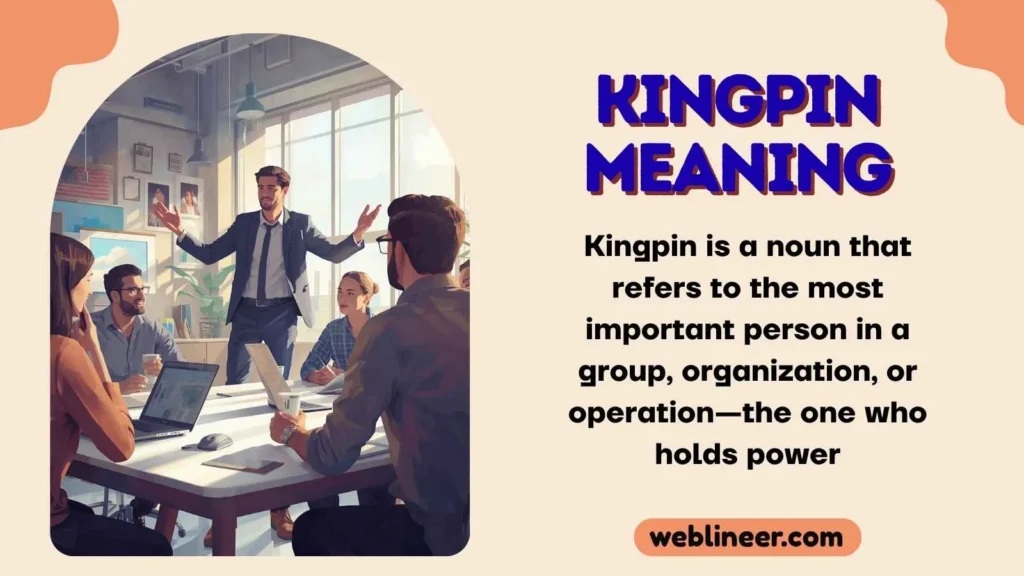
Kingpin is a noun that refers to the most important person in a group, organization, or operation—the one who holds power, influence, or control.
Quick Answer
Kingpin meaning: the central leader or most powerful figure in a group, often responsible for major decisions or operations.
Origin of the Word
The word kingpin originally had nothing to do with crime or leadership.
It started in:
- Bowling — The kingpin is the front pin that stands in the center.
- Machinery and wagons — The kingpin is the main bolt that holds parts together.
Over time, people began using the term metaphorically. By the early 1900s, it described:
- Crime bosses
- Powerful leaders
- Key decision-makers
Today, the meaning has expanded to include both negative and positive contexts.
Pronunciation Guide
KING-pin
/ˈkɪŋ.pɪn/
Simple. Two syllables. Stress on the first word.
How to Use “Kingpin” Correctly in Texts & Chat
The word kingpin is flexible. You can use it in casual conversations, storytelling, journalism, or professional discussions.
Tone and Context
Common tones:
- Serious
- Dramatic
- Respectful
- Slightly humorous
Platform-Specific Usage
SMS / WhatsApp
Used to describe someone in charge.
Example:
“He’s the kingpin of the whole project.”
Instagram / TikTok
Often used playfully or dramatically.
Example:
“Mom is the kingpin of family planning.”
Discord / Gaming
Refers to the main strategist or leader.
Example:
“Jake is the kingpin of our raid team.”
Workplace Chat
Acceptable in semi-formal settings.
Example:
“Sarah is the kingpin behind the marketing strategy.”
When NOT to Use It
Avoid using kingpin when:
- Speaking in highly formal legal documents
- Addressing sensitive situations
- Describing minor roles
- Writing academic research papers
Formatting Tips
- Usually lowercase: kingpin
- No abbreviation
- No emoji required
- Can be paired with dramatic emojis:
Examples:
🧠
👑
🎯
Real Conversation Examples Using “Kingpin”
Here are realistic scenarios showing how the word works in everyday communication.
Between Friends
Ali: Who organized this whole trip?
Sara: Ahmed is the kingpin behind it.
Meaning: Ahmed planned everything and made decisions.
In a Workplace Chat
Manager: Who handled the client negotiations?
Team Member: Fatima was the kingpin on that deal.
Meaning: She played the key leadership role.
In a Family Setting
Dad: Who keeps this house running smoothly?
Mom: Grandma is the kingpin here.
Meaning: She manages the household.
In Gaming
Player 1: How did we win that match?
Player 2: Leo was the kingpin of our strategy.
Meaning: He led the team to success.
In News or Crime Discussion
Reporter: Police arrested the kingpin of the smuggling network.
Meaning: The main criminal leader was captured.
Common Mistakes & Misunderstandings
Even native speakers sometimes misuse this word.
Here are the most common issues.
1. Assuming It Always Means Criminal
Not true.
Kingpin can describe:
- Business leaders
- Sports captains
- Project managers
- Influencers
2. Using It for Minor Roles
Incorrect:
“He’s the kingpin of bringing snacks.”
Correct:
“He’s the kingpin of the operations team.”
The word implies importance.
3. Confusing It with “King”
A king is a ruler.
A kingpin is simply the most important person in a specific situation.
Generational Differences
Older generations may associate the term with crime.
Younger people often use it casually or humorously.
Cultural Differences
In global English:
- In Western media — often crime-related
- In business — leadership-focused
- In casual speech — playful or exaggerated
“Kingpin” Across Different Platforms & Demographics
Language changes depending on audience and platform.
Here’s how usage varies.
Gen Z
Uses the word casually and dramatically.
Examples:
- “She’s the kingpin of group chats.”
- “He’s the kingpin of memes.”
Millennials
Often use it in work or leadership contexts.
Examples:
- Project leader
- Business strategist
- Team organizer
Older Generations
More likely to use it in:
- News
- Crime stories
- Formal discussions
Social Media Trends
TikTok
Used in storytelling and humor.
Instagram
Used in captions about leadership or influence.
Discord
Used in gaming communities.
Reddit
Used in discussions about business, crime, and strategy.
Is It Formal or Informal?
Answer:
Semi-formal
Safe for:
- Work conversations
- News writing
- Blogs
- Presentations
Not ideal for:
- Legal contracts
- Academic papers
Related Slang, Abbreviations & Alternatives
Here are common words similar to kingpin meaning.
| Term | Meaning | Tone |
|---|---|---|
| Boss | Person in charge | Neutral |
| Mastermind | Strategic planner | Dramatic |
| Ringleader | Group organizer | Slightly negative |
| Chief | Leader | Professional |
| Big Shot | Important person | Informal |
| Head Honcho | Top leader | Casual |
| Shot Caller | Decision-maker | Slang |
| Leader | Person guiding others | Neutral |
| Key Player | Essential member | Professional |
| Power Broker | Influential figure | Formal |
FAQs
What does kingpin meaning in business?
In business, a kingpin is the most influential person responsible for decisions, strategy, or operations. This could be a CEO, founder, or project leader who drives success.
Is kingpin a positive or negative word?
It depends on context. In crime, it has a negative meaning. In business or leadership, it can be positive and show respect for someone’s importance.
Can women be called kingpins?
Yes. The term is gender-neutral and can describe anyone in a leadership role, regardless of gender.
Is kingpin slang or formal English?
It is standard English but slightly informal. It appears in news, media, and conversations more than academic writing.
What is the difference between kingpin and leader?
A leader guides people. A kingpin is the central figure everything depends on. The word emphasizes importance and control.
Conclusion
The kingpin meaning is simple but powerful. It describes the person who holds everything together—the leader, organizer, or mastermind behind the scenes.
You’ll see this word everywhere: news stories, workplace conversations, gaming chats, and social media posts.
Sometimes it refers to crime bosses. Other times, it highlights respected leaders or key decision-makers.
Knowing how to use kingpin correctly helps you communicate more clearly and sound more confident in modern English.
Now your turn:
What’s the most interesting slang word you’ve heard recently? Drop it into your notes, messages, or next conversation—and keep building your language skills.

Hi, I’m Smith Roy, the writer of Weblineer.com, where I break down words, slang, and meanings into something you can actually understand without overthinking it.
I’ve always been curious about how language works, how a simple word can carry different meanings depending on context, culture, or even a trending moment online. That curiosity turned into Weblineer, a space where I simplify complex terms, decode internet slang, and explain meanings in a way that feels natural, clear, and useful.