Have you ever looked at something so impressive that you just stopped and thought, “Wow, that’s incredible”?
Maybe it was a breathtaking sunset, a stunning building, or even a clever idea. That exact feeling of awe is captured perfectly by the word marvel.
Understanding the marvel meaning is more useful than you might think. This single word shows up in books, conversations, news headlines, and even brand names.
People use it to express admiration, surprise, and deep appreciation for something extraordinary.
And in today’s fast-moving digital world, strong expressive words like this help your communication sound more vivid and confident.
In this updated-for-2026 guide, you’ll learn:
- The clear definition of marvel
- Where the word came from
- How to use it correctly in texts and conversations
- Real-life examples you can copy
- Common mistakes to avoid
- Related words and modern usage trends
Let’s break it down in the simplest, most practical way.
What Does “Marvel” Mean?
Definition:
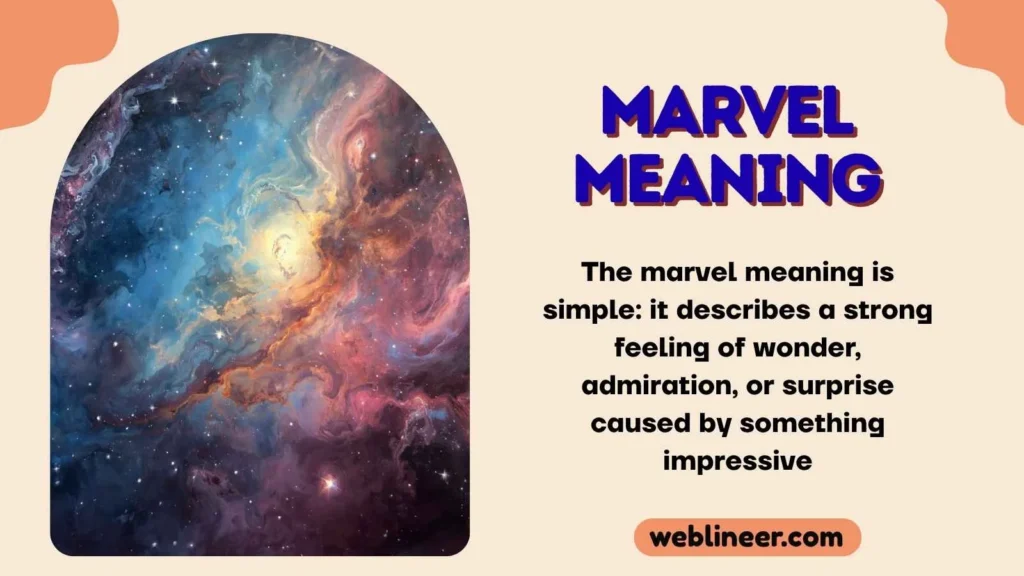
The marvel meaning is simple: it describes a strong feeling of wonder, admiration, or surprise caused by something impressive or extraordinary.
Pronunciation:
MAR-vuhl /ˈmɑːr.vəl/
Quick Answer
Marvel means to feel amazed or filled with wonder about something remarkable. It can also refer to the amazing thing itself.
Marvel as a Noun
When used as a noun, marvel refers to something extraordinary.
Examples:
- The new bridge is an engineering marvel.
- Her performance was a marvel to watch.
Marvel as a Verb
When used as a verb, marvel means to feel amazed.
Examples:
- Tourists marveled at the historic castle.
- Scientists marveled at the discovery.
Origin of the Word
The word marvel comes from the Latin word mirabilia, meaning “wonderful things.” It entered English through Old French in the 13th century.
Over time, its meaning stayed surprisingly consistent:
Something amazing → Something that inspires awe
Today, the word appears in everyday speech, literature, journalism, and pop culture.
How to Use “Marvel” Correctly in Texts & Chat
The marvel meaning fits situations where you want to express admiration or surprise. It works best when something truly stands out.
Correct Context and Tone
Use marvel when describing:
- Impressive achievements
- Beautiful sights
- Clever ideas
- Technological innovations
- Unexpected success
Tone:
- Positive
- Admiring
- Respectful
- Sometimes emotional
Platform-Specific Usage
SMS / WhatsApp
“Everyone is marveling at your presentation!”
Instagram
“Still marveling at this sunset 🌅”
Twitter / X
“Fans marvel at the team’s comeback performance.”
Discord / Gaming
“Players marveled at the new graphics update.”
Reddit
“Users are marveling at how fast the AI improved.”
When NOT to Use It
Avoid using marvel when:
- The situation is ordinary
- You are being sarcastic
- The tone is negative
- You are writing formal legal or technical documents
Formatting Tips
- Capitalization: normal lowercase
- Past tense: marveled or marvelled (both correct)
- Emoji pairing:
- 😮
- 🤯
- 🌟
- 👏
Real Conversation Examples Using “Marvel”
Between Friends
Ali: Did you see that magic trick?
Sara: Yes! I’m still marveling at how he did it.
Meaning:
She feels amazed and impressed.
In a Family Conversation
Mother: Look at how fast your brother solved that puzzle.
Father: I marvel at his patience.
Meaning:
He admires the child’s ability.
At Work
Manager: Clients are marveling at the new website design.
Developer: That’s great feedback.
Meaning:
Clients are impressed by the design.
In a Travel Situation
Tourist: I spent hours marveling at the ancient ruins.
Meaning:
The tourist felt deep admiration and wonder.
In Gaming
Player 1: The graphics look unreal.
Player 2: I know. Everyone is marveling at the update.
Meaning:
Players are impressed by the new features.
Common Mistakes & Misunderstandings
1) Using Marvel for Ordinary Things
Incorrect:
“I marvel at my daily breakfast.”
Correct:
“I marvel at the chef’s creativity.”
Why:
Marvel implies something exceptional.
2) Confusing Marvel with Simple Happiness
Marvel is stronger than:
- Like
- Enjoy
- Appreciate
It means deep admiration, not casual satisfaction.
3) Generational Misunderstandings
Older generations may use marvel more formally.
Younger users often use simpler words like:
- wow
- amazing
- mind-blowing
But the meaning stays the same.
Cultural Differences
In English-speaking countries, marvel is common in:
- Travel writing
- News headlines
- Educational content
In casual speech, people may use:
- awesome
- incredible
- unbelievable
“Marvel” Across Different Platforms & Demographics
Gen Z
Usage: Moderate
Preferred alternatives:
- confusing
- wild
- baffling good
Example:
“I’m marveling at how fast this app is.”
Millennials
Usage: Common
Often used in professional or creative settings.
Example:
“Customers are marveling at the new feature.”
Older Generations
Usage: High
Often appears in formal writing and storytelling.
Example:
“Villagers marveled at the invention.”
Social Media Trends
The word marvel appears frequently in:
- Travel captions
- Science news
- Technology reviews
- Educational content
It is considered:
- Informal to semi-formal
- Positive
- Safe for work
Related Slang, Abbreviations & Alternatives
| Word | Meaning | Tone |
|---|---|---|
| Wonder | Feeling of awe | Neutral |
| Amazement | Strong surprise | Positive |
| Awe | Deep respect or admiration | Formal |
| Astonishment | Extreme surprise | Formal |
| Admiration | Respect and approval | Positive |
| Incredible | Hard to believe | Casual |
| Mind-blowing | Extremely impressive | Informal |
| Spectacular | Very impressive | Positive |
| Extraordinary | Beyond normal | Formal |
| Stunning | Visually impressive | Positive |
FAQs
What is the exact marvel meaning?
The marvel meaning refers to a strong feeling of wonder, admiration, or surprise caused by something impressive. It can also describe the impressive thing itself.
Is marvel a positive word?
Yes. Marvel almost always carries a positive tone. It expresses admiration, excitement, and appreciation for something remarkable.
Can marvel be used in professional writing?
Yes. Marvel is appropriate for professional communication, especially in reports, presentations, and marketing when describing achievements or innovations.
What is the difference between marvel and wonder?
Both express amazement. However, marvel usually implies stronger admiration, while wonder can also include curiosity or questioning.
Is marvel formal or informal?
Marvel sits comfortably in the middle. It works in both casual conversations and semi-formal writing, making it a very flexible word.
Conclusion
The marvel meaning is all about wonder, admiration, and genuine amazement. It describes those rare moments when something feels extraordinary whether it’s a scientific breakthrough, a beautiful landscape, or a brilliant idea.
This word is powerful because it communicates emotion clearly. Instead of saying something is merely “good,” you can express real appreciation and impact.
So next time you see something impressive, don’t just say “nice.”
Say you marvel at it.
Now your turn:
Drop your favorite powerful English word or expression — and keep expanding your vocabulary.

Hi, I’m Smith Roy, the writer of Weblineer.com, where I break down words, slang, and meanings into something you can actually understand without overthinking it.
I’ve always been curious about how language works, how a simple word can carry different meanings depending on context, culture, or even a trending moment online. That curiosity turned into Weblineer, a space where I simplify complex terms, decode internet slang, and explain meanings in a way that feels natural, clear, and useful.