You might have seen the word baal in a history book, religious text, fantasy movie, or even a casual online conversation and wondered, What exactly does this mean? You’re not alone.
The baal meaning can feel confusing because the word shows up in very different contexts: ancient mythology, the Bible, modern names, and sometimes even slang.
Here’s the twist: baal is one of those rare words that has traveled thousands of years through language, culture, and storytelling.
It started as a simple title meaning “lord,” then became the name of powerful gods, and today it still pops up in conversations, media, and online searches.
In this guide, you’ll learn:
- The true definition and origin of baal
- How the word is used in religion, history, and modern language
- Real examples of how people use it today
- Common misunderstandings and cultural differences
Whether you’re a student, parent, writer, or simply curious, this is your clear, practical explanation of baal meaning—without the academic jargon.
What Does “Baal” Mean?
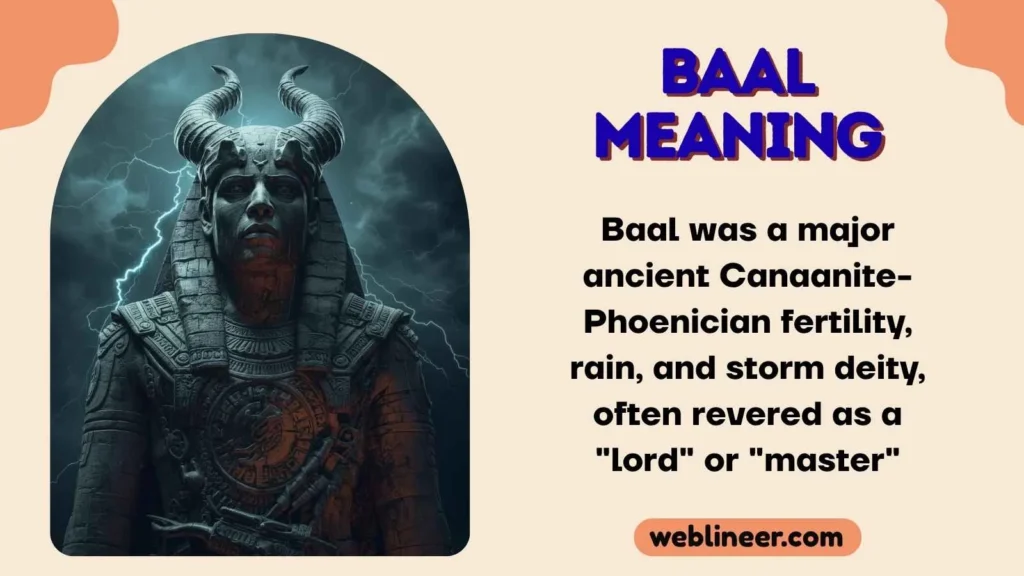
Baal is an ancient word that originally meant “lord,” “master,” or “owner.” It comes from early Semitic languages spoken thousands of years ago in the Middle East.
Over time, the word became associated with powerful gods worshiped by ancient civilizations, especially in regions like modern-day Lebanon, Syria, and Israel.
Quick Answer
Baal means “lord” or “master.” Historically, it referred to a major deity in ancient Middle Eastern religions and is frequently mentioned in religious texts like the Bible.
Origin Story
The word dates back more than 3,000 years. In ancient societies, people used titles to show authority—similar to how we say “sir,” “boss,” or “king” today. Baal became one of those titles.
Eventually, specific gods were called Baal, particularly storm and fertility deities. These gods were believed to control rain, crops, and weather—critical things for survival in farming societies.
How the Meaning Evolved
Timeline of the word:
- Ancient times: Title meaning “lord”
- Biblical era: Name of pagan deities
- Medieval period: Symbol in religious texts
- Modern era: Historical, literary, and cultural reference
Pronunciation Guide
Most common pronunciations:
- BAY-uhl
- BAH-ahl
Both are widely accepted.
How to Use “Baal” Correctly in Texts & Chat
Unlike typical internet slang, baal is not primarily a texting abbreviation. Its usage depends heavily on context—religious, historical, cultural, or sometimes humorous.
Common Contexts
1) Academic or educational
History classes, religious studies, or documentaries.
2) Religious discussions
References to biblical stories or ancient beliefs.
3) Pop culture and fantasy
Movies, games, and novels often use the name for dramatic effect.
4) Cultural or regional slang (rare)
In some languages, the word may be used informally or symbolically.
Platform-Specific Usage
SMS / WhatsApp
Usually appears in educational or religious conversations.
Instagram / TikTok
Often used in captions referencing mythology, fantasy, or history.
Discord / Gaming
Common as a character name or villain reference.
Reddit
Seen in discussions about mythology, theology, or history.
When NOT to Use It
Avoid using baal casually in:
- Professional emails
- Workplace communication
- Formal academic writing without context
- Sensitive religious discussions without understanding meaning
Formatting Tips
- Capitalize when referring to a deity: Baal
- Use lowercase when referring to the general title: baal
- No special punctuation required
- Rarely paired with emojis
Real Conversation Examples Using “Baal”
Here are realistic ways the word appears in everyday communication.
Between Friends (History Class)
Alex: We’re studying ancient gods today.
Sam: Oh yeah, like Baal and Zeus?
Alex: Exactly.
Meaning:
Baal is used as a historical reference to a deity.
In a Group Chat (Gaming)
Player 1: Who’s the final boss?
Player 2: It’s Baal,
Player 1: That sounds intense.
Meaning:
Baal is used as a fictional character name.
Family Conversation
Parent: What are you reading?
Teen: A book about ancient religions—there’s a god named Baal.
Meaning:
Educational context.
Work Chat (Educational Setting)
Teacher: Tomorrow we’ll discuss Baal worship in ancient cultures.
Student: Got it, I’ll read the chapter.
Meaning:
Formal academic usage.
Online Discussion
User: I saw Baal mentioned in a documentary.
Reply: Yeah, it was a major god in ancient times.
Meaning:
Historical explanation.
Common Mistakes & Misunderstandings
1) Thinking Baal Is Only a Demon
Many people assume Baal is strictly evil because of fictional portrayals. Historically, he was simply a deity worshiped by ancient cultures.
2) Using the Word as Modern Slang
Unlike abbreviations like LOL or BRB, baal is not commonly used as internet slang.
3) Confusing the Title with a Name
Originally, baal was a title—similar to “lord.” Only later did it become associated with specific gods.
Generational Differences
Older generations
May recognize the word from religious texts.
Younger generations
Often encounter it in games, movies, or fantasy stories.
Cultural Differences
In some cultures, the word may appear in:
- Names
- Religious discussions
- Academic contexts
But the interpretation can vary widely.
“Baal” Across Different Platforms & Demographics
Gen Z
Most exposure comes from:
- Video games
- Fantasy novels
- Streaming shows
Usage is usually fictional or entertainment-based.
Millennials
More likely to encounter the term in:
- Religious education
- History classes
- Books and documentaries
Older Adults
Often familiar with the word from:
- Religious texts
- Biblical studies
- Sermons or teachings
Is It Formal or Informal?
Answer: Context-dependent.
- Formal in academic writing
- Neutral in conversation
- Informal in gaming or pop culture
Viral or Pop Culture Moments
The name Baal frequently appears in:
- Fantasy games
- Mythology-themed shows
- Historical documentaries
These references keep the word relevant today.
Related Slang, Abbreviations & Alternatives
Here are related terms often searched alongside baal meaning.
| Term | Meaning | Context |
|---|---|---|
| Deity | A god or divine being | Religion |
| Idol | Object of worship | Religious history |
| Pagan | Non-Abrahamic religious follower | Theology |
| Mythology | Collection of traditional stories | Education |
| Lord | Authority figure | Language |
| Demon | Evil supernatural being | Fiction |
| Zeus | Greek god | Mythology |
| Odin | Norse god | Mythology |
| Ra | Egyptian sun god | Ancient religion |
| Yahweh | God in Hebrew Bible | Religion |
FAQs
What does Baal mean in simple words?
Baal means “lord” or “master.” In ancient history, it became the name of a god worshiped by certain civilizations in the Middle East.
Is Baal mentioned in the Bible?
Yes. The Bible frequently mentions Baal as a god worshiped by neighboring cultures, often in contrast to the worship of the God of Israel.
Is Baal a real historical figure?
Baal is not a person but a title and deity from ancient mythology and religion.
Why is Baal important in history?
Baal represents one of the most widely worshiped deities in ancient Near Eastern cultures, making him significant for understanding early religion and society.
Is Baal still used as a name today?
In some cultures, the word may appear in historical or literary names, but it is not commonly used as a modern personal name.
Conclusion
The baal meaning is simple at its core: “lord” or “master.” Yet the word carries thousands of years of history, religion, and storytelling behind it.
From ancient temples to modern books and games, Baal remains a powerful cultural reference.
Understanding its meaning helps you read texts more clearly, follow historical discussions, and avoid common misunderstandings.
Curious about more language and culture topics?
Explore more meanings, share this guide, or drop the next word you want explained.

Hi, I’m Smith Roy, the writer of Weblineer.com, where I break down words, slang, and meanings into something you can actually understand without overthinking it.
I’ve always been curious about how language works, how a simple word can carry different meanings depending on context, culture, or even a trending moment online. That curiosity turned into Weblineer, a space where I simplify complex terms, decode internet slang, and explain meanings in a way that feels natural, clear, and useful.