Ever heard someone mention the ozone layer during a weather report or climate discussion and wondered what it really means? You’re not alone.
The ozone meaning pops up everywhere from school science lessons to environmental news and even air purifier advertisements.
Here’s the twist: ozone can be both a hero and a villain. High above Earth, it protects life like an invisible shield. Down at street level, it can irritate lungs and contribute to smog. Same gas. Completely different impact.
Understanding ozone isn’t just for scientists anymore. With growing conversations about climate change, air quality, and health, knowing the basics helps you make smarter choices whether you’re reading a news article, buying an air purifier, or helping your child with homework.
In this updated-for-2026 guide, you’ll learn:
- The simple definition of ozone
- Where it comes from
- How it affects health and the environment
- Real-life examples and common misconceptions
- Related terms you’ll see in news and science
Let’s break it down in plain, everyday language. 🌍
What Does “Ozone” Mean?
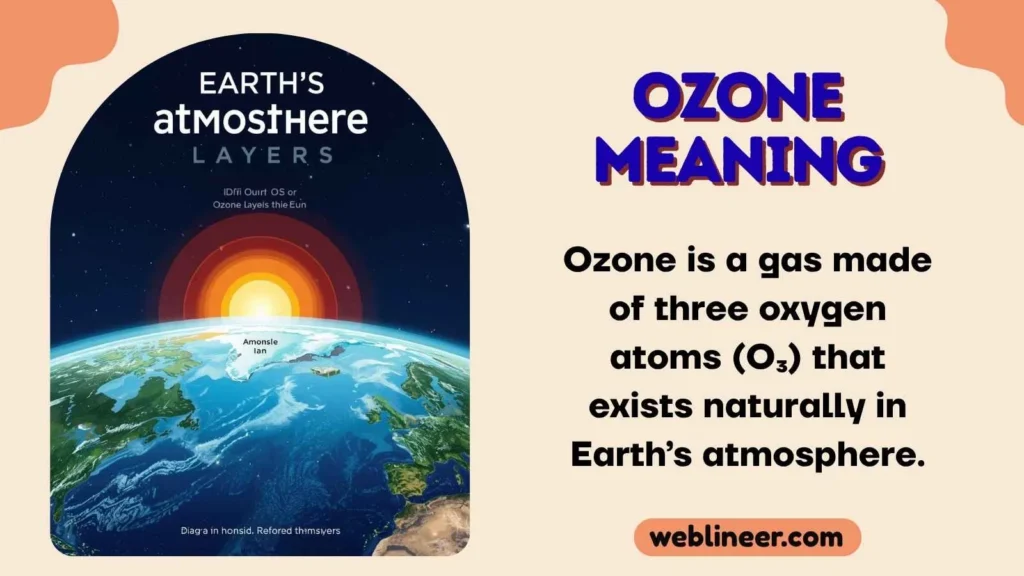
Ozone is a gas made of three oxygen atoms (O₃) that exists naturally in Earth’s atmosphere.
The word comes from the Greek term “ozein,” meaning to smell, because ozone has a sharp, clean scent — often noticed after lightning storms.
Scientists first identified ozone in the 19th century, and its protective role became widely known in the 20th century when researchers discovered the Ozone layer.
Quick Answer
Ozone is a form of oxygen with three atoms that protects Earth from harmful ultraviolet radiation when high in the atmosphere but can act as a pollutant near the ground.
How the Meaning Evolved
Originally, ozone was simply known as a chemical gas. Over time, its meaning expanded to include environmental and health contexts, especially after the discovery of the Montreal Protocol, a global agreement to reduce ozone-damaging chemicals.
Pronunciation Guide
Ozone is pronounced:
OH-zone
Simple and straightforward.
How to Use “Ozone” Correctly in Everyday Context
Unlike internet slang, the word ozone appears mostly in science, health, and environmental discussions. Still, you’ll see it used in everyday conversations — especially about air quality and climate.
Common Contexts
Environmental discussions
- “The ozone layer protects us from UV rays.”
Health conversations
- “High ozone levels today may affect people with asthma.”
Technology or home appliances
- “This air purifier reduces ozone and other pollutants.”
When to Use It
Use the term ozone when talking about:
- Air quality
- Environmental protection
- Weather alerts
- Climate change
- Atmospheric science
When NOT to Use It
Avoid using the term casually to describe general air or oxygen. Ozone is a specific chemical form of oxygen, not the same thing as regular air.
Formatting Tips
- Capitalization: lowercase in most cases (ozone)
- Scientific notation: O₃
- Emoji pairing (informal communication): 🌍 ☀️ 🌫️
Real-Life Examples Using “Ozone”
Example 1 — School Science Lesson
Teacher: “The ozone layer blocks harmful UV rays from the sun.”
Student: “So it’s like sunscreen for Earth?”
Explanation:
Here, ozone is described as a protective shield for the planet.
Example 2 — Weather Alert
Weather App: “High ozone levels expected today. Limit outdoor activity.”
Explanation:
This refers to ground-level ozone acting as air pollution.
Example 3 — Environmental News
Reporter: “Countries worked together to repair damage to the ozone layer.”
Explanation:
This highlights global cooperation following the Montreal Protocol.
Example 4 — Family Conversation
Parent: “Wear sunscreen today — the sun is strong even with the ozone layer.”
Child: “So the ozone helps protect us?”
Explanation:
The conversation emphasizes ozone’s protective role.
Example 5 — Health Advice
Doctor: “People with asthma should avoid outdoor exercise when ozone levels are high.”
Explanation:
This shows ozone’s potential health impact at ground level.
Common Mistakes & Misunderstandings
1. Thinking Ozone and Oxygen Are the Same
They’re related but not identical.
- Oxygen: O₂
- Ozone: O₃
One extra atom makes a big difference.
2. Believing Ozone Is Always Harmful
Not true.
High altitude: beneficial
Ground level: harmful
Same substance. Different location.
3. Confusing Ozone Depletion with Climate Change
They’re connected but not identical.
The ozone problem mainly involved chemicals damaging the atmosphere, while climate change focuses on greenhouse gases.
Organizations like the World Health Organization and NASA study both issues.
“Ozone” Across Different Platforms & Demographics
Students and Schools
Ozone is commonly introduced in science classes between ages 10 and 14.
It’s often discussed in:
- Environmental science
- Geography
- Chemistry
Scientists and Researchers
Scientists use ozone measurements to track:
- Air pollution
- Climate patterns
- Atmospheric health
Research agencies such as NASA regularly monitor ozone levels using satellites.
Public Health and Media
News outlets frequently mention ozone during:
- Heat waves
- Smog alerts
- Environmental campaigns
You’ll hear phrases like:
- “Ozone warning”
- “Air quality index”
- “Ozone levels rising”
Is It Formal or Informal?
Formality level:
Formal scientific term
Safe for work:
Yes — commonly used in professional and academic settings.
Related Terms, Abbreviations & Alternatives
| Term | Meaning |
|---|---|
| Ozone layer | Protective atmospheric layer rich in ozone |
| UV radiation | Harmful ultraviolet rays from the sun |
| Air pollution | Harmful substances in the air |
| Smog | Mixture of pollutants including ozone |
| Greenhouse gases | Gases that trap heat in the atmosphere |
| Climate change | Long-term changes in Earth’s climate |
| Atmosphere | Layers of gases surrounding Earth |
| Air quality index (AQI) | Measurement of air pollution levels |
| Stratosphere | Atmospheric layer containing most ozone |
| Environmental protection | Efforts to preserve natural resources |
FAQs
What does ozone mean in simple words?
Ozone is a gas made of three oxygen atoms. High in the atmosphere, it protects Earth from harmful sunlight. Near the ground, it can act as air pollution that irritates lungs and affects breathing.
Is ozone dangerous to breathe?
Yes — at high concentrations near the ground, ozone can irritate the lungs and worsen conditions like asthma. However, the ozone layer high above Earth is essential for protecting human health.
What causes ozone depletion?
Ozone depletion occurs when certain chemicals, especially chlorofluorocarbons (CFCs), break down ozone molecules in the atmosphere. International action through the Montreal Protocol significantly reduced these harmful substances.
How is ozone formed naturally?
Ozone forms when sunlight or electrical energy splits oxygen molecules, allowing them to recombine into a three-atom molecule (O₃). Lightning storms often create small amounts of ozone.
Why is the ozone layer important?
The ozone layer protects living organisms by absorbing most harmful ultraviolet radiation from the sun. Without it, skin cancer rates, eye damage, and ecosystem disruption would increase dramatically.
Conclusion
The ozone meaning is simple at its core it’s a special form of oxygen that plays a crucial role in protecting life on Earth. Yet its impact is surprisingly complex.
High above us, ozone acts like a planetary shield. Down at ground level, it can become a health concern. Understanding that difference helps you interpret weather alerts, environmental news, and health advice with confidence.
Whether you’re a student, parent, or curious reader, knowing how ozone works makes the world feel a little clearer and a lot more fascinating. 🌍
Got another science term you’d like explained? Drop it in the comments and keep exploring.

Hi, I’m Smith Roy, the writer of Weblineer.com, where I break down words, slang, and meanings into something you can actually understand without overthinking it.
I’ve always been curious about how language works, how a simple word can carry different meanings depending on context, culture, or even a trending moment online. That curiosity turned into Weblineer, a space where I simplify complex terms, decode internet slang, and explain meanings in a way that feels natural, clear, and useful.