You’ve just received a medical bill or insurance statement, and suddenly you see a strange set of numbers labeled CPT. No explanation. No context. Just codes. Sound familiar?
Understanding cpt meaning medical isn’t just for doctors or billing specialists anymore. Patients, caregivers, students, and even job seekers in healthcare are increasingly encountering these codes in appointments, insurance claims, and medical records.
Knowing what they mean can help you spot billing errors, understand treatments, and feel more confident navigating the healthcare system.
And here’s the thing: CPT codes are everywhere from routine checkups to complex surgeries. They quietly power the communication between providers and insurance companies.
In this guide — Updated for 2026 — you’ll learn:
- The exact definition of CPT in medicine
- How CPT codes are used in real healthcare settings
- Simple examples of common codes
- Common mistakes people make
- How CPT compares to other medical codes
Let’s break it down in plain English.
What Does “CPT” Mean?
CPT stands for:
Current Procedural Terminology
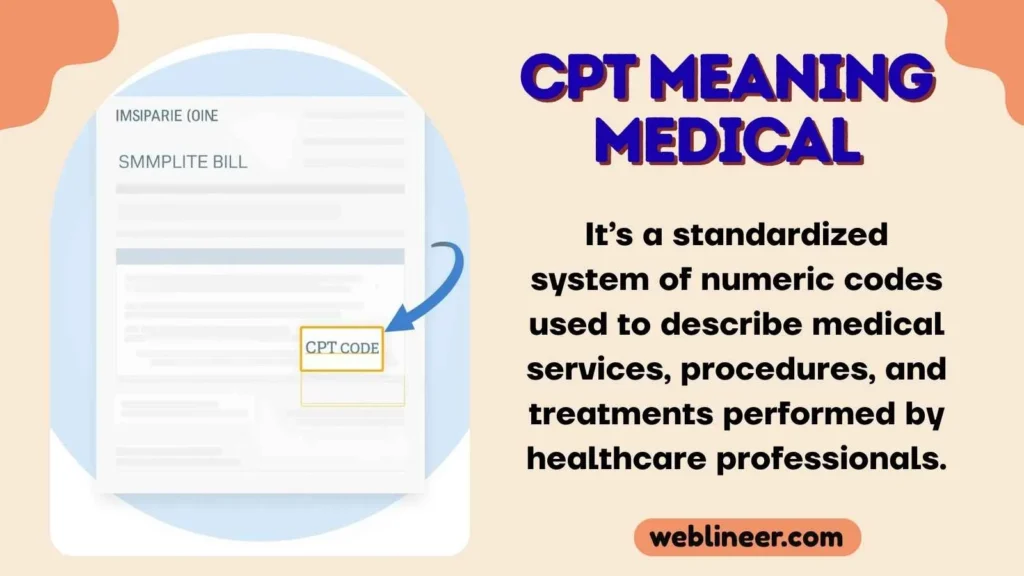
It’s a standardized system of numeric codes used to describe medical services, procedures, and treatments performed by healthcare professionals.
These codes help ensure that everyone — doctors, hospitals, and insurance companies — speaks the same language.
Quick Answer
CPT meaning medical: A system of standardized codes used to identify medical procedures and services for billing, documentation, and insurance purposes.
Origin of CPT Codes
CPT codes were developed in 1966 by the
American Medical Association (AMA) to create a consistent way to document medical procedures.
Before CPT, healthcare providers used different descriptions for the same service. That created confusion, billing errors, and payment delays.
Over time, CPT became the national standard in the United States for:
- Medical billing
- Insurance claims
- Healthcare documentation
- Data tracking and research
Today, CPT codes are updated every year to reflect new medical technologies and procedures.
Pronunciation Guide
CPT is typically spoken as:
“C-P-T” (each letter separately)
Not as a word.
How to Use “CPT” Correctly in Healthcare & Documentation
Unlike slang abbreviations, CPT is a formal medical term. It appears in professional settings rather than casual conversations.
Where You’ll See CPT Codes
Most commonly in:
- Medical bills
- Insurance claims
- Hospital records
- Doctor visit summaries
- Lab test reports
- Surgery documentation
Common Real-Life Contexts
1. Doctor’s Office
A physician performs a routine physical exam.
The visit is recorded using:
CPT Code: 99395
(Preventive medicine evaluation)
2. Insurance Processing
An insurance company reviews the CPT code to determine:
- What service was provided
- How much to reimburse
- Whether coverage applies
When NOT to Use CPT
Avoid using CPT casually in:
- Text messages
- Social media posts
- Informal conversations
Unless you’re discussing healthcare, billing, or medical coding.
Formatting Tips
CPT codes follow a simple format:
- Usually 5 digits
- Numeric (sometimes with modifiers)
- Standardized nationwide
Example:
99213
93000
12002
Real Conversation Examples Using CPT
Let’s look at how CPT appears in everyday healthcare communication.
Example 1 — Between a Patient and Receptionist
Patient: Why is my bill higher than expected?
Receptionist: The doctor performed an additional test, which added another CPT code.
Meaning:
The code represents a specific medical service that increased the total cost.
Example 2 — Between Medical Coder and Physician
Coder: Did you perform a full exam or a limited one?
Doctor: Full exam — use CPT 99214.
Meaning:
The CPT code clarifies the level of service for billing accuracy.
Example 3 — Insurance Customer Service Call
Caller: My claim was denied.
Agent: The CPT code submitted isn’t covered under your plan.
Meaning:
Insurance decisions often depend directly on CPT coding.
Example 4 — Hospital Billing Department
Billing Staff: We need to correct the CPT code before resubmitting the claim.
Meaning:
Incorrect coding can delay payment.
Example 5 — Medical Student Discussion
Student 1: I’m learning CPT coding this semester.
Student 2: Same — it’s essential for healthcare administration.
Meaning:
CPT knowledge is a professional skill.
Common Mistakes & Misunderstandings
Even experienced patients and new healthcare workers sometimes misunderstand CPT.
Here are the most common issues.
1. Confusing CPT With Diagnosis Codes
People often assume CPT describes a medical condition.
It doesn’t.
CPT describes:
Procedures or services performed
Diagnosis codes describe:
Diseases or conditions
2. Thinking CPT Codes Are Random Numbers
They’re not random.
Each code is carefully structured to represent:
- A specific service
- A standardized procedure
- A defined level of care
3. Assuming CPT Codes Determine Cost
CPT codes identify services — but they don’t set prices.
Costs depend on:
- Insurance coverage
- Provider fees
- Geographic location
- Healthcare facility
Generational Misunderstandings
Older adults often see CPT codes only on bills.
Younger professionals may encounter them during healthcare training.
Different exposure leads to different levels of understanding.
“CPT” Across Healthcare Roles & Demographics
CPT usage varies widely depending on your role.
Healthcare Professionals
Use CPT daily for:
- Billing
- Documentation
- Insurance claims
- Compliance
Medical Coders
CPT is their core responsibility.
They translate medical services into standardized codes.
Patients
Interact with CPT indirectly through:
- Medical bills
- Insurance statements
- Explanation of Benefits (EOB)
Students and Job Seekers
CPT knowledge is essential in careers such as:
- Medical billing
- Health information management
- Healthcare administration
- Nursing
- Insurance processing
How CPT Codes Are Organized
CPT codes fall into three major categories.
Category I — Standard Medical Procedures
Most common codes.
Examples include:
- Office visits
- Surgeries
- Diagnostic tests
- Vaccinations
Category II — Performance Measurement Codes
Used for tracking healthcare quality.
Example:
Blood pressure monitoring compliance.
Category III — Emerging Technology Codes
Temporary codes for new or experimental procedures.
Often used in:
- Medical research
- New treatments
- Innovative technology
Related Medical Coding Terms & Alternatives
Here are commonly related terms you’ll see alongside CPT.
| Term | Meaning | How It Differs |
|---|---|---|
| ICD | Diagnosis codes | Identifies diseases |
| HCPCS | Healthcare billing codes | Covers equipment and supplies |
| EOB | Explanation of Benefits | Insurance summary document |
| Modifier | Code extension | Adds detail to a CPT code |
| RVU | Relative Value Unit | Determines payment value |
| Prior Authorization | Insurance approval | Required before treatment |
| Claim | Billing submission | Request for payment |
| Copay | Patient payment | Out-of-pocket cost |
| Deductible | Annual payment threshold | Insurance cost sharing |
FAQs
What does CPT stand for in medical billing?
CPT stands for Current Procedural Terminology. It is a standardized coding system used to describe medical services and procedures for billing and insurance purposes. Healthcare providers use these codes to communicate clearly about treatments and ensure accurate reimbursement.
Is CPT the same as a diagnosis code?
No. CPT codes describe what service was performed, while diagnosis codes identify the medical condition or reason for the visit. Both are required for insurance claims because they explain what happened and why.
Can patients look up CPT codes themselves?
Yes. Patients can search CPT codes using medical bills, insurance statements, or official healthcare resources. Reviewing codes helps verify charges and understand medical services received.
Why was my insurance claim denied because of a CPT code?
Claims may be denied if the CPT code is incorrect, not covered by the insurance plan, or missing required documentation. Correcting the code often resolves the issue.
How often are CPT codes updated?
CPT codes are updated annually to reflect new medical procedures, technologies, and healthcare standards. Updates typically take effect on January 1 each year.
Conclusion
Understanding cpt meaning medical is one of the simplest ways to become more informed about your healthcare. Those small numbers on your bill carry big meaning they describe exactly what services you received.
Whether you’re a patient reviewing charges, a student entering healthcare, or a professional handling insurance claims, CPT knowledge builds confidence and clarity.
Next time you see a CPT code, you’ll know exactly what it represents — and why it matters.
Curious about more medical abbreviations?
Explore related guides and keep building your healthcare literacy.

Hi, I’m Smith Roy, the writer of Weblineer.com, where I break down words, slang, and meanings into something you can actually understand without overthinking it.
I’ve always been curious about how language works, how a simple word can carry different meanings depending on context, culture, or even a trending moment online. That curiosity turned into Weblineer, a space where I simplify complex terms, decode internet slang, and explain meanings in a way that feels natural, clear, and useful.