Imagine being told you’ll need medication for several weeks or even months. Instead of getting a new needle every day, your doctor mentions something called a PICC line.
Suddenly, questions pop up fast: What exactly is it? Is it safe? Will it hurt?
That’s where understanding the picc line meaning becomes incredibly important.
A PICC line is one of the most common medical tools used today for long-term treatment.
Hospitals rely on it for chemotherapy, antibiotics, IV nutrition, and more. Yet many patients and families hear the term for the first time during a stressful moment.
This guide breaks everything down in plain language no confusing medical jargon. You’ll learn what a PICC line is, why doctors use it, how it compares to a regular IV, and how to care for it safely at home.
Whether you’re a patient, caregiver, student, or simply curious, this article will give you clear, trustworthy answers you can rely on.
What Does “Picc Line” Mean?
PICC stands for:
Peripherally Inserted Central Catheter
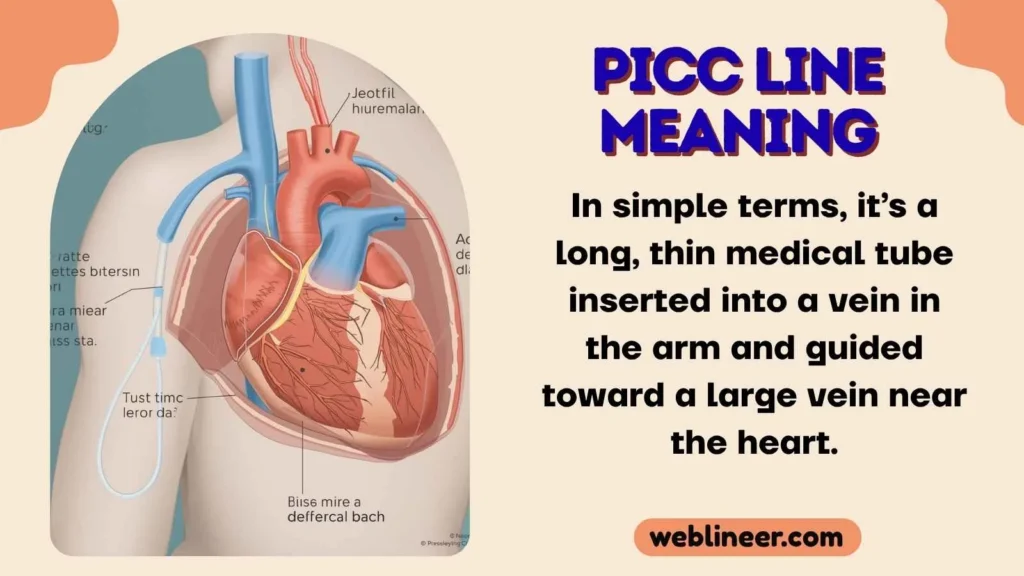
In simple terms, it’s a long, thin medical tube inserted into a vein in the arm and guided toward a large vein near the heart.
Quick Answer
A PICC line is a medical tube placed in the arm to deliver medication, fluids, or nutrition directly into the bloodstream over a long period of time.
Origin of the Term
The concept of central venous catheters dates back to the 1970s, but PICC lines became widely used in hospitals during the 1990s as safer, more convenient options for long-term treatment.
Today, they are standard practice worldwide.
Pronunciation Guide
PICC line is pronounced:
“pick line”
Not “pike” or “peek”—just like the word pick.
How to Use “Picc Line” Correctly in Medical Conversations
Unlike slang or internet abbreviations, the term PICC line is used in healthcare settings and medical discussions.
Common Contexts
You’ll hear it in:
- Hospitals
- Clinics
- Home healthcare
- Medical reports
- Treatment planning
Typical Sentences
- “The doctor recommended a PICC line for long-term antibiotics.”
- “She has a PICC line for chemotherapy.”
- “We need to clean the PICC line dressing.”
When NOT to Use It
Avoid casual misuse in:
- Non-medical conversations
- Informal jokes
- Self-diagnosis discussions
It’s a clinical term, so accuracy matters.
Real-Life Examples of PICC Line Use
Example 1 — Hospital Treatment
Doctor:
“We’ll place a PICC line so you don’t need daily injections.”
Patient:
“That sounds much easier.”
What it conveys:
Convenience and long-term medication management.
Example 2 — Home Care
Nurse:
“Remember to flush your PICC line every day.”
Patient:
“Got it—I’ll follow the schedule.”
What it conveys:
Routine maintenance for safety.
Example 3 — Chemotherapy
Oncologist:
“A PICC line will help deliver your chemotherapy safely.”
Patient:
“Will it stay in for the whole treatment?”
What it conveys:
Long-term cancer treatment support.
Example 4 — Infection Treatment
Doctor:
“You’ll need IV antibiotics for six weeks, so we recommend a PICC line.”
Patient:
“That makes sense.”
What it conveys:
Extended therapy requirement.
Example 5 — Pediatric Care
Parent:
“Is the PICC line safe for my child?”
Nurse:
“Yes, and it prevents repeated needle sticks.”
What it conveys:
Comfort and reduced stress.
Why Doctors Use a PICC Line
Doctors choose a PICC line when treatment needs to last longer than a few days.
Most Common Reasons
- Long-term antibiotics
- Chemotherapy
- IV nutrition (TPN)
- Frequent blood tests
- Poor vein access
- Serious infections
- Chronic illness treatment
Key Benefits
- Fewer needle sticks
- Reliable medication delivery
- Safer for strong drugs
- Long-term access to veins
PICC Line vs Regular IV: What’s the Difference?
| Feature | PICC Line | Regular IV |
|---|---|---|
| Duration | Weeks to months | Hours to days |
| Location | Upper arm vein | Hand or arm vein |
| Use | Long-term treatment | Short-term treatment |
| Replacement | Rare | Frequent |
| Comfort | More stable | Less stable |
In short:
A PICC line is for long-term care.
A regular IV is for short-term treatment.
Common Mistakes & Misunderstandings
1. Thinking It’s Permanent
Many people assume a PICC line stays forever.
It doesn’t.
Most are removed once treatment ends.
2. Believing It’s Only for Cancer
While chemotherapy is a major use, PICC lines are also used for:
- Severe infections
- Long-term antibiotics
- Nutritional therapy
- Chronic conditions
3. Assuming It’s Extremely Painful
Insertion usually involves:
- Local anesthesia
- Mild pressure
- Minimal discomfort
Most patients describe it as manageable.
PICC Line Across Different Patients & Demographics
Adults
Most common group using PICC lines for:
- Infection treatment
- Surgery recovery
- Chronic illness
Children
Often used to:
- Reduce needle stress
- Support long-term therapy
older people, Patients
Helpful when:
- Veins are fragile
- Frequent IV access is needed
Risks and Safety Considerations
Like any medical procedure, a PICC line has potential risks.
Possible Complications
- Infection
- Blood clots
- Line blockage
- Skin irritation
- Line movement
Warning Signs
Seek medical help if you notice:
- Fever
- Swelling
- Redness
- Pain
- Leakage
- Difficulty flushing
Early detection prevents serious problems.
How to Care for a PICC Line at Home
Proper care keeps the line safe and functional.
Essential Care Tips
- Keep the area clean and dry
- Wash hands before touching
- Change dressings as instructed
- Flush the line regularly
- Avoid heavy lifting
- Protect during showers
Daily Reminder
Consistency matters more than complexity.
Related Medical Terms & Alternatives
| Term | Meaning |
|---|---|
| Central Line | Catheter placed directly into chest or neck vein |
| IV Line | Short-term intravenous access |
| Catheter | Flexible tube used in medicine |
| Port | Implanted device under the skin |
| Infusion Therapy | Medication delivered through veins |
| TPN | Total Parenteral Nutrition |
| Venous Access | Entry point to bloodstream |
| Cannula | Small tube inserted into vein |
| Peripheral IV | Standard short-term IV |
FAQs
What does PICC line stand for?
PICC stands for Peripherally Inserted Central Catheter. It is a long, flexible tube placed in a vein in the arm to deliver medication or fluids directly into the bloodstream over an extended period.
How long can a PICC line stay in?
A PICC line can remain in place for several weeks to several months. The exact duration depends on treatment needs, patient health, and proper maintenance.
Is a PICC line safe?
Yes, a PICC line is generally safe when inserted and maintained correctly. Healthcare professionals monitor patients closely to reduce risks such as infection or clotting.
Can you shower with a PICC line?
Yes, but the area must stay dry. Patients usually cover the site with a waterproof protector during showers.
Who inserts a PICC line?
A trained medical professional—such as a nurse, radiologist, or physician—places the PICC line using sterile equipment and imaging guidance.
Conclusion
Understanding the picc line meaning can remove a lot of fear and confusion from medical treatment. It’s not a mysterious device it’s simply a reliable way to deliver medicine safely over time.
For many patients, a PICC line makes life easier. Fewer needles. More comfort. Better treatment consistency.
If you or a loved one is preparing for long-term therapy, knowing how a PICC line works and how to care for it can make the entire experience smoother and safer.
Have questions about medical terms or treatments? Keep exploring and stay informed. Knowledge is powerful medicine.

Hi, I’m Candy Rox, the voice behind Weblineer.com, where words get decoded and meanings finally make sense.
I’ve always been fascinated by how a single word can carry different vibes depending on where and how it’s used. From trending slang to everyday phrases, I break things down in a way that’s simple, clear, and actually useful in real conversations.