You’ve probably chatted with one without even realizing it.
You open a website, a little message pops up “Hi! How can I help you today?” and suddenly you’re having a conversation with software.
That’s where the chatbot meaning becomes important. In 2026, chatbots are everywhere from customer service and banking apps to online shopping and education platforms.
They answer questions, book appointments, and even help write emails. For many businesses, they’re now the first point of contact.
Understanding what a chatbot is isn’t just tech trivia anymore. It’s part of everyday digital life whether you’re a student, business owner, parent, or casual internet user.
In this guide, you’ll learn:
- The clear definition of a chatbot
- Where the term came from
- How chatbots work in real conversations
- When to use them — and when not to
- Real-world examples you’ll recognize instantly
Let’s break it down in plain English.
What Does “Chatbot” Mean?
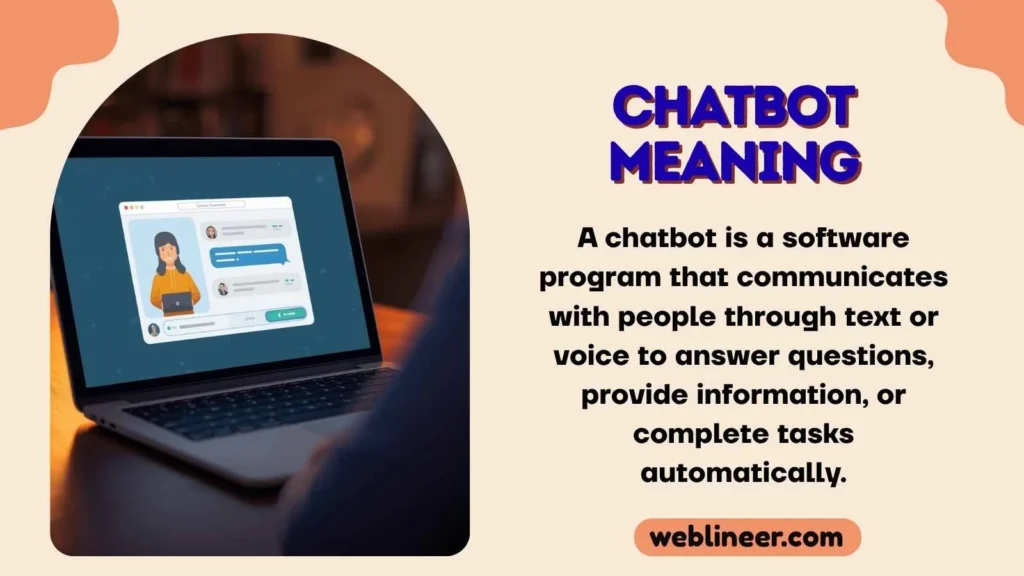
A chatbot is a software program that communicates with people through text or voice to answer questions, provide information, or complete tasks automatically.
In simple terms, it’s a digital assistant you can talk to.
Origin of the Word “Chatbot”
The word chatbot combines two simple words:
- Chat — to talk or communicate
- Bot — short for robot (an automated program)
The term first appeared in the 1990s, but chatbots became widely popular in the 2010s when messaging apps and artificial intelligence technology improved.
Today, modern chatbots use advanced language processing to understand human conversation more naturally than ever before.
Pronunciation Guide
Chatbot is pronounced:
CHAT-bot
(/ˈtʃæt.bɒt/)
Quick Answer
A chatbot is a computer program that talks with users through text or voice to provide information, answer questions, or perform tasks automatically.
How to Use “Chatbot” Correctly in Texts & Chat
The word chatbot is usually used in conversations about technology, customer service, or automation. It’s not slang — it’s a standard tech term used worldwide.
Correct Context and Tone
Chatbot is typically used in:
- Technology discussions
- Business conversations
- Customer support settings
- Online services
- Digital marketing
- Education and training
Tone:
Neutral, professional, or informative.
Platform-Specific Usage
SMS or WhatsApp
“That message was from a chatbot, not a real person.”
Instagram or Social Media
“The brand uses a chatbot to reply to comments.”
Workplace Chat (Slack, Teams)
“We added a chatbot to handle common customer questions.”
Customer Support Websites
“Talk to our chatbot for instant help.”
Discord or Gaming Communities
“This server has a moderation chatbot.”
When NOT to Use It
Avoid using the term incorrectly in these situations:
Formal academic writing (without explanation)
Define the term first.
Personal conversations unrelated to technology
It may sound confusing or unnecessary.
Emotional or sensitive discussions
People may expect a human response instead.
Formatting Tips
- Capitalization: lowercase (chatbot) unless starting a sentence
- Plural: chatbots
- Emoji pairings (informal settings):
- 🤖 robot emoji
- 💬 chat bubble emoji
- ⚡ automation emoji
Real Conversation Examples Using “Chatbot”
Here are realistic scenarios showing how people use the word chatbot in everyday communication.
Example 1 — Customer Support
Customer:
“I got a reply instantly. Was that a real person?”
Agent:
“No, that was our chatbot helping with basic questions.”
Meaning:
The chatbot handled simple support automatically.
Example 2 — Online Shopping
Friend:
“How did you track your order so quickly?”
You:
“I just asked the store’s chatbot.”
Meaning:
The chatbot provided fast information without human help.
Example 3 — Workplace Discussion
Manager:
“Our response time is slow.”
Team Member:
“Let’s add a chatbot to handle FAQs.”
Meaning:
The chatbot is proposed as a solution for efficiency.
Example 4 — Student Conversation
Student:
“I needed help with homework.”
Friend:
“Did you use the school’s chatbot?”
Meaning:
The chatbot provides academic assistance.
Example 5 — Banking App
User:
“I forgot my password.”
App Message:
“Hi! I’m the chatbot. I can help reset your password.”
Meaning:
The chatbot performs a secure automated task.
Common Mistakes & Misunderstandings
Even though the term seems simple, people often misunderstand what a chatbot actually is.
Mistake 1 — Thinking Every Chatbot Uses AI
Reality:
Some chatbots use simple scripts or rules.
Example:
“If user asks about hours → show business hours.”
Not all chatbots are intelligent.
Mistake 2 — Assuming Chatbots Are Always Human
People sometimes think they’re talking to a person.
Clue it’s a chatbot:
- Instant replies
- Repetitive responses
- Limited conversation options
Mistake 3 — Believing Chatbots Can Do Everything
Chatbots are helpful, but they have limits.
They may struggle with:
- Complex problems
- Emotional conversations
- Unique requests
Generational Differences
Younger users:
Comfortable interacting with chatbots daily.
Older users:
May prefer speaking to a real person.
Cultural Differences
In some countries, chatbots are widely trusted.
In others, people still prefer human customer service.
“Chatbot” Across Different Platforms & Demographics
Chatbots are now part of everyday digital experiences across industries.
Gen Z
Uses chatbots frequently for:
- Shopping
- Gaming
- School help
- Tech support
Comfort level: Very high.
Millennials
Common uses:
- Banking
- Customer service
- Travel bookings
- Online shopping
Comfort level: High.
Older Generations
Typical uses:
- Appointment scheduling
- Banking assistance
- Customer support
Comfort level: Moderate.
Popular Platforms Using Chatbots
- Websites
- Banking apps
- E-commerce stores
- Customer service portals
- Messaging apps
- Education platforms
- Healthcare services
Is “Chatbot” Formal or Informal?
Answer:
Neutral and professional.
It’s safe for:
- Work
- School
- Business
- Technology discussions
Related Slang, Abbreviations & Alternatives
Here are related terms you’ll often see alongside chatbot.
| Term | Meaning |
|---|---|
| AI assistant | Software that helps users using artificial intelligence |
| Virtual assistant | Digital helper that performs tasks |
| Bot | Automated software program |
| Conversational AI | Technology that enables natural conversation |
| Automation | Technology that performs tasks automatically |
| Helpdesk bot | Customer service chatbot |
| Support bot | Chatbot for answering questions |
| Voice assistant | AI that responds to spoken commands |
| Customer service bot | Automated support tool |
| Smart assistant | Intelligent digital helper |
FAQs
What is the main purpose of a chatbot?
The main purpose of a chatbot is to provide quick assistance without human intervention. It can answer questions, guide users, complete tasks, or offer information instantly, saving time for both customers and businesses.
Are chatbots replacing human workers?
Not completely. Chatbots handle repetitive or simple tasks, but humans are still needed for complex issues, emotional support, and decision-making. Most organizations use chatbots to assist workers rather than replace them.
Do chatbots use artificial intelligence?
Some do, and some don’t. Basic chatbots follow programmed rules, while advanced chatbots use artificial intelligence to understand language and respond more naturally.
Can chatbots talk like humans?
Modern AI chatbots can sound very natural, but they still have limitations. They may misunderstand context, humor, or unusual requests.
Are chatbots free to use?
Many chatbots are free for users, especially on websites or apps. Businesses usually pay to create or maintain the chatbot system behind the scenes.
Conclusion
The chatbot meaning is simple: it’s software designed to talk with people and help them complete tasks quickly.
You’ve likely interacted with one today maybe while shopping online, checking a bank balance, or asking a question on a website.
As technology keeps evolving, chatbots will become even more common, more helpful, and more natural to use.
Understanding how they work gives you an advantage in school, business, and everyday digital life.
Next step:
Start noticing where chatbots appear in your daily routine — you might be surprised how often you use them.
And if you’re curious about more digital terms, explore other communication and tech vocabulary guides.

Hi, I’m Smith Roy, the writer of Weblineer.com, where I break down words, slang, and meanings into something you can actually understand without overthinking it.
I’ve always been curious about how language works, how a simple word can carry different meanings depending on context, culture, or even a trending moment online. That curiosity turned into Weblineer, a space where I simplify complex terms, decode internet slang, and explain meanings in a way that feels natural, clear, and useful.