Ever watched a video online and thought, “That’s absolutely bonkers!” Or heard a friend describe a wild situation with the same word? You’re not alone.
The phrase bonkers meaning has become increasingly popular as people search for fun, expressive slang to describe moments that feel chaotic, unbelievable, or just plain silly.
Language evolves fast especially in the age of memes, viral videos, and nonstop group chats.
Words like bonkers stick around because they’re vivid, humorous, and easy to understand. They add personality to everyday conversations without sounding harsh or offensive.
In this updated-for-2026 guide, you’ll learn exactly what bonkers means, where it came from, how to use it correctly, and when to avoid it.
We’ll also cover real conversation examples, common mistakes, and related slang terms so you can sound confident and natural when using this classic expression.
What Does “Bonkers” Mean?
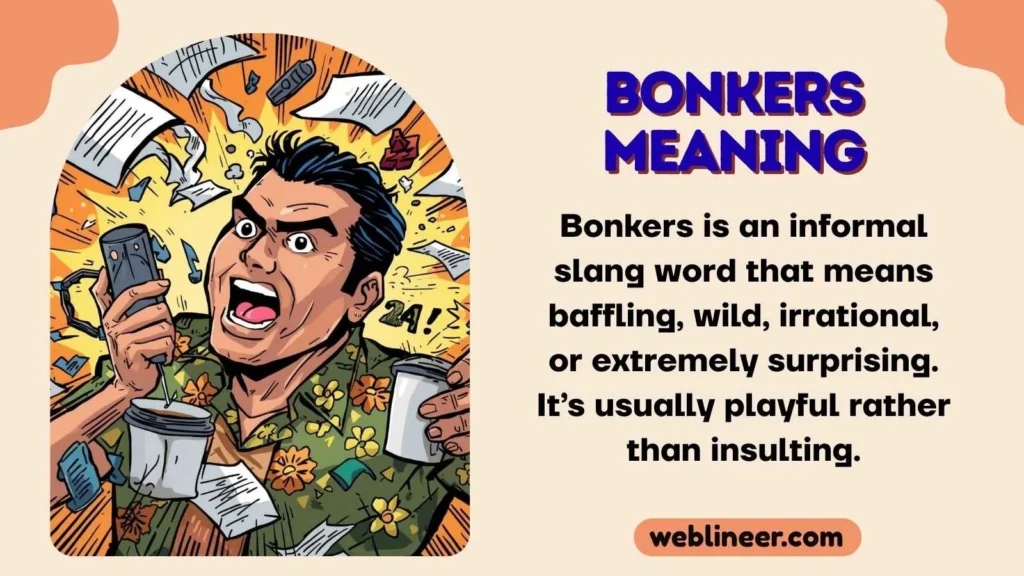
Bonkers is an informal slang word that means baffling, wild, irrational, or extremely surprising. It’s usually playful rather than insulting.
Quick Answer
Bonkers means something is wildly surprising, chaotic, or silly in a humorous way.
Origin of the Word
The word bonkers first appeared in British slang in the mid-20th century, around the 1950s. Linguists believe it evolved from earlier slang words like bonk, which referred to a knock on the head—suggesting someone was acting irrationally.
Over time, the meaning softened. Instead of implying mental instability, bonkers became a lighthearted way to describe anything outrageous or unbelievable.
Today, it’s widely used in:
- British English
- American English
- Online conversations
- Social media captions
- Casual speech
Pronunciation Guide
Bonkers is pronounced:
BON-kurz
It rhymes with:
- Honkers
- Conkers
How to Use “Bonkers” Correctly in Texts & Chat
Understanding the bonkers meaning is only half the job. Knowing when and how to use it makes all the difference.
Tone and Context
Bonkers is best used when something feels:
- Wild
- Ridiculous
- Unexpected
- Funny
- Over-the-top
It often carries a sense of exaggeration.
Examples:
- “That roller coaster was bonkers!”
- “The price of that concert ticket is bonkers.”
- “Your schedule this week is bonkers.”
Platform-Specific Usage
SMS / WhatsApp
Short reactions to surprising news.
Example:
“Wait, you finished the project in one night? That’s bonkers!”
Instagram
Captions describing exciting or chaotic moments.
Example:
“Weekend was absolutely bonkers 😂”
Twitter / X
Quick commentary on news or trends.
Example:
“This weather today is bonkers.”
Discord / Gaming
Reacting to intense gameplay.
Example:
“That final boss fight was bonkers!”
Reddit
Describing unusual stories.
Example:
“This plot twist is bonkers.”
When NOT to Use It
Avoid bonkers in:
- Job applications
- Formal emails
- Academic papers
- Professional presentations
Instead of:
“The new policy is bonkers.”
Use:
“The new policy is unreasonable.”
Formatting Tips
- Usually lowercase: bonkers
- Can be emphasized with punctuation:
- “That was bonkers!”
- Often paired with emojis:
- 😂
- 🤯
- 😅
Real Conversation Examples Using “Bonkers”
Between Friends
Alex: “I just ran 10 miles before breakfast.”
Jamie: “That’s bonkers!”
What it conveys:
Surprise and admiration mixed with humor.
In a Group Chat
Sam: “We finished the entire pizza in five minutes.”
Taylor: “You guys are bonkers.”
What it conveys:
Playful teasing.
Dating Scenario
Jordan: “I drove three hours just to see you.”
Riley: “That’s bonkers—but sweet.”
What it conveys:
A mix of amazement and affection.
Family Conversation
Mom: “Your little brother stayed up until 3 a.m.”
Dad: “That kid is bonkers.”
What it conveys:
Light frustration without harsh criticism.
Gaming Chat
Player 1: “I beat the level without losing health.”
Player 2: “That’s absolutely bonkers!”
What it conveys:
Excitement and respect.
Common Mistakes & Misunderstandings
Even simple slang can cause confusion. Here are the most common mistakes people make with the bonkers meaning.
1) Using It as an Insult
Incorrect:
“You’re bonkers.”
This can sound rude if directed at a person.
Better:
“That idea is bonkers.”
Focus on the situation, not the individual.
2) Using It in Formal Settings
Mistake:
“The financial projections are bonkers.”
Why it’s wrong:
It sounds unprofessional.
Alternative:
“The financial projections are unrealistic.”
3) Misinterpreting the Tone
Some older generations may think bonkers implies serious mental instability. In modern usage, it’s usually playful.
Tip:
If someone seems confused, clarify with context.
Example:
“I mean wild in a funny way.”
“Bonkers” Across Different Platforms & Demographics
Gen Z
Uses bonkers to react to:
- Viral videos
- Unexpected plot twists
- Dramatic situations
Example:
“That ending was bonkers.”
Millennials
Often use it humorously to describe busy schedules or chaotic days.
Example:
“My work week is bonkers.”
Older Generations
May use it to describe unusual behavior.
Example:
“The weather lately has been bonkers.”
Social Media Trends
Bonkers appears frequently in:
- TikTok comments
- Instagram captions
- Meme culture
- Reaction posts
It’s considered:
- Informal
- Family-friendly
- Safe for everyday conversation
Related Slang, Abbreviations & Alternatives
Here are popular alternatives to bonkers and how they compare.
| Term | Meaning | Tone |
|---|---|---|
| baffling | Unbelievable or wild | Neutral |
| Wild | Exciting or intense | Positive |
| impulsive | Extremely surprising | Strong |
| Nuts | Slightly irrational | Casual |
| Ridiculous | Silly or unreasonable | Neutral |
| Outrageous | Shockingly unusual | Dramatic |
| Mind-blowing | Extremely impressive | Positive |
| Chaotic | Disorganized or messy | Neutral |
| Absurd | Illogical or unreasonable | Formal |
Synonyms:
baffling,wild, ridiculous, unbelievable
Antonyms:
normal, calm, predictable, ordinary
FAQs
What does bonkers mean in slang?
In slang, bonkers means something is extremely surprising, chaotic, or silly. It’s usually used in a playful way rather than as an insult.
Is bonkers British or American?
Bonkers originated in British slang but is now widely used in both British and American English, especially in casual conversations and online communication.
Can bonkers describe a person?
Yes, but it’s safer to describe behavior or situations rather than people. Saying someone is bonkers can sound rude depending on tone and context.
Is bonkers offensive?
Generally, no. It’s considered mild, humorous slang. However, context matters—using it to label someone negatively could be seen as insensitive.
Why is the word bonkers popular again?
Short, expressive words like bonkers fit perfectly into modern communication styles, especially on social media where quick reactions and humor matter.
Conclusion
Language doesn’t have to be complicated to be powerful. Sometimes a single word—like bonkers captures exactly how you feel in a moment of surprise, chaos, or excitement.
Now you know the full bonkers meaning, its origins, how to use it naturally, and when to keep it out of formal situations. That confidence makes conversations smoother and more expressive.
So next time something unbelievable happens, you’ll know exactly what to say.
Got a favorite slang word you use all the time? Drop it in the comments and explore more modern expressions below.

Hi, I’m Smith Roy, the writer of Weblineer.com, where I break down words, slang, and meanings into something you can actually understand without overthinking it.
I’ve always been curious about how language works, how a simple word can carry different meanings depending on context, culture, or even a trending moment online. That curiosity turned into Weblineer, a space where I simplify complex terms, decode internet slang, and explain meanings in a way that feels natural, clear, and useful.