You’ve probably heard the name John Doe in movies, news reports, or legal dramas. Maybe a police officer says, “We have an unidentified male John Doe,” or a headline reads, “John Doe files lawsuit.”
But what does that actually mean? Is John Doe a real person? Or just a placeholder?
Understanding the john doe meaning matters more than you might think. This simple name appears in legal systems, hospitals, online privacy discussions, and even cybersecurity conversations.
It’s one of the most widely recognized anonymous identities in the English-speaking world.
In this guide, you’ll learn exactly what John Doe means, where the name came from, how it’s used today, and when it’s appropriate (or not) to use it.
You’ll also see real-life examples, common misunderstandings, and related terms you might encounter.
Let’s break it down in plain English.
What Does “John Doe” Mean?
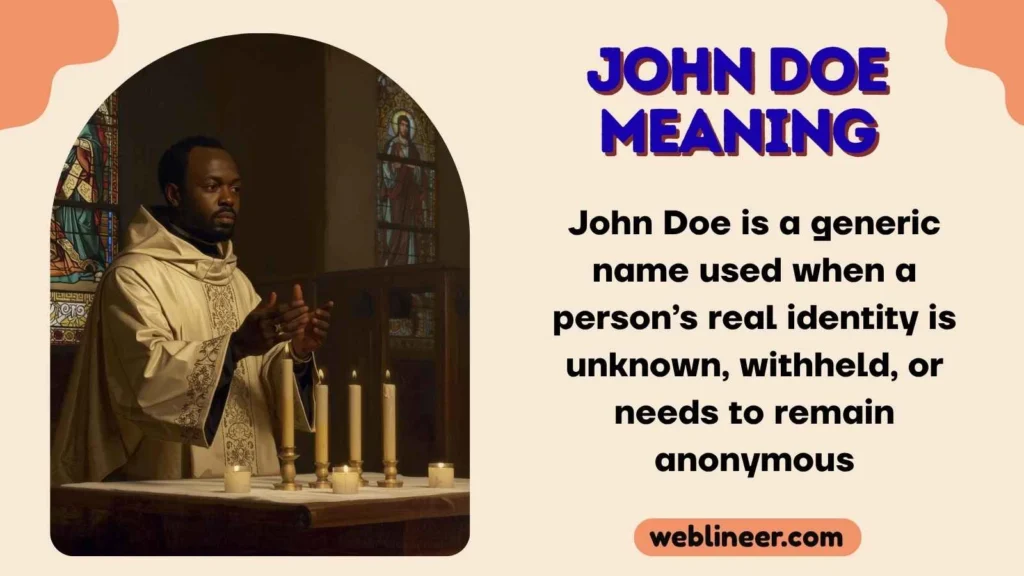
John Doe is a generic name used when a person’s real identity is unknown, withheld, or needs to remain anonymous.
Quick Answer
John Doe is a placeholder name for an unidentified or anonymous person, commonly used in legal, medical, and official situations.
The Origin Story
The name dates back to medieval England, around the 1300s. Lawyers used fictional names like:
- John Doe
- Richard Roe
These names helped represent anonymous parties in property disputes. Over time, John Doe became the standard placeholder in English-speaking legal systems.
By the 20th century, the term expanded into:
- Hospitals
- Police departments
- Media reporting
- Online privacy discussions
Today, the john doe meaning is widely understood across cultures.
Pronunciation Guide
John Doe is pronounced:
/jon doh/
Simple. Just like two regular names.
How to Use “John Doe” Correctly in Texts & Chat
The term isn’t slang in the modern sense—but it still appears frequently in conversation, messaging, and online discussions.
Correct Context and Tone
Common Uses
- Legal discussions
- Crime reporting
- Privacy examples
- Hypothetical scenarios
- News headlines
Tone
- Neutral
- Formal
- Informational
It’s not emotional or humorous by default.
Platform-Specific Usage
SMS / WhatsApp
Used in explanations or examples.
Example:
“If someone signs up anonymously, they might be listed as John Doe.”
Social Media (Instagram / X / TikTok)
Often appears in discussions about privacy or identity.
Example:
“This account is basically a John Doe profile.”
Reddit / Forums
Common in legal or hypothetical discussions.
Example:
“Imagine John Doe files a lawsuit—what happens next?”
When NOT to Use It
Avoid using John Doe:
- In professional communication about real people
- As a joke about someone’s identity
- When the actual name is known
Formatting Tips
Correct
John Doe
john doe
“John Doe”
Avoid
JOHN DOE (unless shouting or headline style)
Emoji Pairings (Informal Context)
Sometimes used casually online:
- 🕵️ (mystery)
- ❓ (unknown identity)
- 🆔 (identification)
Real Conversation Examples Using “John Doe”
Here are realistic, everyday scenarios showing how the term appears.
Example 1 — Between Friends
Friend A:
“I saw a news story about a John Doe found unconscious.”
Friend B:
Yeah, that just means they don’t know who he is yet.
Emotional Meaning:
Informational and factual.
Example 2 — In a Hospital Setting
Nurse:
“We admitted the patient as John Doe until identification is confirmed.”
Doctor:
“Understood.”
Emotional Meaning:
Professional and procedural.
Example 3 — In a Legal Discussion
Law Student:
“What happens if John Doe sues a company anonymously?”
Professor:
“The court may allow it temporarily.”
Emotional Meaning:
Academic and formal.
Example 4 — Online Privacy Conversation
User 1:
“I use a fake email and name online.”
User 2:
“So basically you’re a digital John Doe.”
Emotional Meaning:
Casual and slightly humorous.
Example 5 — Gaming Scenario
Player 1:
“Who joined the server?”
Player 2:
“Some random John Doe account.”
Emotional Meaning:
Neutral, slightly dismissive.
Common Mistakes & Misunderstandings
Even though the term is simple, people often misunderstand it.
Mistake 1 — Thinking John Doe Is a Real Person
It’s not.
John Doe represents:
- Unknown identity
- Anonymous individual
- Placeholder name
Mistake 2 — Assuming It Means Criminal
Many people associate the name with crime scenes because of TV shows.
But John Doe can refer to:
- Accident victims
- Hospital patients
- Legal plaintiffs
- Anonymous citizens
Mistake 3 — Using It as an Insult
Calling someone “John Doe” can sound dismissive or rude.
Example:
Wrong:
“You’re just another John Doe.”
Better:
Avoid using it about real people.
Generational Misunderstandings
Older generations may see the term as strictly legal.
Younger generations may use it more casually—especially online.
Cultural Differences
In some countries, different placeholder names exist.
Examples:
- UK: John Smith
- Germany: Max Mustermann
- Spain: Juan Pérez
“John Doe” Across Different Platforms & Demographics
The john doe meaning remains consistent—but usage varies by age group and platform.
Gen Z
Usage:
- Online anonymity
- Gaming accounts
- Social media privacy
Example:
“This profile is just a John Doe account.”
Millennials
Usage:
- Legal references
- Workplace discussions
- News conversations
Older Generations
Usage:
- Court cases
- Official documentation
- Medical situations
TikTok & Social Media Trends
The name occasionally trends in:
- True crime content
- Mystery stories
- Missing person cases
It’s often used in captions like:
“Unidentified victim known as John Doe.”
Is It Formal or Informal?
Answer:
Mostly formal.
But acceptable in casual conversation when discussing anonymity.
Safe for Work?
Yes.
Completely safe for:
- Professional settings
- Academic writing
- Legal documents
Related Slang, Abbreviations & Alternatives
Here are commonly related terms you might encounter.
| Term | Meaning |
|---|---|
| Jane Doe | Female version of John Doe |
| Baby Doe | Unidentified infant |
| Richard Roe | Secondary placeholder in legal cases |
| Anonymous | Identity intentionally hidden |
| Placeholder | Temporary name or value |
| Unknown subject | Person not yet identified |
| Alias | Alternate name |
| Pseudonym | Fake name used intentionally |
| Incognito | Hidden identity |
| Redacted | Information removed for privacy |
Synonyms in Casual Language
- Unknown person
- Mystery individual
- Anonymous user
- Unidentified person
Antonyms
- Identified person
- Named individual
- Verified identity
FAQs
What does John Doe mean in legal terms?
In legal contexts, John Doe refers to an unidentified or anonymous person involved in a case. Courts use the name temporarily until the person’s real identity becomes known.
Why do police use the name John Doe?
Police use John Doe when they find someone whose identity is unknown, such as after an accident or crime. The name allows them to document the case before identification.
What is the female version of John Doe?
The female equivalent is Jane Doe. It is used in the same way to represent an unidentified woman in legal or medical situations.
Can someone legally be named John Doe?
Yes. A person can legally change their name to John Doe, but in official contexts, the name usually indicates anonymity rather than a real identity.
Is John Doe still used in 2026?
Yes. The term remains widely used in:
- Courts
- Hospitals
- Police reports
- Media coverage
- Privacy discussions
Conclusion
The john doe meaning is simple but incredibly important. It represents anonymity, privacy, and unknown identity in situations where names aren’t available or shouldn’t be revealed.
From medieval courts to modern hospitals and online privacy debates, the term has stood the test of time. It’s one of the most recognizable placeholder names in the English language.
Now that you understand what John Doe really means, you’ll spot it instantly—in news stories, legal documents, and everyday conversations.
Curious about more digital terms and expressions? Drop your favorite abbreviation or phrase to explore next.

Hi, I’m Candy Rox, the voice behind Weblineer.com, where words get decoded and meanings finally make sense.
I’ve always been fascinated by how a single word can carry different vibes depending on where and how it’s used. From trending slang to everyday phrases, I break things down in a way that’s simple, clear, and actually useful in real conversations.